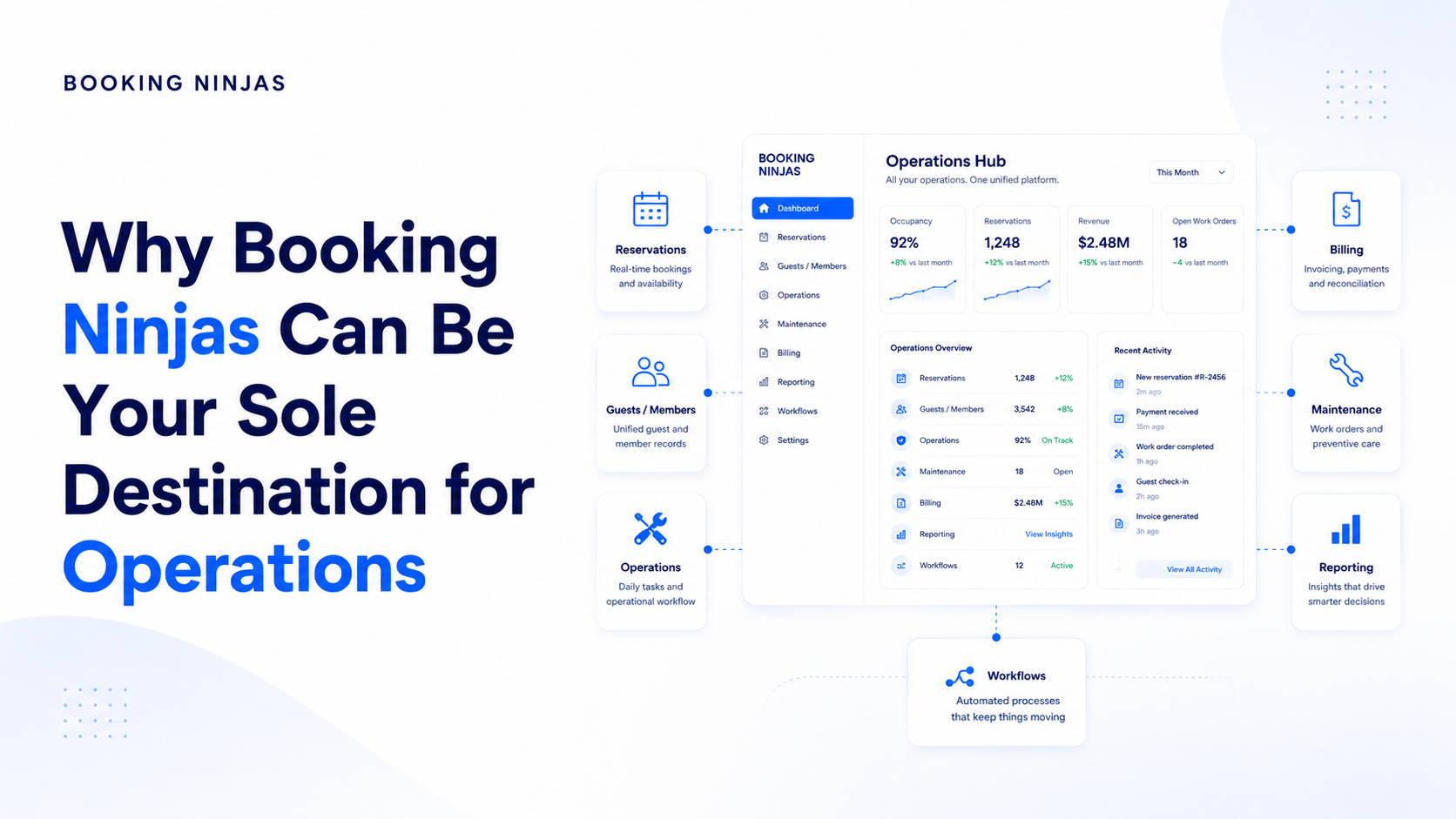
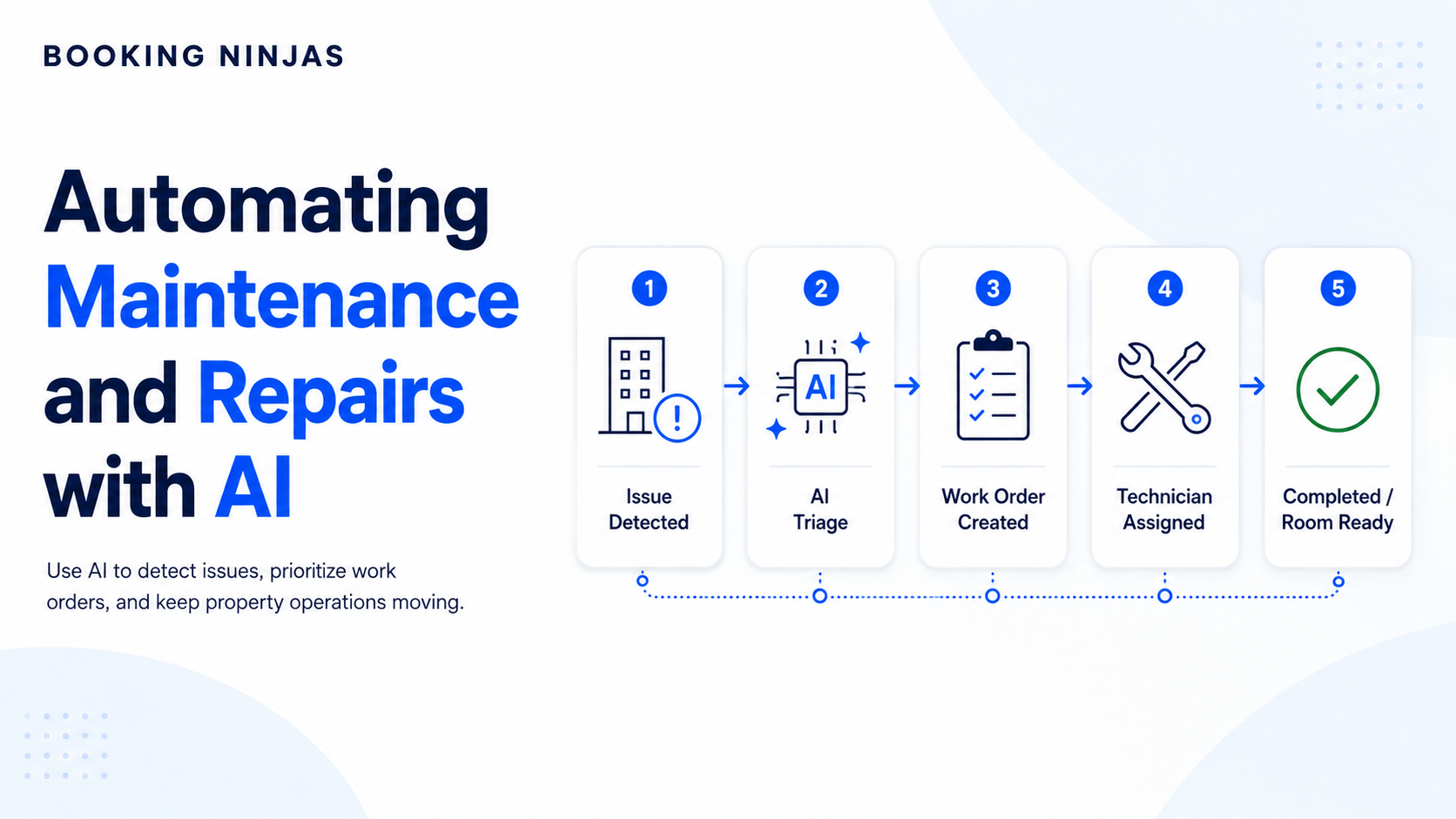
AI and automation can support property maintenance by helping teams capture requests, route work, monitor activity, identify patterns, surface exceptions, and keep maintenance history connected to the property, space, or asset involved.
Key takeaways
- Start with connected maintenance records and a defined workflow.
- Automate predictable routing, notifications, status changes, escalations, and recurring work before adding AI.
- Use AI where interpretation, summarization, patterns, or decision support can add useful context.
- Keep technicians and property teams involved in diagnosis, safety, exceptions, expensive work, and final decisions.
- Measure results from the maintenance workflow rather than assuming AI automatically reduces cost or downtime.
What do AI and automation mean in maintenance operations?
AI and automation can work together, but they solve different parts of a maintenance process.
Use automation when the rule is already known
Straightforward automation is usually the better starting point when a maintenance event should always produce a predictable next action.
Examples of predictable maintenance automation
- Create a task after an approved request
- Route work by location or issue type
- Send status notifications
- Create recurring maintenance activity
- Escalate overdue work
- Update status after a defined event
Booking Ninjas' Workflow & Process Management can provide this rules-based operating structure for routing, status changes, assignments, approvals, and other defined handoffs.
Use AI where information needs interpretation
AI can add another layer where the system needs to interpret less-structured information, summarize context, recognize patterns, or help staff decide what deserves attention.
Booking Ninjas' AI capabilities can form part of these workflows where the required data, permissions, configuration, integrations, and implementation support the intended use case.
Why does AI need connected operational data?
A maintenance issue can involve the affected property, asset, previous work, open requests, technician notes, status, service history, and other operational information.
AI becomes more useful when those records can be understood together. This is why AI needs connected operational information rather than simply access to more disconnected data.
What should a connected maintenance workflow look like?
A maintenance issue normally passes through several stages before the underlying work is truly complete.
Capture the issue as an operational record
The first step is making sure a reported problem does not remain inside a phone call, text message, email, or personal note.
Booking Ninjas' Request Management can give an incoming issue a structured record, ownership, status, routing, and follow-up.
Determine priority and ownership
Not every request requires the same response. Teams may need to distinguish routine work from safety issues, property-impacting failures, guest or resident problems, access issues, and other exceptions.
Known rules can handle predictable cases. AI may assist where more information needs to be interpreted, while high-impact exceptions remain visible for human review.
Turn substantial issues into trackable work
Once work needs to be performed, a Work Order can provide ownership, status, property context, maintenance notes, and a history of the work performed.
Connect the maintenance process to the wider facility
Booking Ninjas' Facility Management capabilities can provide broader operational context around spaces, facility activity, maintenance processes, and related records.
Confirm the work is actually complete
Closing a maintenance record should not automatically mean the underlying problem has disappeared. Some work may require testing, inspection, verification, documentation, or another operational check before the space or equipment returns to normal use.
Listen: AI for automated property maintenance and repairs
How can AI and automation improve maintenance intake?
Maintenance intake becomes easier to manage when the issue arrives with enough structure for the rest of the workflow to act on it.
Useful information to capture at intake
- Property or location
- Room, unit, space, or asset
- Issue category
- Description
- Requester
- Priority indicators
- Photos or supporting information
- Current status
Route predictable requests automatically
Known issue types can follow predefined workflows based on property, category, urgency, team, or another operating rule.
Booking Ninjas' Request Management and Workflow & Process Management can provide the intake and routing structure behind that handoff.
Use AI for less-structured information
Where the implementation supports it, AI can assist with summarizing request descriptions, interpreting incoming information, identifying possible categories, or surfacing information that deserves staff attention.
Uncertain, unusual, safety-sensitive, or high-impact requests should remain available for human review.
How can AI support preventive and predictive maintenance?
Reactive maintenance begins after a problem is reported. Preventive, condition-based, and predictive approaches try to use available operational information to identify maintenance needs earlier.
Where the necessary information exists, facility and equipment records can help teams review changes in condition or activity before another service request occurs.
Repeated issues, previous work orders, repair history, and operating signals can help teams identify assets or locations that deserve closer attention.
Analytical or AI-supported workflows may help identify unusual records, recurring patterns, or other signals that warrant human investigation.
A possible maintenance problem becomes operationally useful when it can move into a request, workflow, or Work Order rather than remaining inside another dashboard.
Booking Ninjas' Facility Management provides the wider facility context, while Insights capabilities can support analysis and operational visibility where the underlying data and implementation support the intended use case.
This connected foundation is also part of the wider idea behind AI-ready buildings and connected facility data .
How should inspections connect to maintenance automation?
Inspections can identify work before a resident, guest, member, tenant, or staff member needs to report the issue separately.
Schedule predictable checks
Recurring facility checks can follow known frequencies, locations, operating standards, or other defined rules through the wider maintenance workflow.
Keep findings connected to facility records
Booking Ninjas' Facility Management can provide a broader operating structure for maintenance, facility information, inspections, and corrective work.
Convert a discovered problem into work
Example inspection handoff
Check completed → issue identified → request or work order created → responsible team assigned → corrective work completed → status recorded
The operational improvement is the connection between finding a problem and making sure someone owns the corrective action.
How can automation support maintenance scheduling?
Maintenance scheduling works best when known recurring activity, open work, exceptions, and status changes remain connected to the maintenance record.
Routine servicing, checks, testing, and other predictable activity can be scheduled around defined dates, frequencies, or operating rules.
Known routing and escalation rules can help move urgent work ahead of routine work without requiring every handoff to be manually coordinated.
A rescheduled visit, delayed part, access issue, or another dependency should stay visible against the work rather than disappear into a separate calendar or message thread.
Booking Ninjas' Workflow & Process Management can support these defined operating rules and handoffs.
How can facility data reveal maintenance issues?
Equipment condition, facility activity, consumption, inspections, and other operating signals can sometimes reveal patterns that deserve investigation.
Bring facility context into the maintenance record
Booking Ninjas' Facility Management capabilities can provide a wider operational context around spaces, equipment, maintenance activity, and related facility information.
Use analytics to surface questions, not automatic diagnoses
An unusual signal can have many possible causes. A change may relate to equipment condition, occupancy, usage, configuration, environment, or another factor.
Booking Ninjas' Insights capabilities can support operational analysis, while AI may help surface or summarize patterns where the underlying data supports the use case.
A technician or facility team may still need to determine what a signal actually means and what physical work, if any, is required.
What data does AI need for maintenance operations?
AI cannot create a complete maintenance history that the operation never recorded. Useful AI starts with useful operational context.
Maintenance context may include
- Property and location records
- Asset or equipment information
- Maintenance requests
- Work-order history
- Inspection results
- Technician notes
- Previous repairs
- Issue categories and statuses
- Relevant facility data
- External monitoring data where available
Connected records matter as much as record volume
Ten separate systems containing more information do not automatically provide better context if the system cannot understand which property, asset, request, work order, or person the records belong to.
Booking Ninjas' Salesforce-native foundation provides a platform context for connected records, relationships, workflows, permissions, and operational processes.
External data may need to be integrated
If required maintenance or facility information exists in another system, it may need to be exchanged rather than duplicated manually.
Booking Ninjas' Integration capabilities can support those connections where the relevant system exposes appropriate interfaces and the integration is included in scope.
Which maintenance tasks should you automate first?
Start with repetitive work that follows a clear rule. Add AI when the workflow requires interpretation or pattern recognition rather than predictable execution.
| Activity | Better starting point | Relevant capability |
|---|---|---|
| Recurring maintenance activity | Workflow automation | Workflow & Process |
| Routine request routing | Rule-based automation | Request Management |
| Track substantial maintenance work | Structured workflow | Work Orders |
| Facility and equipment context | Connected records | Facility Management |
| Interpret free-text issue descriptions | Potential AI assistance | AI |
| Analyze recurring operational patterns | Analytics / potential AI assistance | Insights |
| Safety-critical diagnosis | Human review | Qualified staff or technician |
| Approve major repair work | Human decision | Configured approval process |
What can improve when maintenance workflows are connected?
Connected maintenance should be measured through operational changes rather than assumed AI outcomes.
Staff can spend less time forwarding requests, checking separate lists, and determining who owns the next step.
Request Management can make ownership, routing, status, and unresolved activity more visible.
Work Orders can preserve the history of assigned maintenance activity through completion.
Facility and maintenance information can be reviewed together rather than treating every issue as an isolated service event.
Analytics, inspections, operational rules, or AI-assisted review may surface activity that deserves attention before it is lost inside a larger volume of maintenance records.
Booking Ninjas' Insights can help managers analyze connected operational information when the relevant records are available.
Questions connected maintenance data can help answer
- Which locations create the most maintenance work?
- Which issues remain unresolved longest?
- Which categories recur most often?
- Where are exceptions accumulating?
- Which types of work require repeated follow-up?
- How much work is currently open?
These are measurable operating improvements. They should not be replaced by an assumption that AI automatically lowers cost, extends equipment life, prevents failures, or improves customer satisfaction.
What can go wrong when AI is added to maintenance?
AI can add another layer of capability, but it also increases the importance of clear records, ownership, permissions, and human review.
Missing records, inconsistent issue categories, incomplete work histories, duplicates, and unclear statuses reduce the context available to automation and AI.
If teams do not agree on prioritization, ownership, escalation, completion, and review, AI can make confusion move faster rather than fix it.
AI-assisted classification, pattern recognition, or recommendations can be incomplete or wrong. Maintenance teams still need appropriate review.
AI should not become a route around the access controls that protect resident, guest, employee, facility, access, or other operational information.
Teams need to understand what is automated, where AI is being used, when to review it, and who remains responsible for the work.
Booking Ninjas' Salesforce-native foundation provides the broader platform context for users, permissions, records, workflows, and governance, while the exact access model still depends on configuration and implementation.
For the privacy side of the decision, see data privacy and responsible AI in property operations .
For the adoption side, see how property operators prepare teams for new software .
How should you evaluate the business case for AI maintenance?
Do not begin with “How much money can AI save?” Start with the maintenance problem and the current cost of handling it.
Measure current request volume, manual handoffs, unresolved work, recurring issues, response time, technician workload, or other relevant operating measures.
Identify the specific step that will become automated or AI-assisted rather than evaluating a vague promise to “add AI.”
Software, implementation, data preparation, integrations, training, process redesign, governance, and ongoing ownership can all affect the business case.
Compare the changed workflow with the baseline instead of assuming that deployment itself represents improvement.
For the broader ROI framework, see how to evaluate the business case for AI in property operations .
What should you look for in AI-enabled maintenance software?
Do not evaluate a maintenance system only by whether its marketing says “AI.” Evaluate the operational foundation underneath the AI.
| Question | Why it matters | Relevant Booking Ninjas capability |
|---|---|---|
| Can it capture incoming maintenance issues? | AI needs a structured operational record to work from. | Request Management |
| Can predictable work be routed automatically? | Clear rules should not require AI for every decision. | Workflow & Process |
| Can substantial work be assigned and tracked? | Maintenance needs ownership, status, and completion history. | Work Orders |
| Can maintenance connect to facility context? | Work is easier to understand when it is connected to the property or facility involved. | Facility Management |
| Can managers analyze connected operational activity? | Results need to be measured after implementation. | Insights |
| Can external systems exchange information? | Relevant context may live outside the maintenance platform. | Integrations |
| Can permissions remain part of the operating model? | AI should not bypass existing information controls. | Salesforce DNA |
| Can AI be introduced selectively? | AI should be used where context and measurable value justify it. | AI |
The important question is not how many AI features a platform can list. It is whether requests, workflow rules, work, facility context, reporting, integrations, permissions, and AI can work together around the same maintenance process.
How does Booking Ninjas support connected maintenance operations?
Booking Ninjas is a Salesforce-native platform for bookings and operations . Maintenance can therefore sit inside the wider operational environment rather than existing only as a separate repair tool.
The exact capabilities required depend on the organization. A simple request-and-work-order workflow may need far less than an operation connecting facilities, multiple properties, external systems, analytics, and AI.
Capture the issue
Give incoming maintenance needs a record, owner, status, and route into the operating process.
Request Management →Track the work
Turn substantial maintenance activity into assigned, trackable work with status and completion history.
Work Orders →Move predictable handoffs
Use defined rules for routing, status changes, approvals, escalations, and repeatable operational processes.
Workflow & Process →Add property context
Connect maintenance with the broader spaces, facilities, and operational records surrounding the work.
Facility Management →Analyze the operation
Review connected operational information and measure patterns, exceptions, and maintenance activity.
Insights →Add AI selectively
Apply AI where the available data, workflow, controls, and intended outcome support the use case.
AI Capabilities →Connect other systems
Exchange required information with external applications where the relevant interfaces and implementation support it.
Integrations →Keep the platform configurable
Use Salesforce-native records, relationships, permissions, workflows, and platform capabilities as the underlying operating foundation.
Salesforce DNA →Why does the Salesforce-native foundation matter for maintenance?
Maintenance requirements rarely remain fixed. An organization may begin with requests and work orders, then later need more properties, facility processes, approvals, integrations, reporting, new user roles, automation, or AI-assisted workflows.
Booking Ninjas uses Salesforce as its platform foundation so those operational requirements can be configured and extended within a broader operating environment rather than assuming that every new maintenance need requires another disconnected application.
This does not mean every future requirement is automatic or unlimited. New workflows, integrations, data structures, AI use cases, and substantial changes still need to be scoped, implemented, and tested.
What does an AI-supported maintenance workflow look like?
Consider an HVAC issue reported at a property.
- A user sends a message about the problem.
- Someone manually forwards it to maintenance.
- A technician asks which space or equipment is affected.
- Previous maintenance history is checked elsewhere.
- The technician performs the work.
- Completion is reported through another message.
- The maintenance history may or may not be updated.
- The issue becomes a structured request.
- Property and relevant facility context are connected.
- Known rules handle predictable routing.
- AI may assist where interpretation adds value.
- A work order receives ownership and status.
- The technician can review relevant maintenance history.
- The repair is completed and recorded.
- Follow-up can occur when required.
- The maintenance history reflects the completed work.
Where does Booking Ninjas fit into this example?
Request Management can provide the intake layer, Workflow & Process Management can handle predictable routing, Work Orders can track the substantial repair work, and Facility Management can provide broader operational context.
AI can then be evaluated at the points where interpreting the incoming issue, summarizing history, recognizing patterns, or supporting staff decisions provides measurable value.
Frequently asked questions
How can AI be used in property maintenance?
AI can support maintenance by helping interpret requests, summarize operational information, identify patterns, assist prioritization, and surface conditions that may deserve attention. The exact use depends on the available data, workflow, controls, and implementation.
What maintenance tasks can be automated?
Predictable tasks such as standard request routing, recurring activity, notifications, status changes, escalations, and other defined handoffs are common automation candidates when clear rules exist.
What is predictive maintenance?
Predictive maintenance uses relevant historical, condition, or monitoring information to estimate when an asset may require attention. Its usefulness depends on the quality and relevance of the available data and the model used.
Does AI replace maintenance technicians?
No. AI can assist with information processing, summarization, pattern detection, prioritization, and decision support. Technicians and facility teams remain important for diagnosis, physical work, safety, exceptions, and final judgment.
What data does AI maintenance software need?
Depending on the use case, useful context can include requests, work orders, property information, facility records, inspections, repair history, issue categories, equipment conditions, and relevant external data.
Should property managers automate maintenance all at once?
Usually it is more practical to begin with a specific workflow, establish the baseline, automate the clearest repetitive steps, measure the result, and expand only where the process and data support it.
Which Booking Ninjas features support maintenance operations?
Depending on the use case, relevant Booking Ninjas capabilities can include Request Management, Work Orders, Workflow and Process Management, Facility Management, Insights, Integrations, AI, and the Salesforce-native platform foundation. The exact combination depends on the organization's requirements, data, systems, permissions, and implementation scope.
Connect maintenance first, then decide where AI belongs
Bring requests, workflows, work orders, facility information, reporting, and external data into a connected operating model. Then add automation and AI where they can create measurable operational value.