
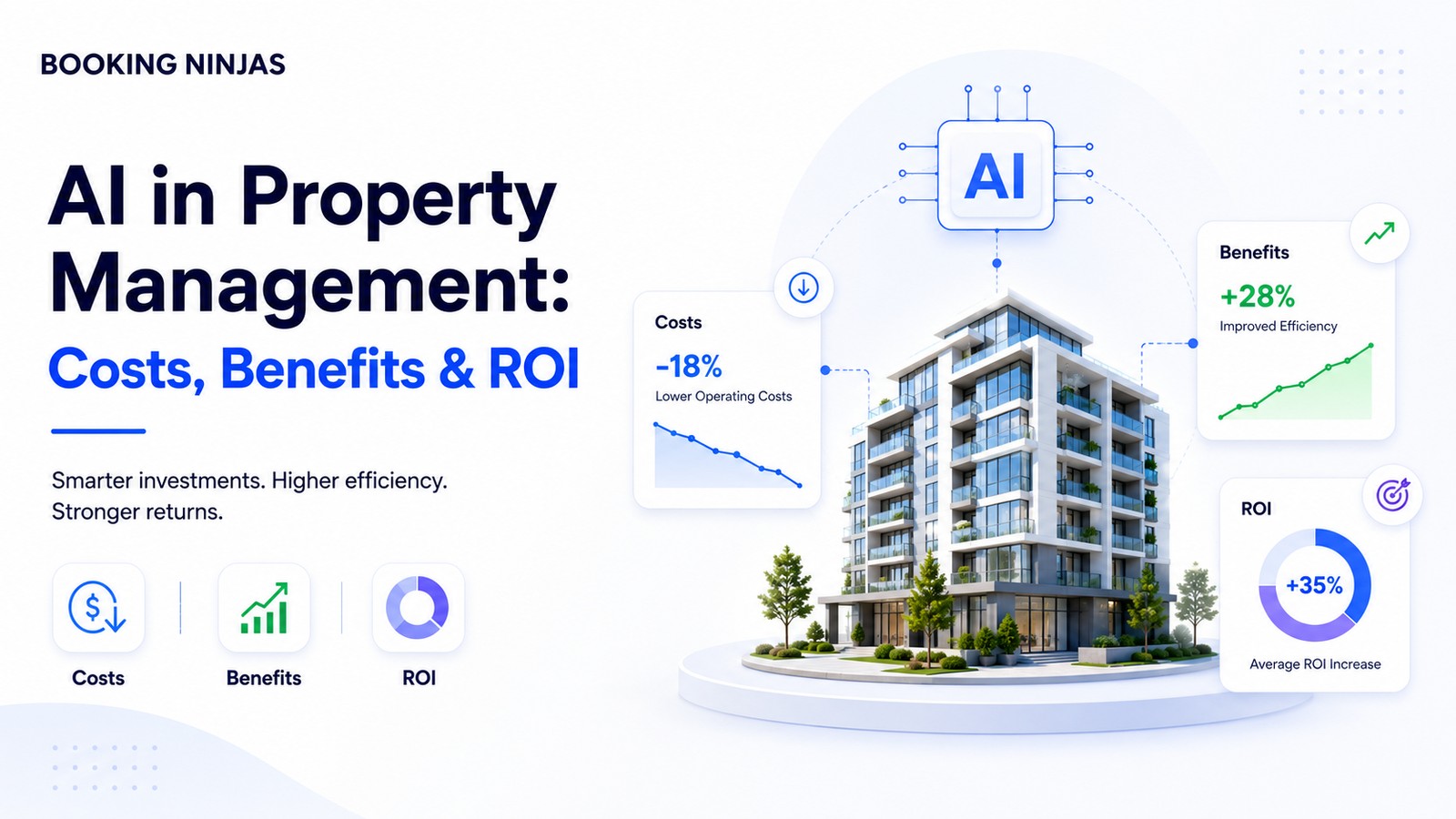
The business case for AI in property operations should be based on a specific workflow, the cost of changing it, the quality of the available data, and measurable improvement after implementation.
Key takeaways
- Evaluate AI around a specific operational problem rather than a general technology initiative.
- Include software, implementation, integrations, data, training, governance, and ongoing operating costs.
- Establish the baseline before implementation so improvement can actually be measured.
- AI becomes more useful when relevant operational information is connected and reliable.
- Keep human review where decisions involve uncertainty, safety, financial impact, access, customer impact, or policy.
Listen: AI in property management — costs, benefits, and ROI
What does a business case for AI actually measure?
A useful AI business case compares the current operating process with a proposed future process and asks whether the change is worth the money, effort, risk, and ongoing responsibility.
Start with the operational problem
“We want to use AI” is not a business case. A stronger starting point identifies what is actually going wrong today.
Examples of problems worth investigating
- Maintenance requests take too long to route.
- Staff manually review repetitive requests.
- Operational exceptions are difficult to identify.
- Information is repeatedly copied between systems.
- Managers spend hours assembling reports.
- Routine work depends on manual handoffs.
Define the workflow that would change
Map what happens today and identify the exact step where automation or AI could provide useful support.
Example: maintenance intake
Request received → staff reads request → category selected → priority assigned → team identified → work created → follow-up tracked
Booking Ninjas' Workflow & Process Management can provide the structured operational process around which automation or AI is introduced.
Establish the current baseline
Before changing the workflow, record how it performs today. Otherwise, it becomes difficult to distinguish measurable improvement from a general impression that the new system is better.
Useful baseline measures can include
- Volume of work
- Staff time involved
- Number of manual handoffs
- Time to complete the process
- Open or unresolved exceptions
- Error or rework rate
- Associated operating cost
- Time spent preparing reports
What costs should be included in an AI business case?
The cost of AI is broader than an AI license or monthly usage fee. The business case should include the operating system around the AI as well as the AI capability itself.
| Cost area | What can be included |
|---|---|
| Software | Platform access, users, AI services, storage, and subscriptions. |
| Implementation | Workflow design, configuration, testing, and deployment. |
| Integration | APIs, middleware, external systems, authentication, and data exchange. |
| Data | Cleanup, migration, classification, mapping, and record preparation. |
| People | Training, adoption, process redesign, and internal ownership. |
| Governance | Permissions, security, human review, monitoring, and audit. |
| Ongoing operations | Support, updates, AI usage, workflow changes, and quality review. |
Integration can be part of the business cost
AI may need information from property systems, maintenance records, billing, payments, CRM, building systems, or other applications.
Booking Ninjas' integration capabilities can provide part of that architecture where required systems expose the necessary interfaces and the integration is included in scope.
Data preparation may be part of the project
Duplicate records, missing history, inconsistent categories, unclear ownership, and disconnected systems can require work before AI has enough reliable context to support a workflow.
This is why AI needs connected operational information rather than simply access to more data.
Training and governance continue after launch
Staff need to understand what changed, what the AI is being used for, what happens when an output is uncertain, and when a person must intervene.
Our guide to preparing property teams for new software covers the adoption side of that change.
Where can AI create measurable operational value?
Value should come from a measurable change in the operating process, not from the presence of an AI feature itself.
AI or automation may help with categorization, summarization, routing, standard communication, information retrieval, and repetitive record processing.
Booking Ninjas' Request Management can give incoming operational needs ownership, routing, status, and follow-up before AI is used to assist with interpretation or prioritization.
Work Order Management can turn substantial maintenance or operational issues into assigned work with trackable progress and completion.
AI can potentially help identify unusual records, recurring patterns, or other conditions that deserve human attention when the relevant operational data is available.
Connected AI can help staff find and summarize relevant operational information without manually searching several disconnected systems.
Connected records can make reporting more useful because managers can evaluate the workflow against the activity that actually happened. Booking Ninjas' Financial Reporting can support financial visibility where the relevant records and implementation apply.
Maintenance is one useful example because requests, priorities, work orders, property context, inspections, and follow-up can cross several operational steps.
See how AI and automation can support maintenance operations for a workflow-level example.
Facility information can also matter. Booking Ninjas' Facility Management capabilities can provide additional property and facility context around operational work.
How should you measure AI ROI?
Select measures that correspond directly to the workflow being changed, then compare the post-implementation result with the original baseline.
| Workflow | Possible baseline | Possible measured change |
|---|---|---|
| Maintenance intake | Manual routing time | Less staff time routing standard requests |
| Request management | Unassigned requests | Fewer requests waiting for ownership |
| Reporting | Hours spent compiling information | Less manual report preparation |
| Service operations | Open exceptions | Earlier identification of unresolved activity |
| Data review | Manual records reviewed | Reduced repetitive information review |
Calculate the full net benefit
Add the measurable benefits attributable to the new workflow and subtract the full cost of implementing and operating it.
Calculate ROI after costs and benefits are defined
Use an appropriate time horizon
Some implementation costs occur once, while software, support, governance, AI usage, and workflow maintenance can continue. Compare costs and benefits over a period that reflects the useful life of the workflow rather than only the first month after launch.
Separate AI value from process-improvement value
A project may also improve because the organization cleaned its data, standardized procedures, redesigned a workflow, or connected previously separate systems. Those improvements still matter, but separating them creates a more credible ROI analysis.
What makes an AI use case worth evaluating?
Strong AI use cases usually combine enough operating volume, measurable effort, relevant data, clear ownership, and an outcome that can be compared with a baseline.
Automation usually has more leverage when the activity occurs repeatedly rather than only a few times per year.
Time, cost, delay, rework, exceptions, or another operating problem should be identifiable before the project starts.
AI needs sufficient, relevant operational context to support the use case.
A good project defines what better looks like before the workflow is changed.
Someone should remain responsible for performance, exceptions, workflow changes, and ongoing improvement.
Teams should know which outputs can continue automatically and which situations require review.
When is the business case for AI weak?
The business case becomes weaker when the organization cannot clearly define the operating problem, reliable data, ownership, expected result, or acceptable risk.
Warning signs
- The main objective is simply to “use AI.”
- The source data is fragmented or unreliable.
- The workflow happens too infrequently.
- No baseline has been recorded.
- The process has no clear owner.
- The outcome cannot be measured.
- The risk is too high for unattended automation.
- The underlying workflow is already poorly defined.
How should you evaluate data readiness for AI?
AI readiness begins with knowing where the required operational information lives, whether those records are connected, and who should be able to use them.
Determine which system owns each resident, guest, property, asset, payment, reservation, request, maintenance, or other record required by the workflow.
A request becomes more useful when it can be connected to the relevant person, property, reservation, asset, payment, history, or other operational context.
Look for missing values, duplicates, inconsistent categories, incomplete history, and outdated information.
If required information lives in several applications, decide how those systems will exchange data before designing the AI workflow.
The fact that information exists does not mean every user, workflow, or AI capability should be allowed to use it.
Booking Ninjas' Salesforce-native architecture gives the platform a shared foundation for operational records, permissions, relationships, workflows, and integrations. Learn more about the Salesforce DNA behind Booking Ninjas .
What human review and governance does AI need?
Governance should define what the AI-supported workflow may do, which information it may use, when a person must intervene, and how important actions remain accountable.
Core governance questions
- Which actions can continue automatically?
- Which actions require approval?
- Which users can access the information?
- Which exceptions require escalation?
- How are important actions recorded?
- Who owns workflow quality?
- How is privacy handled?
- How are changes reviewed over time?
Permissions should remain part of the operating workflow
AI should not become a route around the controls that already determine who can access operational information.
Booking Ninjas' Salesforce-native foundation provides a platform context for users, permissions, operational records, workflows, and reporting. The exact controls still depend on the organization's configured roles, requirements, and implementation.
Privacy belongs inside the business case
Property operations can involve personal, financial, access, resident, guest, employee, and operational information.
Our guide to data privacy and responsible AI in property operations goes deeper into that part of the decision.
How should an AI project be implemented?
A practical rollout starts with one measurable workflow and expands only when the evidence supports doing more.
- Choose one meaningful use case Start with a workflow where the problem, owner, data, and desired outcome can be clearly defined.
- Document the current baseline Record how the workflow performs before changing it.
- Prepare the required data and integrations Make sure the future workflow can access the operational context it actually needs.
- Define automation and human-review boundaries Decide which events can continue automatically and which require approval, escalation, or exception handling.
- Configure and test the workflow Booking Ninjas' Workflow & Process Management can provide the operational structure around the configured process.
- Give users time to operate it Controlled real-world usage can reveal exceptions and workflow problems that are difficult to see during design.
- Measure against the original baseline Compare the changed workflow with the original operating measures instead of relying on general impressions.
- Expand only where the evidence supports it A successful first use case can help identify where the next automation or AI investment has the strongest business case.
Where does Booking Ninjas fit into an AI business case?
Booking Ninjas is a Salesforce-native platform for bookings and operations . The platform can provide the operational foundation around an AI use case rather than treating AI as an isolated application with no connection to the work being performed.
The appropriate capabilities depend on the actual workflow. An AI project involving maintenance may need different records and processes than one focused on requests, financial operations, reporting, or customer service.
Connected data and workflow
Organize records, relationships, permissions, and operational processes before adding AI.
Salesforce DNA →Requests and work
Give incoming operational needs ownership, routing, status, assignment, and completion.
Request Management →Track substantial work
Turn operational and maintenance issues into traceable work rather than leaving them inside messages.
Work Orders →Define the process first
Use rules, statuses, routing, and handoffs for predictable work before using AI for more ambiguous information.
Workflow & Process →Add AI where it has context
Apply AI where the data, workflow, permissions, and intended outcome justify it.
AI Capabilities →Keep external systems connected
Bring required information into the wider workflow where supported rather than assuming every existing system must disappear.
Integrations →Why does the Salesforce-native foundation matter?
AI projects often change after implementation. The organization may add new record types, workflows, approvals, integrations, locations, users, reporting needs, or operating rules.
Booking Ninjas uses Salesforce as its platform foundation so the operating environment can remain configurable as those requirements evolve instead of designing the entire AI workflow around one fixed point solution.
This does not mean every future requirement is automatic or unlimited. New processes, integrations, data models, AI use cases, and substantial changes still need to be scoped, configured, implemented, and tested.
The exact Booking Ninjas setup depends on the organization's workflows, data, external systems, permissions, integrations, operating requirements, and implementation scope.
What does a practical AI business case look like?
Consider a property operation where maintenance requests arrive through several channels and staff spend significant time reading, categorizing, routing, and following up on them.
- “We need AI for maintenance.”
- No baseline is recorded.
- Requests remain fragmented.
- Maintenance history is incomplete.
- No specific workflow is selected.
- No measurement plan exists.
- Request-routing workload is measured.
- A structured intake process is defined.
- Property and maintenance context are connected.
- Routine requests follow predictable rules.
- AI assists where interpretation adds value.
- Exceptions remain visible for human review.
- Results are compared with the original baseline.
What would Booking Ninjas contribute to this workflow?
Request Management can provide the intake and ownership layer, Workflow & Process Management can handle predictable routing and handoffs, and Work Orders can track substantial maintenance work through completion.
AI can then be evaluated around the points where interpretation, summarization, pattern identification, or decision support adds value rather than being expected to replace the whole workflow.
What determines whether the project succeeded?
Success is not that the organization deployed an AI feature. Success is whether the selected workflow became measurably better relative to the cost, complexity, and operational risk of changing it.
Frequently asked questions
How do you calculate ROI for AI in property management?
Define the measurable benefits created by the AI-supported workflow, subtract the total implementation and operating costs, and compare the resulting net benefit with the total project cost. The calculation is only useful when the underlying costs and benefits are realistic and measurable.
What are the main costs of implementing AI?
Costs can include software, implementation, integrations, data preparation, migration, staff training, change management, security, governance, support, usage, and ongoing workflow maintenance.
What are the benefits of AI in property operations?
Depending on the workflow, AI can support categorization, summarization, information retrieval, pattern detection, prioritization, exception identification, and decision support. The value should be measured through the operational improvement those capabilities produce.
Does AI always reduce property management costs?
No. AI introduces software, implementation, data, integration, governance, and operating costs. Whether it reduces total cost depends on the use case and whether the measurable benefits exceed those costs.
What makes a good AI use case?
A strong use case usually has a clear operating problem, sufficient volume, measurable current effort or cost, relevant data, a defined outcome, clear ownership, and appropriate human review.
Why does data readiness matter for AI?
AI needs reliable operational context. Missing, fragmented, duplicated, outdated, or poorly structured data can limit the usefulness of AI-assisted decisions and automation.
Should AI replace human decision-making?
Not automatically. Human review remains important where decisions involve uncertainty, safety, financial impact, customer relationships, access, policy, or other significant consequences.
Which Booking Ninjas features can support an AI operations project?
Depending on the use case, relevant Booking Ninjas capabilities can include AI, Workflow and Process Management, Request Management, Work Orders, Facility Management, Financial Reporting, integrations, and the Salesforce-native platform foundation. The appropriate combination depends on the workflow, data, external systems, permissions, and implementation scope.
Build the AI business case around a real workflow
Start with the operating problem, establish the baseline, connect the required data, and define what success should look like before deciding where AI belongs.



.jpg)
