Campground revenue management is not simply about raising campsite prices when demand is high. It connects the campground's physical inventory, availability, rate rules, reservation behavior, stay restrictions, charges, and historical performance so operators can make controlled pricing and inventory decisions.
The objective is not necessarily to reach the highest possible occupancy or the highest possible rate. A campground may prefer different strategies by season, site type, length of stay, availability level, operating cost, or business objective.
What is campground revenue management?
Campground revenue management is the process of using inventory, availability, demand, reservation, pricing, and revenue information to decide how campground capacity should be sold across different dates and site types.
A campground may need to manage:
- Tent campsites
- RV sites
- Sites with different hookup configurations
- Cabins or specialty accommodation
- Short stays
- Longer or seasonal stays
- Premium site locations
- Add-ons and additional services
Because these resources can have different capacity, amenities, operating requirements, and demand patterns, one universal rate does not necessarily describe their economic value to the campground.
What is the difference between rates, availability, reservations, and revenue?
| Concept | Question it answers | Example |
|---|---|---|
| Inventory | What physical resources can be sold? | Tent sites, RV sites, cabins, or other reservable resources. |
| Availability | Which inventory can still be booked for these dates? | A particular RV site is open for a three-night stay. |
| Rate | What price applies under the current rules? | A seasonal or demand-based rate for that site and date. |
| Reservation | What did the guest actually book? | A specific site or site type for defined arrival and departure dates. |
| Charges | What amounts are connected with the stay? | Accommodation, utilities, equipment, or configured add-ons. |
| Revenue reporting | What financial result did the operation record? | Site revenue, add-on revenue, or revenue by period, property, or category. |
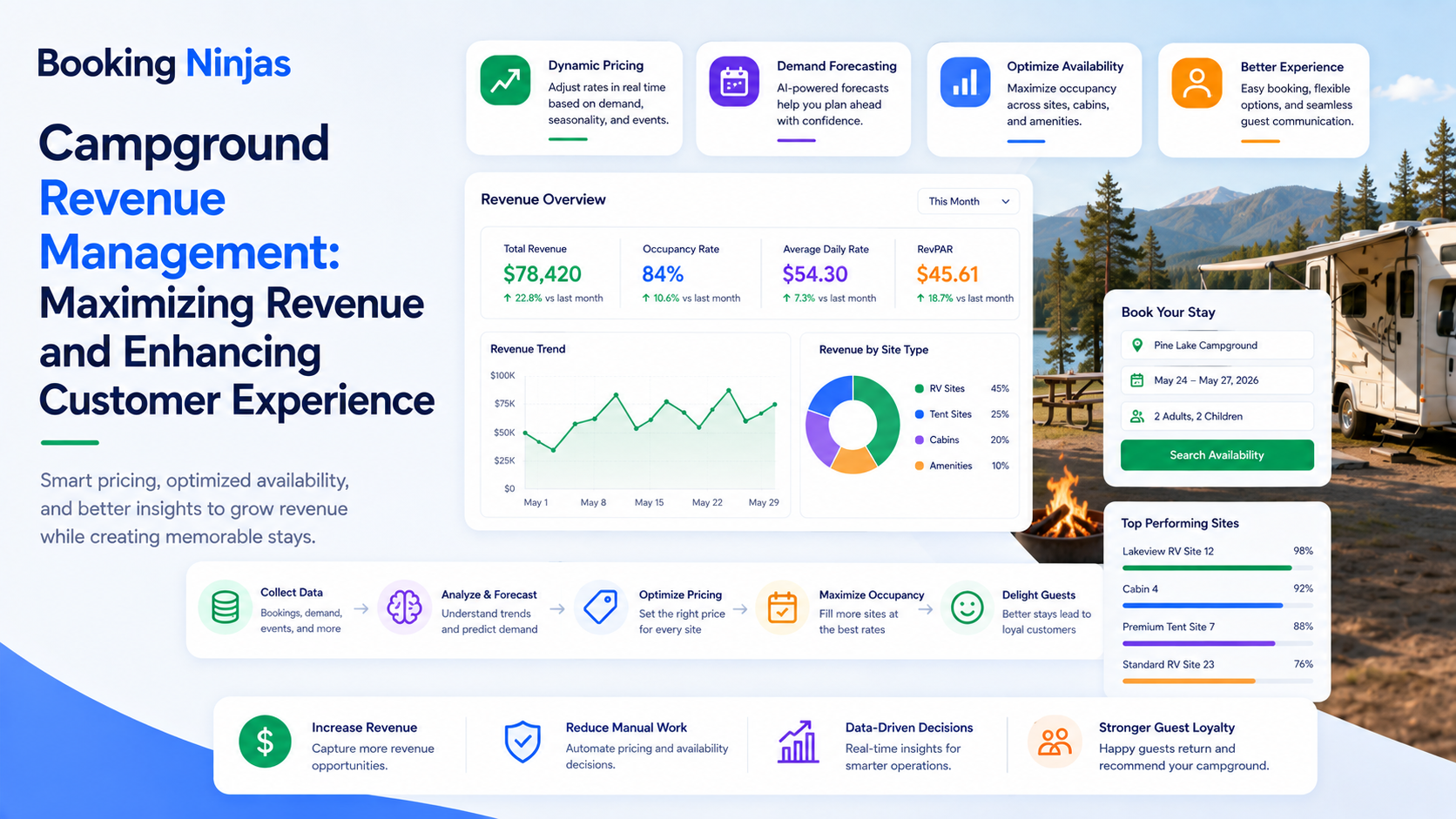
What does the campground revenue-management cycle look like?
Define the campsites, RV sites, cabins, amenities, capacity, and operating restrictions that can affect booking.
Determine which inventory can be sold and which pricing rules apply for the requested dates.
Reservations, cancellations, stay lengths, booking pace, and charges create the actual commercial record.
Reporting and forecasting help operators decide whether pricing, restrictions, or inventory strategy should change.
Why does campground revenue management start with site inventory?
A campsite is not always interchangeable with every other campsite. RV length, hookup configuration, location, capacity, accessibility, surface type, nearby amenities, and accommodation type can affect whether a site is suitable for a particular reservation.
The inventory model should therefore distinguish the attributes required for booking and pricing rather than treating every resource as one undifferentiated campsite.
Booking Ninjas' Campground Management supports tent sites, RV sites, cabins, mixed-use campground layouts, short and longer stays, payments, add-ons, and campground operating workflows within Salesforce.
How does availability affect campground pricing?
Pricing should operate against the inventory that can actually be booked.
Availability may change because of:
- Existing reservations
- Reservation modifications
- Cancellations
- Maintenance blocks
- Seasonal closures
- Restricted dates
- Capacity rules
- Minimum or maximum usage rules
Booking Ninjas' Availability Management connects availability with booking changes, capacity controls, blackout periods, restricted dates, usage windows, permissions, and controlled overrides.
That makes availability an input into pricing decisions rather than a separate calendar that staff have to reconcile manually.
What does reservation data tell a campground about demand?
A reservation is more than a completed sale. Over time, reservation history can show how demand behaves across the campground.
Useful patterns can include:
- Arrival dates
- Length of stay
- Booking lead time
- Site type selected
- Periods of higher or lower demand
- Reservation changes
- Cancellations
- Booking pace by period
Booking Ninjas' Reservation Management connects reservation creation, updates, cancellations, booking rules, availability, and historical booking data inside Salesforce.
What does dynamic pricing mean for a campground?
Dynamic pricing means that rates can change according to defined conditions rather than remaining identical throughout the year.
Depending on the campground's strategy, pricing rules might consider:
- Season
- Date range
- Holiday or event period
- Site or accommodation type
- Current availability
- Occupancy or capacity threshold
- Time remaining before arrival
- Other defined business rules
Booking Ninjas' Rate Management supports seasonal pricing, multi-calendar rate control, demand-and-availability rules, capacity thresholds, time-to-booking conditions, minimum and maximum rates, and role-based pricing controls.
Should every campground use fully dynamic pricing?
No. Different pricing models can be appropriate for different operating environments.
| Pricing model | How it works | When it may be useful |
|---|---|---|
| Fixed pricing | One rate remains in place for a defined period. | Simple operations with limited pricing variation. |
| Seasonal pricing | Rates change across high, low, or shoulder periods. | Campgrounds with predictable seasonal demand. |
| Rule-based dynamic pricing | Rates change when configured demand, availability, timing, or capacity conditions are met. | Operations that want more responsive pricing while retaining explicit controls. |
| AI-assisted pricing | Analytical models identify patterns or recommend pricing adjustments from available data. | Operations with sufficient data and an established review process. |
A campground can also combine these approaches—for example, seasonal base rates with additional rules around availability or booking lead time.
Should different campground site types have different rates?
They can when the underlying product differs.
Rate structures may distinguish among factors such as:
- Tent versus RV accommodation
- Cabin versus open campsite
- Hookup configuration
- Site capacity
- Premium location
- Included amenities
- Physical site characteristics
- Configured accommodation category
Pricing logic should be based on legitimate product, timing, demand, and operational factors rather than sensitive or protected personal characteristics of the guest.
How does length of stay affect campground revenue management?
A reservation consumes availability across every night included in the stay, so length of stay can affect future booking opportunities.
For example, an operator may need to consider whether a particular stay:
- Spans a high-demand weekend
- Creates an unusable one-night gap
- Extends into another pricing season
- Uses a limited premium site
- Qualifies for a configured longer-stay rate
- Conflicts with a minimum or maximum stay rule
Availability and pricing rules should therefore be evaluated together instead of treating each night as an unrelated transaction.
Should campground revenue management include more than campsite rates?
Yes, if the campground sells additional products or services.
Depending on the operation, the financial record may include configured items such as:
- Utility or hookup charges
- Equipment rentals
- Firewood
- Additional guest charges
- Activities
- Premium amenities
- Other campground services
- Deposits
The value of tracking these items is not that every add-on automatically increases spending. It is that the campground can distinguish accommodation revenue from other revenue sources and analyze them separately.
Booking Ninjas' Billing & Payment environment connects charges, invoices, payments, deposits, processing, reconciliation, and financial reporting with operational records.
Which metrics can help evaluate campground revenue performance?
A campground does not need to optimize every metric at the same time. Metrics should help operators understand what is happening across inventory, pricing, reservations, and revenue.
| Metric | What it shows | Example calculation |
|---|---|---|
| Available site-nights | The amount of campground accommodation inventory available for sale during a period. | Available sites × nights in the period, adjusted for applicable closures or blocks. |
| Occupied site-nights | The site-night inventory actually occupied or sold. | Sum of occupied site-nights during the period. |
| Occupancy rate | How much available site-night capacity was occupied. | Occupied site-nights ÷ available site-nights. |
| Average site rate | Average campsite accommodation revenue across occupied site-nights. | Campsite revenue ÷ occupied site-nights. |
| Revenue per available site-night | Relates campsite revenue to total available site-night capacity. | Campsite revenue ÷ available site-nights. |
| Booking lead time | How far in advance reservations are being created. | Days between booking date and arrival date. |
| Cancellation pattern | How reservations are being canceled across dates, rates, or booking periods. | Review canceled reservations against total bookings and timing. |
| Add-on revenue | Revenue coming from configured products or services beyond the accommodation rate. | Sum applicable non-accommodation revenue by category. |
Is higher campground occupancy always better?
Not necessarily.
Occupancy indicates utilization, but it does not show the rate achieved, the revenue generated, the operating cost of serving the stay, or whether high-demand inventory could have been sold under a different pricing strategy.
Two periods can have the same occupancy and produce different financial results because the rates, site mix, stay lengths, and additional charges differ.
How can forecasting support campground revenue decisions?
Forecasting can use historical and current operating data to support estimates about future demand or revenue.
Inputs may include:
- Historical reservations
- Current booking pace
- Seasonality
- Availability
- Rate history
- Site-type demand
- Cancellations
- Revenue trends
Forecasts should be treated as planning inputs rather than certain predictions. Weather, events, market conditions, infrastructure issues, cancellations, and other factors can change actual demand.
What is the difference between rate management and revenue optimization?
Rate management controls how prices are established and changed. Revenue optimization looks at the resulting performance and helps determine whether the pricing and revenue strategy should be adjusted.
Booking Ninjas' Revenue Optimization supports analysis of revenue drivers, pricing performance, discounts, trends, locations, segments, and forecasting information within Salesforce.
That creates a feedback loop:
- Set pricing rules
- Observe reservations
- Record financial results
- Compare periods or site types
- Identify patterns
- Review pricing performance
- Change rules where appropriate
- Measure the next result
What role should AI play in campground revenue management?
AI can support analysis where sufficient relevant data exists.
Useful applications can include:
- Demand pattern detection
- Forecasting support
- Pricing-window recommendations
- Trend analysis
- Anomaly identification
- Scenario analysis
AI should not be treated as a guarantee that a rate is optimal or that predicted demand will occur. Operators should define pricing boundaries, review significant changes, and monitor the actual results.
Why must revenue management connect with campground operations?
A site should not be priced and sold without considering whether it can actually receive the guest.
Operational conditions can affect sellable inventory, including:
- Site maintenance
- Utility problems
- Cleaning or turnover
- Seasonal closure
- Infrastructure restrictions
- Site readiness
- Safety-related blocks
- Other operational restrictions
Booking Ninjas' Work Order Management can connect maintenance activity with the operational records used to track campground work.
The campground solution can then keep site availability, reservations, readiness, payments, and operations within the same Salesforce-native environment.
What should campground revenue reporting help operators understand?
Reporting should help answer specific questions about the campground's commercial performance.
- Which site types are being booked?
- Which dates have constrained availability?
- How do rates vary across periods?
- How does occupancy compare with achieved rate?
- How early are guests booking?
- Which reservation periods are changing or canceling?
- Which revenue comes from accommodation versus add-ons?
- How do locations or site categories compare?
Booking Ninjas' Insights provides reporting and decision-support capabilities across operational, customer, and financial information on Salesforce.
How should a campground build a revenue-management process?
- Model the campground inventory. Define tent sites, RV sites, cabins, site attributes, amenities, capacities, and other reservable resources.
- Define availability rules. Establish closures, blocked periods, capacity limits, maintenance restrictions, and permitted stay windows.
- Define the rate structure. Establish base rates, site-type differences, seasons, minimum and maximum rates, and other controlled pricing rules.
- Connect rates with reservations. Make sure the rate offered corresponds with the inventory, dates, and conditions attached to the booking.
- Track booking behavior. Monitor booking pace, lead time, stay length, cancellations, and demand by site type or period.
- Connect additional charges. Preserve campground services, add-ons, deposits, and other configured charges separately from the accommodation rate where appropriate.
- Connect operations with sellable inventory. Ensure maintenance, closures, and site-readiness conditions can affect availability when required.
- Review revenue and utilization together. Compare rate, occupancy, available capacity, reservation behavior, and realized revenue instead of optimizing one metric alone.
- Adjust and test. Change pricing or inventory rules deliberately, monitor the results, and continue refining the strategy from actual operating data.
How does Booking Ninjas connect campground revenue management?
Booking Ninjas is a Salesforce-native platform for bookings and operations . For campgrounds, site inventory, availability, reservations, rates, payments, operational activity, and reporting can therefore remain connected within the broader Salesforce environment.
The exact revenue strategy remains configurable. Campgrounds can use seasonal pricing, defined rate rules, dynamic pricing conditions, forecasting, operational reporting, and human review according to their own inventory and business model.
Connect tent sites, RV sites, cabins, reservations, payments, site readiness, and campground operations.
Explore Campground Management →Manage seasonal, dynamic, rule-driven, and multi-calendar pricing with controlled rate boundaries.
Explore Rate Management →Connect booking availability with capacity, restrictions, closures, usage rules, and controlled overrides.
Explore Availability Management →Keep reservation activity, changes, cancellations, booking rules, and availability connected.
Explore Reservation Management →Analyze pricing performance, revenue drivers, trends, segments, and forecasting information.
Explore Revenue Optimization →Connect charges, invoices, deposits, payments, reconciliation, and financial reporting with campground records.
Explore Billing & Payment →Analyze operational, customer, pricing, and financial information through Salesforce-native reporting.
Explore Insights →Frequently asked questions
What is campground revenue management?
Campground revenue management connects site inventory, availability, pricing, reservations, charges, and performance data so operators can make controlled decisions about how campground capacity is sold across different dates and site types.
Is campground revenue management the same as dynamic pricing?
No. Dynamic pricing is one possible pricing method within a broader revenue-management process. Revenue management also involves inventory, availability, reservation behavior, stay rules, charges, forecasting, reporting, and operational constraints.
Can campground rates change by season or demand?
Yes. Booking Ninjas Rate Management supports seasonal pricing, date-based rules, demand and availability conditions, occupancy or capacity thresholds, time-to-booking conditions, and other configured pricing logic.
Is higher campground occupancy always better for revenue?
Not necessarily. Occupancy measures utilization but does not show the rate achieved, revenue generated, site mix, operating cost, or opportunity associated with limited inventory. Rate and utilization should therefore be evaluated together.
Can campground revenue management include RV sites, tent sites, and cabins?
Yes. Booking Ninjas Campground Management supports tent sites, RV sites, cabins, mixed-use campground layouts, and different stay models within the same Salesforce-native environment.
Can campground revenue management include add-ons and deposits?
Yes. Campground financial workflows can connect accommodation charges with configured deposits, utilities, add-ons, equipment, or other services. The exact products and billing rules depend on the campground's implementation.
Can AI set campground prices automatically?
AI can support demand analysis, forecasting, pattern detection, and pricing recommendations where sufficient relevant data exists. Pricing boundaries, automation rules, approvals, and human review should still be defined according to the campground's revenue strategy.
Is Booking Ninjas campground management built on Salesforce?
Yes. Booking Ninjas is Salesforce-native, allowing campground site inventory, reservations, availability, rates, payments, operations, reporting, permissions, automation, and integrations to use the broader Salesforce platform foundation.
Connect campground pricing to the operation behind it
See how Booking Ninjas can connect campsite inventory, availability, reservations, rate rules, payments, operations, and revenue reporting within one Salesforce-native campground environment.