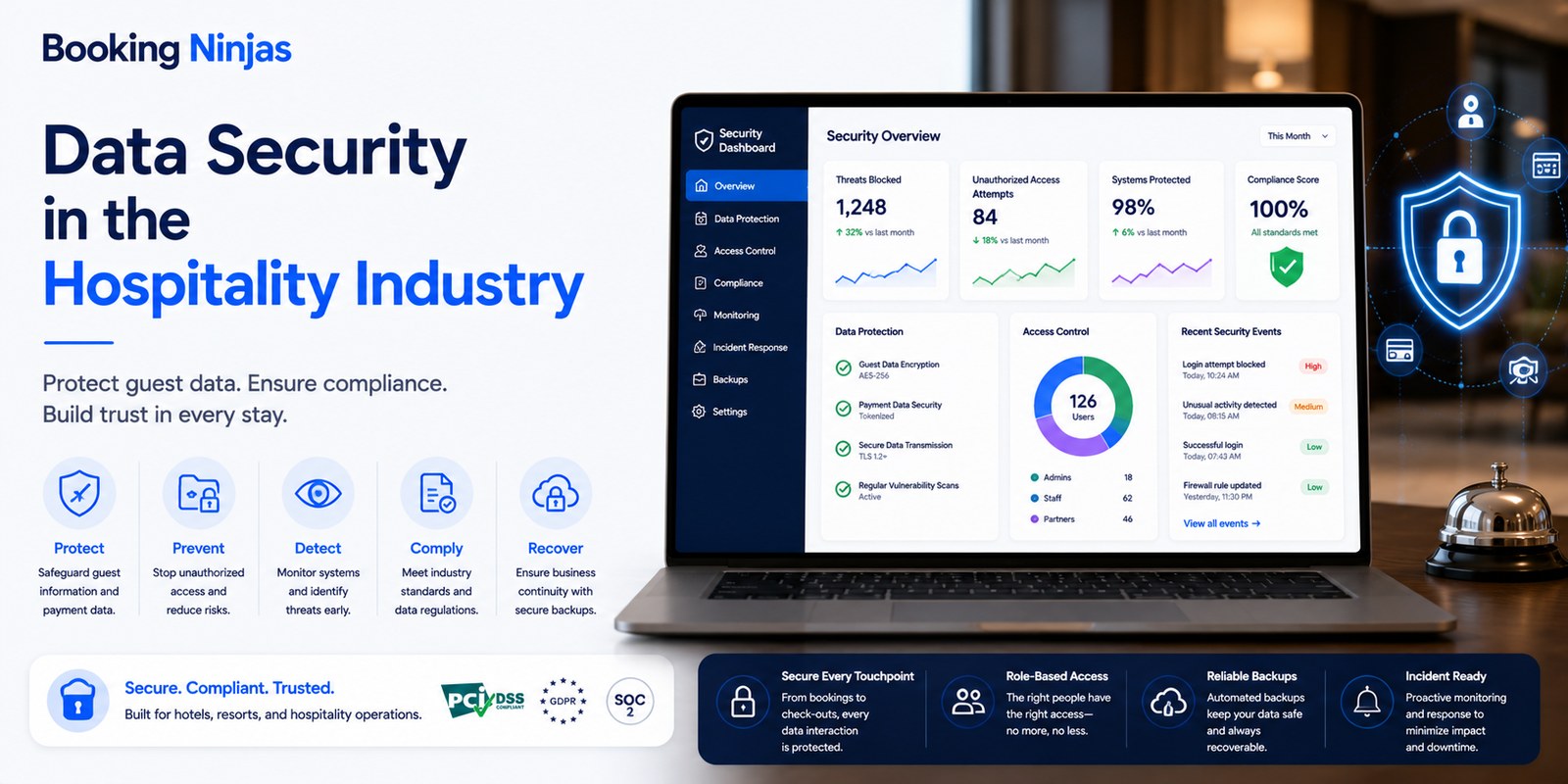
Hospitality data security is the combination of technical controls, identity management, permissions, operating procedures, staff practices, monitoring, and governance used to protect information across reservations, guests, payments, employees, properties, and connected systems.
No property management system can eliminate cyber risk by itself. Security also depends on identity providers, devices, networks, payment systems, integrations, staff behavior, configuration, policies, incident response, and other technology surrounding the property-management environment.
What does hospitality data security need to protect?
Hospitality operations can create and process many types of sensitive or business-critical information.
- Guest identity and contact information
- Reservation and stay history
- Payment-related records
- Invoices and financial information
- Employee and user records
- Documents
- Guest requests and communications
- Access-control information
- Operational and property records
- Integration credentials and system connections
Different information requires different controls. The objective is not to make every record available to every employee simply because all of the information exists inside the same operating platform.
What does a layered hospitality security model look like?
Determine who the user is through authentication, MFA, SSO, or another approved identity process.
Define which applications, records, fields, and actions the user needs for their role.
Preserve appropriate login, change, workflow, integration, and audit information.
Change permissions, investigate exceptions, remove access, and update controls when conditions change.
What is the difference between security, privacy, and compliance?
| Area | Main question | Example |
|---|---|---|
| Security | How is information and system access protected? | Authentication, permissions, encryption, monitoring, secure integrations, and incident response. |
| Privacy | Why is personal information collected, how can it be used, and what rights or preferences apply? | Consent, communication preferences, access requests, correction, deletion, and retention. |
| Compliance | Which legal, regulatory, contractual, or organizational requirements must the operation meet? | Applicable privacy rules, payment obligations, internal policies, audit requirements, or contractual controls. |
Why is identity the starting point for hospitality security?
Before the system decides what someone can access, it first needs a reliable way to establish which user is attempting to enter.
Identity controls can include:
- Named user accounts
- Multi-factor authentication
- Single sign-on
- Enterprise identity providers
- Security keys or passkeys
- Authenticator applications
- Login policies
- Session controls
Salesforce requires multi-factor authentication for covered employee access to Salesforce products, including appropriate direct-login and single-sign-on scenarios.
Booking Ninjas' Identity Management Integration can connect property operations with supported enterprise identity environments, including structured provisioning, access lifecycle, and authentication workflows.
Why are MFA and SSO important?
Passwords alone create unnecessary exposure when credentials are stolen, reused, guessed, or obtained through phishing.
Multi-factor authentication adds another verification factor to the login process. Depending on the organization's architecture, users may authenticate directly through Salesforce or through an approved single-sign-on and identity-provider environment.
Booking Ninjas' Single Sign-On capabilities can align authentication with the wider Salesforce identity and access architecture.
The specific verification methods and identity policies should be determined by the organization's security team and the requirements applicable to each user group.
How should hotels decide what each user can see and do?
Authentication answers “Who are you?” Authorization answers “What are you allowed to do?”
Hospitality organizations can have very different access requirements across:
- Front-desk employees
- Reservations teams
- Housekeeping
- Maintenance
- Finance
- Revenue management
- Property leadership
- Corporate administrators
- External contractors
- Integration users
Salesforce provides multiple access layers for controlling applications, objects, fields, records, and user capabilities. Organizations can use permissions and sharing rules to provide access according to operational need.
What does least-privilege access mean in a hotel?
Least privilege means giving a user the access required to perform their role without unnecessarily exposing unrelated information or administrative capabilities.
| Role | May require | May not require |
|---|---|---|
| Housekeeping | Room status, task information, assigned work. | Broad payment or financial reporting data. |
| Maintenance | Property, asset, work-order, and issue information. | Unrelated guest or revenue information. |
| Front desk | Reservations, guest-facing stay information, configured payment workflow, requests. | Organization-wide administrative configuration. |
| Finance | Charges, invoices, payments, reconciliation, reporting. | Operational data unrelated to financial responsibilities. |
These are examples rather than universal permission rules. Each organization needs to design its own access model according to job responsibilities and risk.
Why does the employee lifecycle matter for security?
Access requirements change when an employee joins, changes roles, moves property, becomes a contractor, goes on leave, or leaves the organization.
A structured identity lifecycle can cover:
- User creation
- Role assignment
- Approval of elevated access
- Property or department changes
- Temporary access
- Periodic access review
- Permission removal
- Account deactivation
Booking Ninjas Identity Management Integration supports structured provisioning and deprovisioning workflows when connected with the organization's supported identity architecture.
Deactivating access promptly is particularly important when the user's employment, role, or legitimate business need ends.
Why are people still part of the security model?
Technical controls cannot remove every risk created by phishing, social engineering, credential sharing, unsafe devices, accidental disclosure, or incorrect handling of information.
Hospitality security programs should therefore include appropriate staff education around:
- Phishing and suspicious messages
- Credential handling
- Multi-factor authentication
- Shared-device practices
- Guest identity verification procedures
- Data exports
- Document handling
- Incident reporting
Training should reflect the actual systems and responsibilities employees use instead of relying on a one-time generic security presentation.
How should payment security fit into the hospitality architecture?
Payment processing introduces its own security, processor, contractual, and regulatory requirements.
Hotels should understand:
- Which payment processor handles the transaction
- Where sensitive payment information is processed
- Which system stores payment references
- Which employees can initiate payment activity
- How refunds or adjustments are authorized
- How payment integrations authenticate
- Which logs or reconciliation records are retained
- Which PCI DSS responsibilities apply to the organization
Booking Ninjas' Payment Processing can connect property transactions with supported processors and payment workflows according to the configured implementation.
Using a payment integration does not automatically make the organization PCI compliant. The operator should determine its responsibilities with its payment providers and qualified security or compliance professionals where necessary.
Why are integrations part of the data-security model?
A hotel can secure its core PMS carefully and still create risk through an improperly designed connection to another application.
Each integration should define:
- System identity
- Authentication method
- Authorization scope
- Data being exchanged
- Direction of the data flow
- Encryption in transit
- Credential or secret management
- Error handling
- Logging and monitoring
- Access removal when the integration ends
Booking Ninjas' Integrations architecture supports structured authentication, encrypted communication, APIs, middleware, and governed data exchange with external systems.
Exact security controls still depend on the external platform, interface, identity model, data exchanged, and implementation.
What should be considered when an API accesses hotel data?
An API connection is another system user and should be governed accordingly.
Rather than granting an integration broad access by default, determine the minimum records, actions, and scope required for the integration to perform its intended job.
Booking Ninjas' API Integration supports structured REST API and event-driven connectivity within the wider Salesforce environment.
How does guest privacy connect with hospitality security?
Security helps protect personal information from unauthorized access. Privacy also asks whether the organization should collect, use, retain, communicate with, or disclose that information in a particular way.
A structured privacy program may need to manage:
- Consent records
- Communication preferences
- Purpose of data collection
- Role-based access
- Retention policies
- Access requests
- Correction requests
- Deletion or anonymization workflows
- Approval and fulfillment history
- Audit documentation
Booking Ninjas' Data Privacy Management provides structured consent, communication-preference, data-subject-request, retention, access-control, and audit workflows inside Salesforce.
These capabilities can support an organization's privacy program, but the organization remains responsible for determining which laws, jurisdictions, policies, contracts, and retention requirements apply.
What should hotels ask about data residency and sovereignty?
Data sovereignty and residency should be evaluated from the organization's actual legal, contractual, operational, and geographic requirements rather than from assumptions about one country or technology vendor.
Relevant questions include:
- Where is the service provided?
- Where can customer data be processed?
- Which entities act as processors or subprocessors?
- Which contractual terms govern data processing?
- Which cross-border transfer mechanisms apply?
- Which jurisdictions affect the organization?
- What documentation does the provider supply?
- Which hosting or residency options are available?
Organizations with specific residency, sovereignty, or transfer requirements should review the relevant Salesforce contractual, infrastructure, privacy, and compliance documentation as part of their legal and technical assessment.
Why do audit history and monitoring matter?
Preventive controls answer only part of the security question. Organizations also need appropriate visibility into activity that has already occurred.
Depending on configuration and licensing, Salesforce capabilities can support:
- Login activity
- Record changes
- Configuration changes
- Field history
- User activity
- Integration activity
- Security events
- Audit reporting
Monitoring becomes useful when the organization defines what it is looking for, who reviews the information, and what response should occur when an unexpected event is identified.
What is Salesforce Shield, and is it automatically included?
Salesforce Shield is a suite of additional Salesforce security and governance products.
The current suite includes:
- Platform Encryption
- Event Monitoring
- Field Audit Trail
- Data Detect
These capabilities can provide additional encryption, monitoring, audit-history, and sensitive-data discovery controls for organizations that require them.
Does encryption solve hospitality data security by itself?
No.
Encryption can protect information in particular states or workflows, but the wider security architecture also needs to control identities, permissions, integrations, devices, administrative access, data exports, monitoring, and user behavior.
Additional encryption options such as Salesforce Shield Platform Encryption can be considered where required, but encryption design should be tested against the fields, applications, integrations, search behavior, reporting, and workflows that need to continue operating.
Can Salesforce restrict access by network or IP address?
Salesforce provides configurable network and profile-level IP controls, but the behavior depends on how they are configured.
Trusted network ranges can affect identity-verification behavior, while profile-level login IP ranges can be used to deny login from addresses outside configured ranges.
That distinction matters for hotels with remote employees, multi-property teams, mobile users, VPNs, integrations, or changing network environments.
Network restrictions should therefore be designed by the organization's security or IT team instead of being enabled from a generic recommendation that every user must log in from one fixed location.
What should happen when a security issue is suspected?
Security controls need a response process behind them.
Depending on the organization and incident, a response workflow can include:
- Record the suspected event
- Identify the affected user or system
- Restrict or revoke access where appropriate
- Preserve relevant evidence
- Assign ownership
- Escalate to security or leadership
- Assess affected data and systems
- Coordinate technical remediation
- Follow applicable notification procedures
- Document resolution and corrective actions
The exact process should come from the organization's incident response plan and qualified security, legal, privacy, and operational teams where appropriate.
How should hospitality organizations test their security controls?
Security testing should be deliberate, authorized, and appropriate to the systems being tested.
Depending on the organization's risk model, this can involve:
- Permission reviews
- User-access reviews
- Offboarding tests
- Phishing-awareness exercises
- Integration reviews
- Configuration reviews
- Incident-response exercises
- Authorized vulnerability assessment
- Authorized penetration testing where appropriate
- Audit and compliance reviews
Organizations should follow applicable provider rules and use appropriately qualified professionals when conducting technical security testing.
Who is responsible for security in a Salesforce-based PMS?
Security is shared across the technology provider, Booking Ninjas, the customer organization, administrators, employees, integration providers, payment providers, identity systems, devices, and other components of the operating environment.
| Layer | Examples of responsibility |
|---|---|
| Platform | Underlying Salesforce service, platform controls, infrastructure, product security, and available security capabilities. |
| Booking Ninjas | Property-management application design, configured workflows, product permissions, and implementation within agreed scope. |
| Customer | Users, access decisions, data, policies, configuration, devices, processes, staff practices, legal requirements, and governance. |
| Connected systems | Security of identity providers, processors, APIs, networks, devices, integrations, and other external technologies. |
How should a hospitality business build its data-security model?
- Identify the data. Determine which guest, employee, financial, operational, payment, access, document, and integration information the organization handles.
- Identify the users. Define employees, administrators, contractors, partners, integrations, portals, and other identities that can access the environment.
- Define authentication. Establish appropriate MFA, SSO, identity-provider, login, session, and network policies.
- Define authorization. Map roles to required applications, objects, records, fields, and administrative capabilities.
- Map external systems. Document payment, identity, accounting, access, API, cloud, and other integrations that can exchange data.
- Define privacy and retention. Establish purposes, consent, communication preferences, data-subject workflows, retention, and deletion policies.
- Define monitoring. Determine which events and changes need to be recorded, who reviews them, and what constitutes an exception.
- Define the employee lifecycle. Create controlled processes for provisioning, role changes, periodic review, and deactivation.
- Prepare incident response. Establish ownership, escalation, investigation, containment, communication, and documentation procedures.
- Review the model regularly. Reassess access and controls when properties, people, systems, regulations, threats, or business processes change.
How does Booking Ninjas fit into hospitality data security?
Booking Ninjas is a Salesforce-native platform for bookings and operations . Property records, reservations, users, workflows, permissions, portals, reporting, privacy processes, and integrations can therefore use the wider Salesforce platform foundation according to the configured implementation.
Booking Ninjas should not be treated as a replacement for every cybersecurity technology an organization may require. Endpoint security, networks, security monitoring, identity providers, payment infrastructure, device management, employee education, incident response, and other security layers can remain separate parts of the wider architecture.
Understand the platform foundation for identity, permissions, data, workflows, reporting, APIs, and governance.
Explore Salesforce DNA →Connect consent, preferences, privacy requests, retention, access controls, and audit workflows.
Explore Data Privacy →Connect property operations with supported identity, provisioning, authentication, and access-lifecycle systems.
Explore Identity Management →Align user authentication with the wider Salesforce and enterprise identity architecture.
Explore Single Sign-On →Connect external systems using structured authentication, encrypted communication, APIs, and governed data flows.
Explore Integrations →Build structured REST API and event-driven connections within the Salesforce-based operating environment.
Explore API Integration →Configure approvals, routing, role assignments, escalation, exception handling, and governance workflows.
Explore Workflow & Process →Connect hotel reservations, guests, payments, operations, and reporting within the wider Salesforce environment.
Explore Hotel Management →Frequently asked questions
What is hospitality data security?
Hospitality data security is the combination of technical controls, identity management, permissions, staff practices, monitoring, governance, and response procedures used to protect information across guests, reservations, payments, employees, properties, and connected systems.
Does using Salesforce automatically make a hotel secure?
No. Salesforce provides a security and governance foundation, but security also depends on configuration, users, permissions, identity systems, integrations, devices, networks, payment infrastructure, policies, training, monitoring, and incident response.
Does Booking Ninjas guarantee GDPR or CCPA compliance?
No. Booking Ninjas provides configurable privacy and governance capabilities that can support an organization's compliance processes. The organization remains responsible for determining which laws apply and configuring its data, policies, workflows, integrations, retention, and procedures accordingly.
Does Salesforce support multi-factor authentication?
Yes. Salesforce supports and requires multi-factor authentication for covered employee access to Salesforce products. Available verification and identity methods depend on the organization's authentication architecture and Salesforce configuration.
Can hotel employees have different data permissions?
Yes. Salesforce supports layered access controls for applications, objects, fields, records, and user capabilities. Booking Ninjas can use this platform foundation to structure access according to property roles and operational responsibilities.
Is Salesforce Shield included with every Booking Ninjas deployment?
No. Salesforce Shield contains additional products such as Platform Encryption, Event Monitoring, Field Audit Trail, and Data Detect. Availability depends on Salesforce licensing, configuration, and implementation scope.
Can Booking Ninjas secure third-party integrations?
Booking Ninjas supports structured authentication, encrypted communication, APIs, and governed integration workflows. Overall security still depends on both systems, the credentials and permissions used, data exchanged, interface design, configuration, and operational governance.
Who is responsible for hospitality data security?
Responsibility is shared across the technology platform, Booking Ninjas, the customer organization, administrators, users, identity providers, payment providers, integrations, devices, networks, and other systems involved in processing or accessing the data.
Build security into the operating architecture
See how Booking Ninjas can connect property operations with Salesforce identity, permissions, privacy workflows, integrations, governance, and reporting within one Salesforce-native environment.