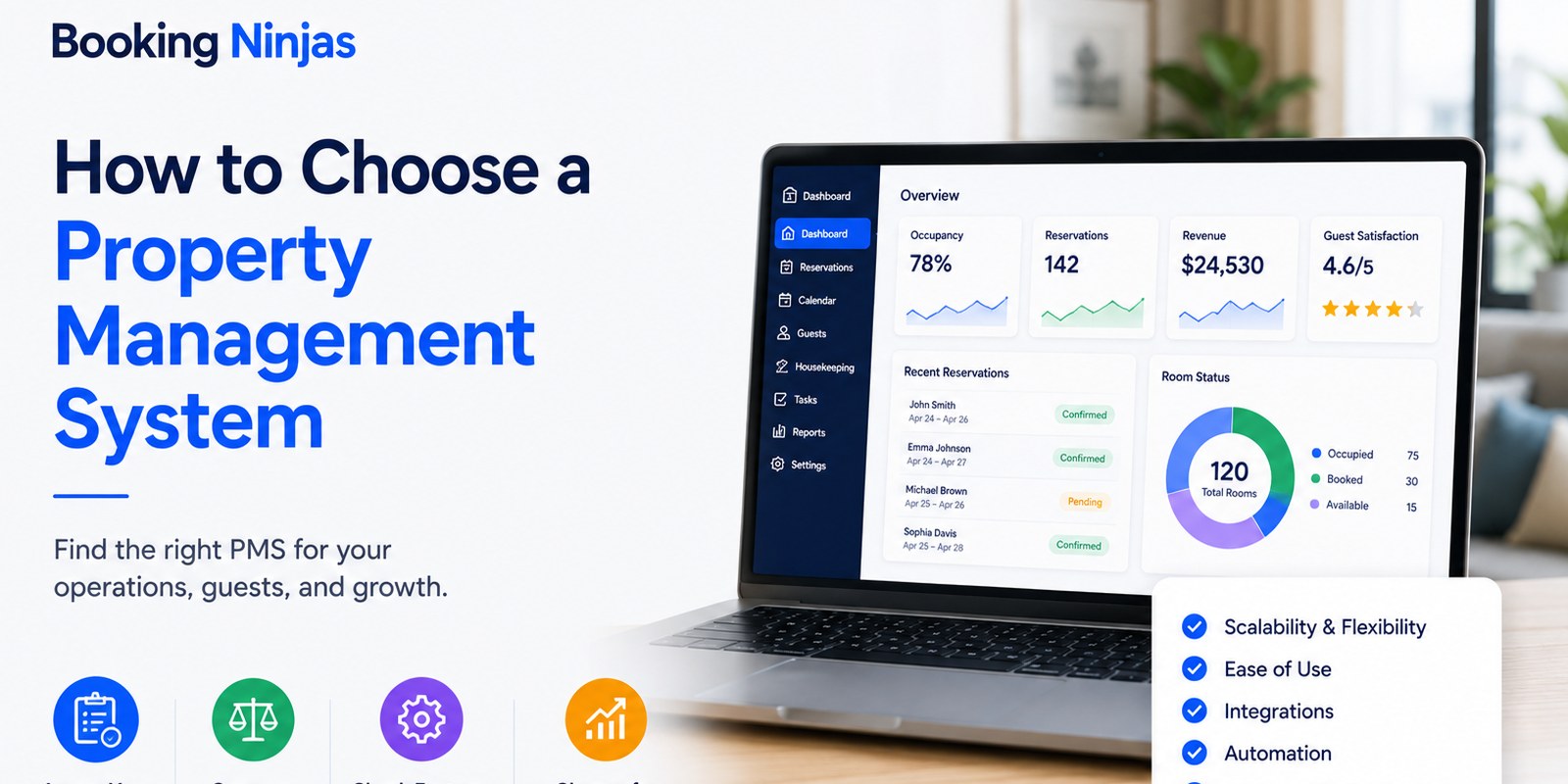
Choosing a property management system should begin with the way your organization operates—not with the length of a vendor's feature list. The right system needs to represent your properties, customers, bookings or leases, payments, service work, permissions, reporting, and external systems in a way that can support real workflows.
A system can have dozens of features and still be a poor fit if employees need spreadsheets, duplicate records, manual reconciliation, or disconnected software to complete the actual operating process.
What should a property management system actually manage?
A property management system is an operational software environment used to manage property-related records and processes.
The exact scope depends on the property model. A hotel, student housing operator, residential landlord, campground, club, venue, or other property-based organization may require very different workflows.
Depending on the operation, the PMS may need to connect records such as:
- Properties, buildings, units, rooms, beds, or spaces
- Availability and occupancy
- Reservations or leases
- Guests, residents, tenants, students, or members
- Rates, charges, invoices, and payments
- Maintenance and service requests
- Documents and approvals
- Operational tasks and workflows
- Permissions and access
- Reporting and performance data
What are the most important criteria when choosing a PMS?
| Evaluation area | Main question | Why it matters |
|---|---|---|
| Operational fit | Can the system represent how your property actually operates? | Determines whether the software supports the real use case rather than forcing it into an unsuitable template. |
| Data model | Can the required records and relationships be represented properly? | Data structure affects workflows, reporting, permissions, integrations, and future changes. |
| Workflow | Can processes, approvals, ownership, and exceptions follow your operating rules? | A feature is less useful when employees still have to coordinate the process outside the system. |
| Integrations | Can the PMS connect with systems that need to remain? | Accounting, ERP, payments, CRM, access, analytics, and other systems may continue to own part of the architecture. |
| Security and governance | Can access and change authority be controlled appropriately? | Operational data should not be equally visible or editable by every user. |
| Reporting | Can the system answer the questions management actually needs to ask? | Reporting depends on connected, structured operational data. |
| Implementation | How will the current operation move into the new system? | Configuration, migration, testing, integrations, and training determine whether the selected design works in practice. |
| Future change | What happens when the organization adds requirements later? | Determines whether change can extend the architecture or requires another replacement project. |
In what order should you evaluate a property management system?
Define properties, people, transactions, workflows, systems, and exceptions.
Determine how the PMS represents the records, relationships, rules, permissions, and integrations.
Demonstrate normal processes, changes, exceptions, approvals, reporting, and cross-system activity.
Review implementation, support, cost, governance, and future expansion before committing.
1. Does the PMS fit your actual operating model?
Begin with the operation itself.
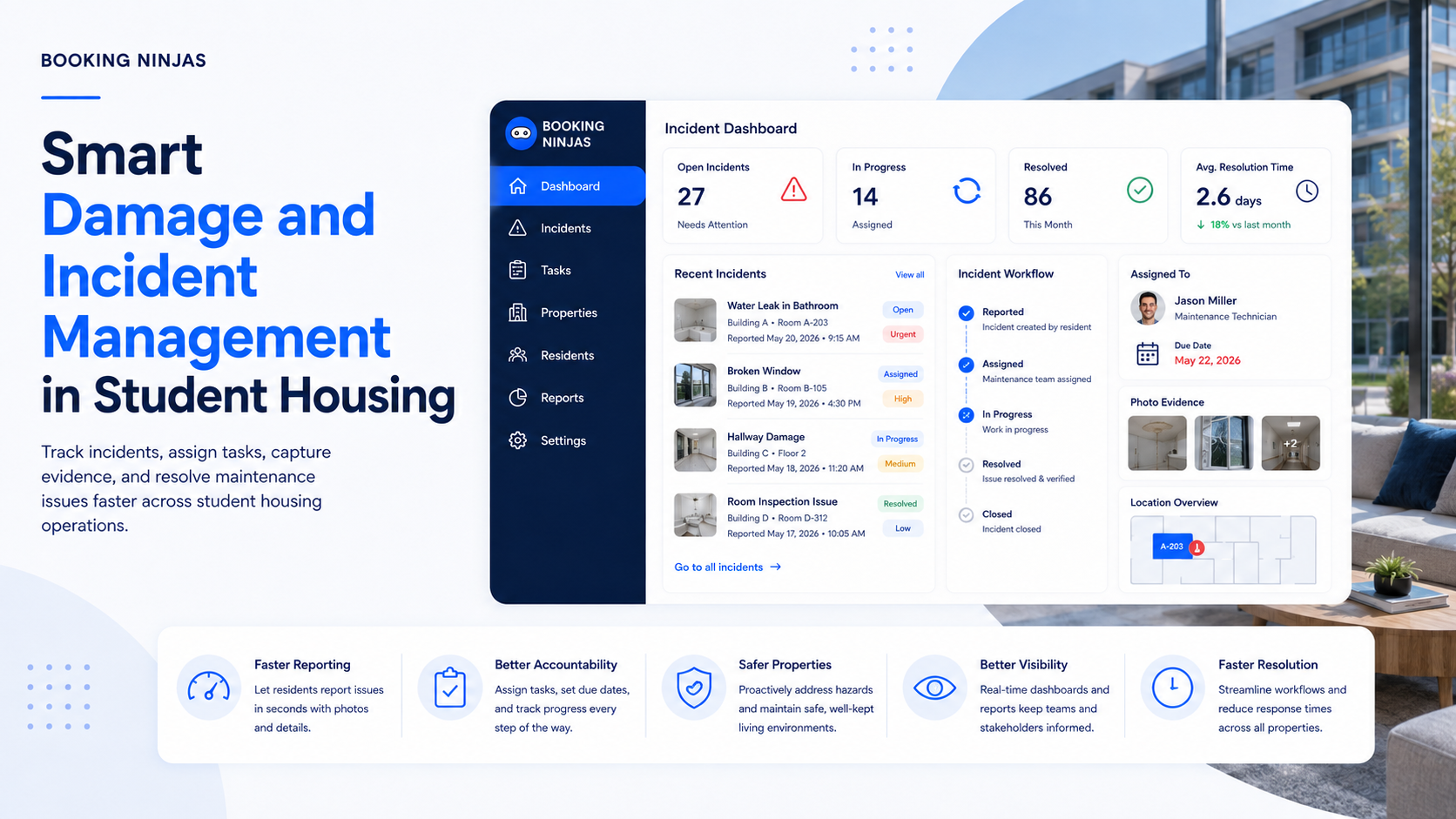
A hotel may organize inventory around rooms and stays. Student housing may require buildings, units, rooms, individual beds, academic terms, and housing assignments. Residential properties may depend on leases, renewals, tenants, recurring billing, and maintenance. A club or venue can introduce memberships, spaces, programs, events, and other resources.
The software should therefore be evaluated against your real operational entities and relationships.
- What exactly is being managed?
- What can be booked, leased, assigned, or reserved?
- Who interacts with those resources?
- Which records depend on each other?
- What changes during the lifecycle?
- Which exceptions occur regularly?
- Which departments participate?
- Which information must remain historically traceable?
If a demonstration only shows generic dashboards and menus, ask the vendor to demonstrate one of your actual operating scenarios from beginning to end.
2. Can the PMS represent your data and relationships properly?
The data model is one of the most important parts of a PMS because nearly everything else depends on it.
Consider a maintenance request. It may need to relate to a property, room or unit, resident or guest, asset, responsible employee, priority, status, work order, vendor, cost, and historical activity.
A booking can similarly relate to:
- Customer
- Property
- Room, unit, bed, or resource
- Availability
- Rate or contract
- Charges and payments
- Requests
- Documents
- Operational activity
- Reporting history
Evaluate whether these relationships are native to the data model, configurable, or dependent on external spreadsheets and manual matching.
3. Can the PMS support your workflows, rules, and exceptions?
Having a feature does not necessarily mean the software can support the complete process around that feature.
For each important workflow, ask:
- What event begins the process?
- Who owns the next step?
- Which conditions affect routing?
- Are approvals required?
- Which notifications are needed?
- When should work escalate?
- What happens when the normal path fails?
- Where is completion recorded?
Booking Ninjas' Workflow & Process Management supports conditional routing, multi-step approvals, role-based assignments, escalation, branching, notifications, exception handling, and process reporting inside Salesforce.
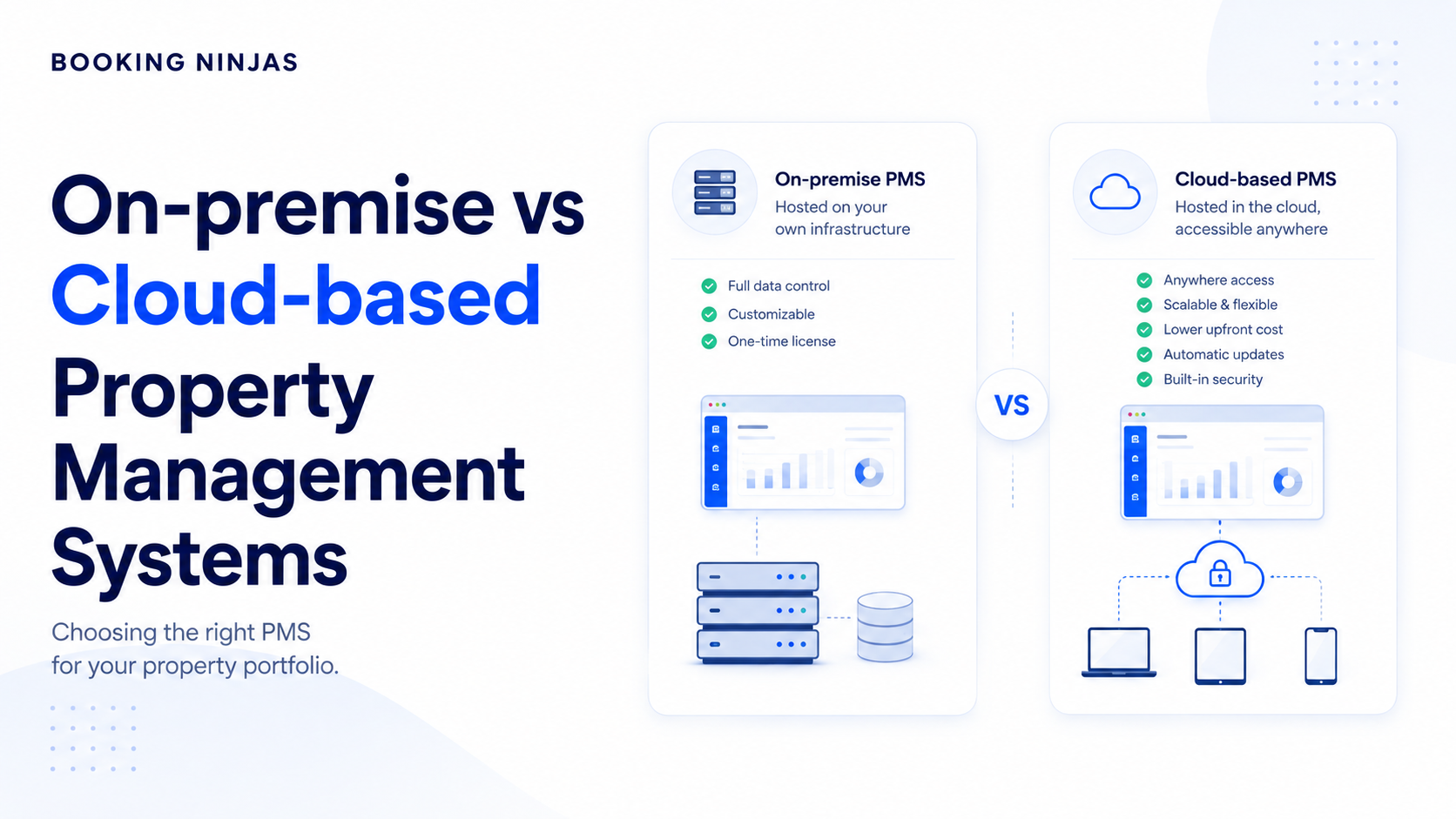
4. Is “cloud-based” still enough to distinguish a good PMS?
No.
Cloud delivery is now common enough that the more useful questions concern the architecture behind it.
Ask about:
- How users authenticate
- How permissions are structured
- How data is governed
- How integrations authenticate
- How environments and changes are managed
- How data can be exported
- How the system handles multiple properties or entities
- Which responsibilities remain with the customer
“Cloud-based” describes where and how software is delivered. It does not by itself prove that the system is secure, configurable, scalable, easy to implement, or appropriate for your organization.
5. Can the PMS integrate with the systems you need to keep?
Most property organizations do not operate in a completely isolated software environment.
Depending on the organization, the PMS may need to interact with:
- Accounting systems
- ERP platforms
- Payment processors
- CRM systems
- Booking or distribution systems
- Access-control infrastructure
- Communication platforms
- Analytics and BI environments
- Building or IoT systems
- Other specialist applications
Booking Ninjas' Integrations architecture supports connections with financial, payment, CRM, analytics, communication, cloud, and other external systems.
Its API Integration environment supports REST APIs and event-driven integrations for structured cross-system workflows.
Exact compatibility should still be confirmed against the specific external product, available interface, data requirements, security model, and implementation scope.
How should you evaluate integration beyond “Does it connect?”
Integration should have an architecture behind it.
For each connected system, determine:
| Question | Why it matters |
|---|---|
| Which system owns the record? | Establishes the authoritative source instead of creating competing versions of the same data. |
| Which data moves? | Prevents assuming that an integration synchronizes fields it does not actually exchange. |
| Which direction does it move? | A one-way export and a bidirectional workflow solve different problems. |
| What triggers synchronization? | Determines whether data moves on demand, on a schedule, or from an operational event. |
| How are errors handled? | Integrations need monitoring and recovery when an expected transaction fails. |
| Who supports the connection? | Clarifies responsibility across vendors and internal teams. |
6. How should you evaluate security, permissions, and governance?
A PMS often contains customer, property, financial, operational, and employee information. Access should therefore be designed according to roles and responsibilities.
Evaluate whether the platform can support:
- Authentication
- Role-based access
- Record and field permissions
- Approval authority
- Audit or activity history
- Integration access
- Data-retention processes
- Privacy workflows where required
- Multi-property or multi-entity separation
- Controlled administrative access
Booking Ninjas operates natively on Salesforce, allowing property applications to use Salesforce's broader platform foundation for permissions, data structures, automation, reporting, and governance.
Security remains a shared responsibility. The technology platform provides controls, while the organization remains responsible for how users, permissions, integrations, devices, policies, and procedures are configured and governed.
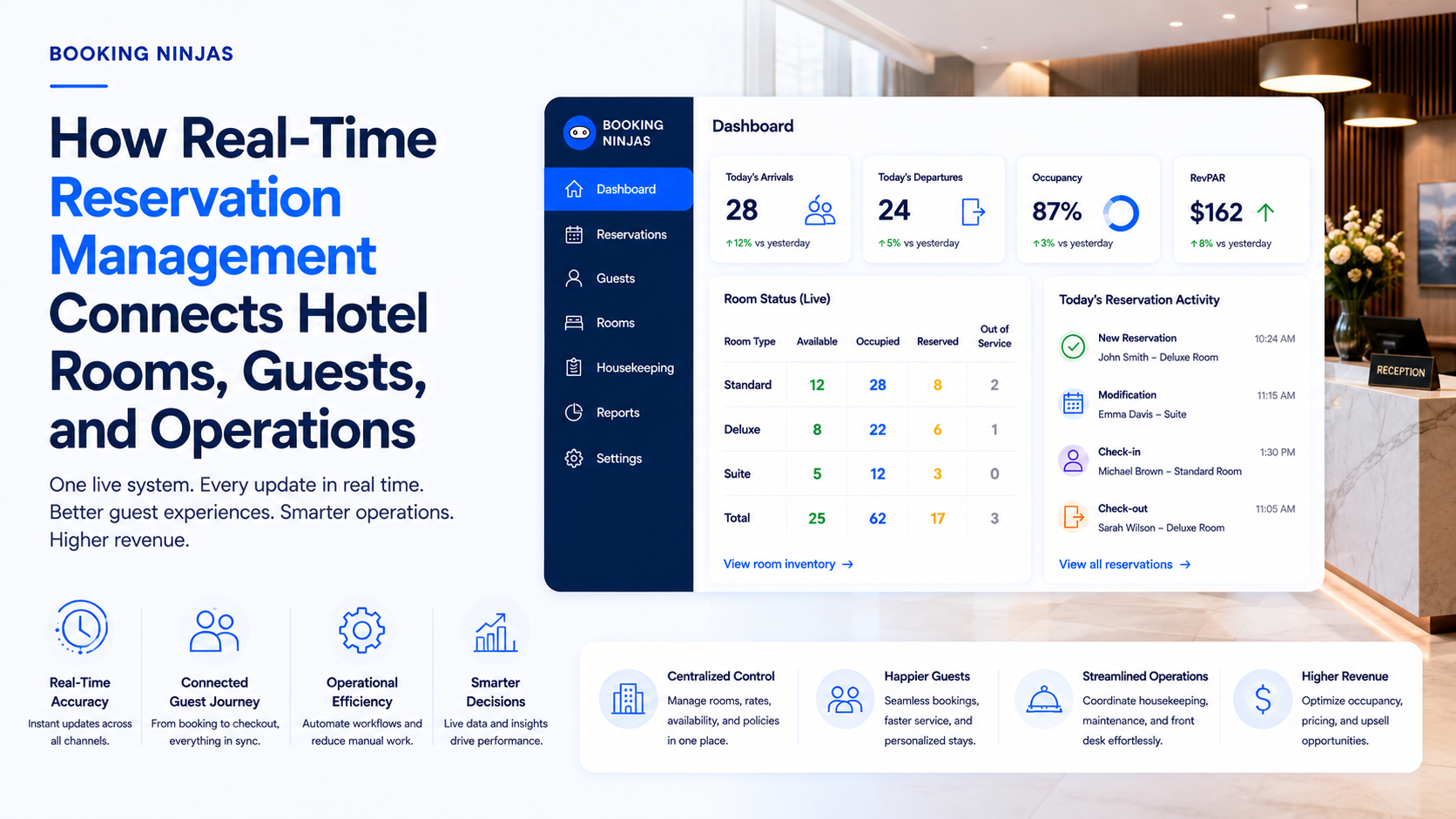
7. Can the PMS report across the operation instead of only individual features?
A dashboard is only as useful as the data relationships underneath it.
During evaluation, give the vendor actual management questions rather than asking whether the product “has reporting.”
For example:
- Which properties have the highest open maintenance workload?
- How does occupancy compare across locations?
- Which invoices need follow-up?
- Which workflows are repeatedly delayed?
- Which resources are underused?
- Which reservation or lease stages require attention?
- How does operational performance change over time?
- Can information be segmented by the dimensions we use?
Booking Ninjas' Insights provides Salesforce-native reporting and decision-support capabilities across connected operational, financial, and customer information.
8. How configurable should a property management system be?
A PMS should not require custom development for every normal operational variation. At the same time, “fully customizable” should not be interpreted as meaning that every imaginable requirement can be introduced instantly without design, implementation, or testing.
Useful areas of configurability can include:
- Fields and record structure
- Relationships
- Roles and permissions
- Workflow rules
- Approvals
- Notifications
- Dashboards
- Reports
- Automation
- Integration behavior
Significant new processes, integrations, data models, or application logic may still require scoped implementation work.
Why should you evaluate the platform underneath the PMS?
The underlying platform can determine how easily the PMS connects data, changes workflows, controls permissions, extends reporting, and integrates with other systems.
Booking Ninjas is built natively on Salesforce rather than operating as a separate PMS that simply sends selected records to Salesforce.
That means Booking Ninjas' property applications can use Salesforce as the foundation for:
- Structured records and relationships
- CRM context
- Roles and permissions
- Workflow automation
- Approvals
- Reporting and dashboards
- APIs and integrations
- Application extension
Learn more about the Salesforce foundation behind Booking Ninjas .
9. What should you evaluate about PMS implementation?
Buying software and implementing an operating system are not the same thing.
A serious PMS implementation can include:
- Requirements validation
- Workflow design
- System configuration
- Data cleansing
- Data migration
- Integration setup
- Permissions
- Testing
- User training
- Go-live planning
Ask who is responsible for each of these activities, what the client must provide, which assumptions the implementation quote is based on, and how scope changes will be handled.
Booking Ninjas provides a dedicated PMS Implementation process covering configuration, migration, integrations, testing, transition, and go-live activities according to the project scope.
10. What should you ask about support after go-live?
“Customer support included” is not specific enough for an operating platform.
Ask the vendor to define:
- How support requests are submitted
- Who can submit them
- How issues are prioritized
- What is considered support versus a change request
- How product defects are handled
- How new configuration requests are handled
- How releases are communicated
- Who owns third-party integration issues
- What documentation is provided
- What happens when requirements expand
This is more useful than evaluating support from a generic promise that the vendor is “always available.”
11. How should you compare PMS pricing and total cost?
A monthly license figure does not necessarily describe the full cost of operating the system.
Depending on the project, compare:
- Software subscriptions
- Implementation
- Data migration
- User licenses
- Integrations
- Payment or transaction-related costs
- Optional modules
- Training
- Support arrangements
- Future configuration or development
- Third-party software
- Renewal terms
The vendor should explain which components are included, which are optional, which depend on scope, and which are supplied by third parties.
12. Can the PMS evolve when the operation changes?
Scalability is not only about adding more rooms or properties.
Growth can introduce:
- New property types
- Additional departments
- More complex permissions
- New billing models
- Additional customer portals
- New approval workflows
- Acquisitions
- Additional reporting requirements
- New integrations
- New regulatory or governance requirements
Ask the vendor to demonstrate how a new requirement would be handled. Can the existing data and workflow architecture be extended? Would a new module be required? Is custom implementation necessary? Or would the organization need another external system?
What should you ask a PMS vendor to demonstrate?
Avoid evaluating a PMS entirely from a predefined vendor tour. Provide scenarios from your own operation.
- Create a realistic operating record. Use the kind of property, room, unit, space, customer, or resource your organization actually manages.
- Run a core transaction. Follow a reservation, lease, assignment, payment, membership, or another central transaction through its lifecycle.
- Change it. Test a modification, cancellation, reassignment, extension, or another realistic change.
- Create an exception. Ask what happens when payment fails, approval is required, inventory is unavailable, or another non-standard situation occurs.
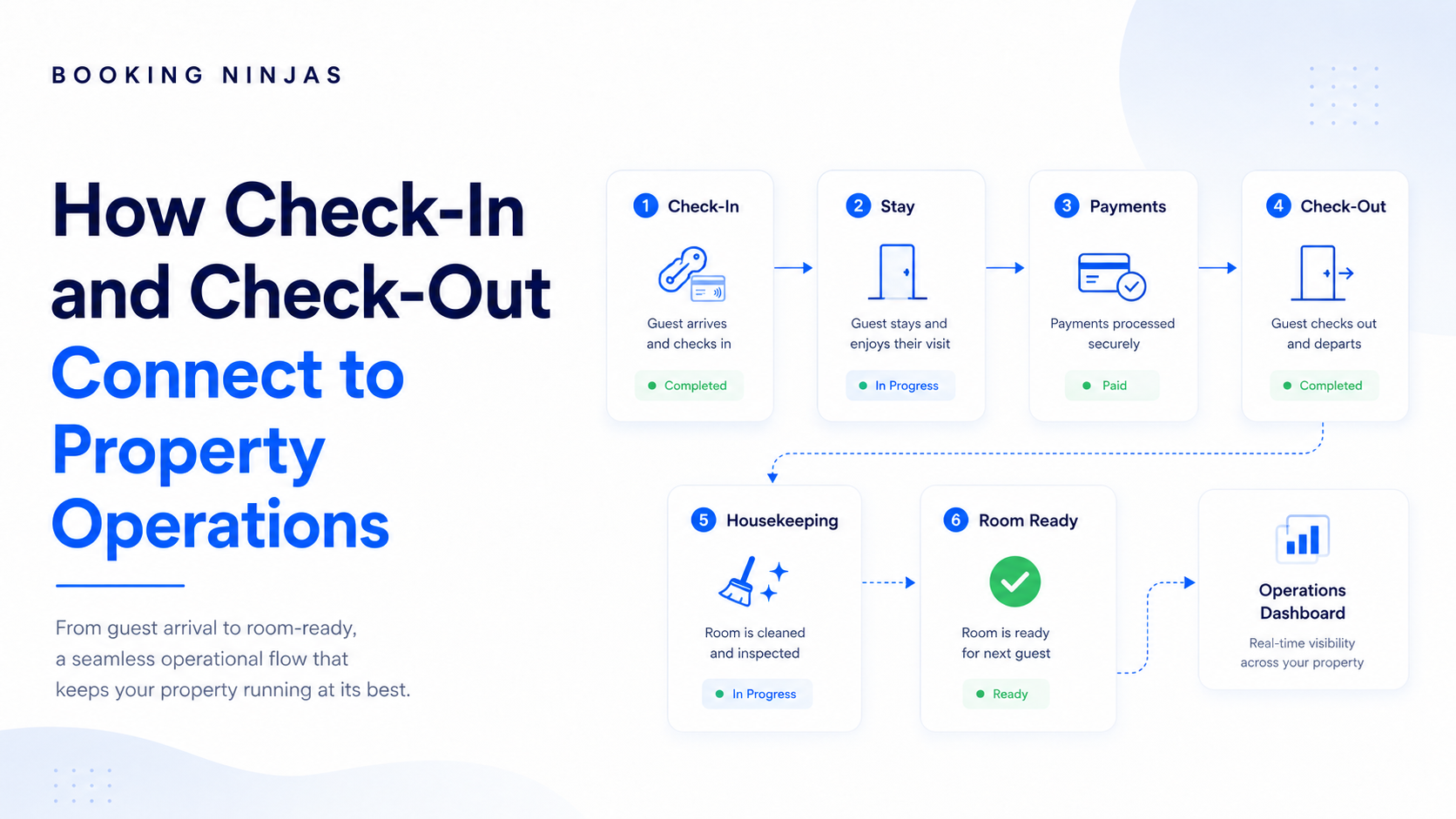
- Cross departments. Follow the process into billing, maintenance, housekeeping, finance, service, or another team where appropriate.
- Test permissions. Ask what different roles can see and change.
- Test an integration. Identify which external system owns the connected record and how information moves.
- Run the report. Ask the system to answer a management question generated by the scenario.
- Ask what happens when requirements change. Test how the architecture responds to a realistic future requirement.
What are warning signs when evaluating PMS software?
No single issue automatically disqualifies a platform, but these situations deserve closer examination:
- The demo avoids your real use cases
- Every unusual requirement is answered with “no problem”
- System-of-record ownership is unclear
- Integrations are described without explaining data flow
- Critical workflows require repeated spreadsheet exports
- Permissions cannot reflect organizational roles
- Reporting depends on manual consolidation
- Implementation responsibilities are undefined
- Support and change requests are not distinguished
- Pricing leaves important scope assumptions unexplained
- Product capabilities are confused with planned features
- Claims about outcomes cannot be tied to the actual workflow
How does Booking Ninjas approach property management architecture?
Booking Ninjas is a Salesforce-native platform for bookings and operations . Property-specific applications use the broader Salesforce foundation for connected records, workflows, permissions, automation, reporting, and integrations.
The aim is not to assume that every external system should disappear. Accounting, ERP, payments, access infrastructure, analytics, CRM, or other specialist technologies can remain part of the architecture where appropriate interfaces and implementation scope support the connection.
Understand the platform foundation for data, permissions, workflows, reporting, automation, CRM, and extensibility.
Explore Salesforce DNA →Review Booking Ninjas applications across bookings, operations, billing, portals, integrations, insights, and related workflows.
Explore Features →Configure routing, ownership, approvals, escalation, notifications, branching, and exception handling.
Explore Workflow & Process →Connect property operations with finance, payments, CRM, analytics, infrastructure, and other external systems.
Explore Integrations →Build structured REST API and event-driven connections with external technology.
Explore API Integration →Report across connected operational, customer, and financial information inside Salesforce.
Explore Insights →Plan configuration, migration, integration, testing, transition, and go-live according to the implementation scope.
Explore PMS Implementation →Frequently asked questions
What should I look for in a property management system?
Evaluate how well the system fits your operating model, data structure, workflows, integrations, permissions, reporting, implementation requirements, support model, total cost, and future requirements. A long feature list is not enough if important processes remain disconnected.
Is a cloud-based PMS automatically better?
No. Cloud delivery is common, but it does not by itself determine whether a PMS is secure, configurable, scalable, integrated, or suitable for the organization. The underlying architecture, permissions, workflows, integrations, governance, and implementation still need to be evaluated.
Should a PMS replace every existing business system?
Not necessarily. Accounting, ERP, payment, CRM, access, analytics, or other specialist systems can remain part of the architecture. The important decision is which system owns each record and how required data and workflows move between them.
Why are PMS integrations important?
Integrations allow required information and workflow events to move between the PMS and external systems instead of depending on repeated manual entry. The specific value depends on the data, system ownership, interface, synchronization rules, and workflow being connected.
What should I test during a PMS demo?
Test realistic end-to-end workflows from your own operation, including normal transactions, changes, exceptions, approvals, permissions, integrations, cross-department handoffs, and reporting. This reveals more than a predefined tour of individual features.
How important is PMS implementation?
Implementation is critical because the selected software still needs to be configured around the operating model. Depending on scope, implementation can include requirements validation, data migration, integrations, permissions, testing, training, and go-live preparation.
How should I compare PMS pricing?
Compare the complete commercial scope rather than only the headline subscription price. Relevant costs can include software licenses, implementation, migration, integrations, users, optional modules, third-party systems, support, training, and future configuration or development.
Is Booking Ninjas built on Salesforce?
Yes. Booking Ninjas is Salesforce-native, allowing property records, customer data, workflows, permissions, reporting, automation, and integrations to use the broader Salesforce platform foundation.
Evaluate the workflow before choosing the software
Show Booking Ninjas how your operation works and see how the platform can connect property records, workflows, permissions, integrations, reporting, and future requirements within a Salesforce-native environment.