Hotels create information about people and organizations throughout everyday operations. A guest makes reservations and requests services. A company negotiates rates and billing arrangements. A travel agency produces bookings under agreed commercial terms.
The objective is to give authorized staff useful context without forcing them to reconstruct the relationship from separate PMS, CRM, billing, communication, and reporting systems.
What is a hotel profile?
A profile represents an ongoing person or business relationship. That makes it different from an individual reservation, transaction, request, or invoice.
Identifies the guest, company, agency, or other relationship.
Connects reservations, stays, services, requests, and other interactions.
Connects rates, invoices, payments, agreements, or commissions where relevant.
Uses the relationship as context for service, approvals, communication, reporting, and follow-up.
Which profiles matter most in hotel operations?
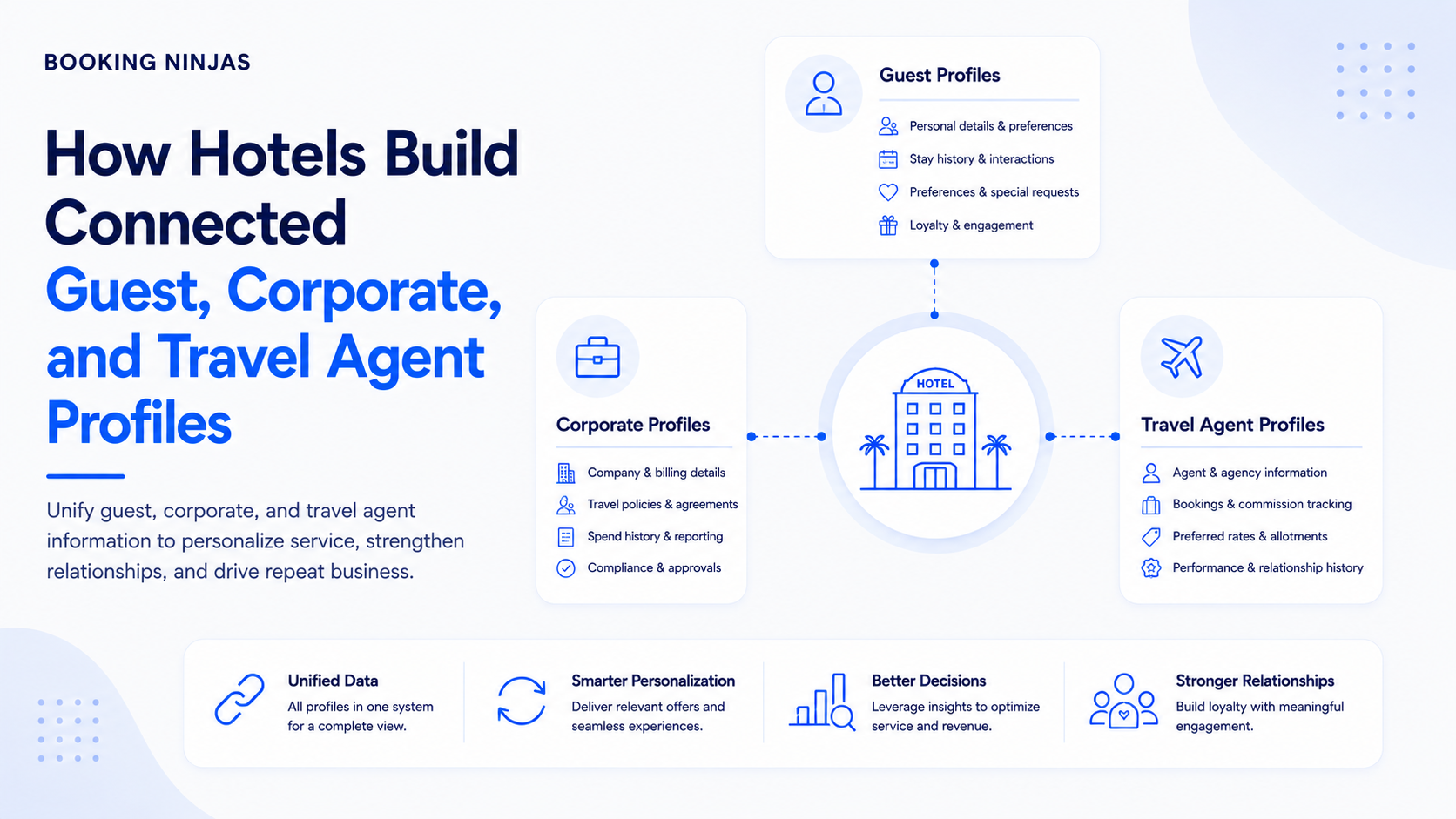
The exact model depends on the hotel, but three relationships appear frequently: the individual guest, the corporate account, and the travel agency or travel partner.
| Profile | Useful context | Connected activity |
|---|---|---|
| Guest | Identity, contact information, communication preferences, explicitly recorded service preferences, and relationship history. | Reservations, stays, payments, requests, services, and relevant communication. |
| Corporate client | Organization information, contacts, commercial terms, negotiated arrangements, and billing requirements. | Employee stays, group activity, rates, invoices, agreements, and account workflows. |
| Travel agency | Agency information, contacts, commercial terms, contracts, and relevant commission arrangements. | Referred reservations, cancellations, commission-related records, and partner activity. |
What belongs in a useful hotel guest profile?
The guest profile should help the hotel understand the relationship across more than one transaction without assuming more about the person than the available data supports.

- Basic identity and contact information
- Reservation and completed-stay history
- Current and upcoming bookings
- Explicitly recorded service preferences
- Relevant requests and service history
- Billing or payment relationships where appropriate
- Communication preferences and permissions
- Relevant customer relationship activity
Booking Ninjas' Reservation Management keeps reservations connected to guest profiles and wider booking activity rather than treating each stay as an unrelated record.
Preferences should come from evidence
A recorded preference is most useful when it comes from something the guest has explicitly requested, selected, or consistently used and the hotel has an appropriate reason to retain it.
Operators should be careful about converting a single interaction into a permanent assumption. A room choice on one trip does not necessarily describe what the guest will want on every future stay.
How is a corporate hotel profile different from a guest profile?
A corporate profile represents a business relationship rather than an individual stay.
The same company may have multiple travelers, contacts, reservations, negotiated arrangements, invoices, and agreements. The hotel therefore needs to preserve the relationship between the organization and the individual activity generated under that account.

- Company identity and account information
- Relevant contacts and roles
- Negotiated rates and conditions
- Billing and invoicing arrangements
- Contracts and account documentation
- Reservation and stay activity
- Group or recurring booking relationships
- Account-level workflow and reporting
Keeping these relationships connected can help reservation, sales, front-office, and finance teams work from consistent commercial context without duplicating the corporate account across separate systems.
What should a hotel track about travel agents and agencies?
Travel agencies and other distribution partners create another type of relationship. The operational question is not simply who the agent is, but how the partner connects to reservations and agreed commercial terms.

- Agency identity and contact information
- Individual agent relationships where needed
- Applicable commercial agreements
- Commission terms where relevant
- Reservation-source relationships
- Booking and cancellation activity
These records can support partner management and reporting, but performance should be evaluated using the hotel's own commercial criteria rather than assuming booking volume alone determines the value of a relationship.
Where should hotel profile data live?
This is where the distinction between PMS and CRM becomes important.
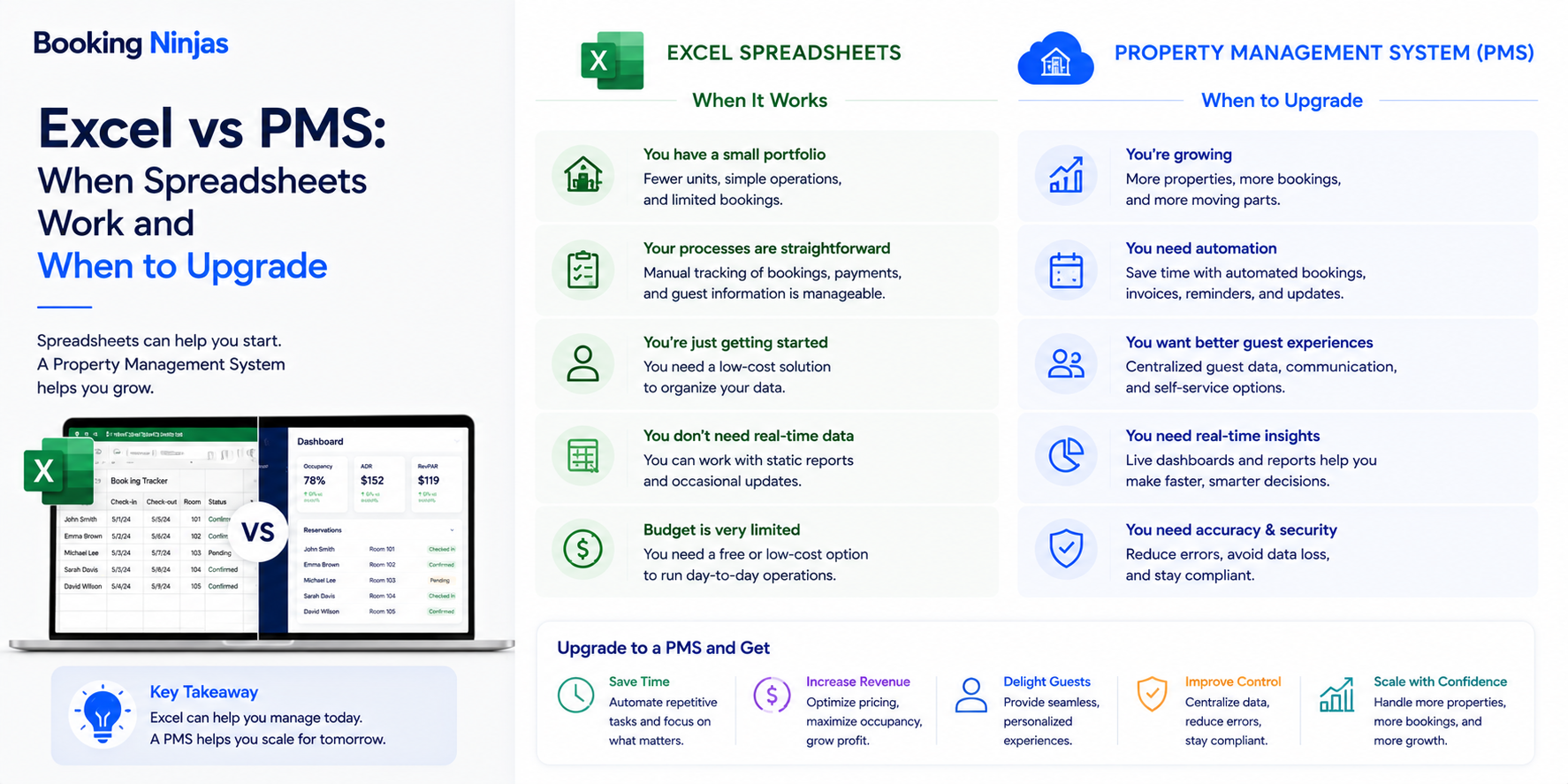
The property management environment manages the stay and related operations. CRM maintains the broader customer or business relationship. Billing systems preserve financial activity, while specialist applications may continue to handle other functions.
When these systems are separate, integrations need to determine which system owns each record and how updates move between them.
Booking Ninjas takes a different architectural approach. It is a Salesforce-native platform for bookings and operations , so reservations and operational activity can use the same broader platform foundation as CRM relationships.
How do connected profiles support hotel operations?
Profile data becomes valuable when it helps a real operational process.
| Process | Useful profile context | Connected operational record |
|---|---|---|
| Reservation | Guest identity, company relationship, agency, and relevant booking history. | Reservation, rate, inventory, dates, and status |
| Guest service | Relevant preferences, previous requests, and current stay context. | Service request, assignment, status, and resolution |
| Corporate billing | Company account, billing arrangement, and appropriate contacts. | Invoice, charge, payment, or financial workflow |
| Partner management | Agency relationship and applicable commercial terms. | Referred reservations and partner activity |
| Reporting | Relationship category and relevant customer history. | Booking, operational, and financial performance records |
How does the guest-facing experience connect to the profile?
A profile should not exist only for staff. Some information and workflows can also be exposed appropriately to the guest through self-service.
Booking Ninjas' Guest Portal connects guest-facing access with bookings, payments, account information, and service requests according to configured permissions and rules.
This creates an important feedback relationship: guest activity in the portal can remain connected to the same operational environment staff use to manage the stay.
How should hotels use profile data for personalization?
Personalization works best when it reduces friction or makes a service more relevant—not when the hotel attempts to infer everything about the guest.
Appropriate examples might include recognizing an explicitly saved communication preference, making a previously requested service easier to arrange, or giving staff access to relevant relationship history when handling a new request.
The profile provides context. Staff and configured workflows decide how that context should be used.
How can hotels understand patterns across profile data?
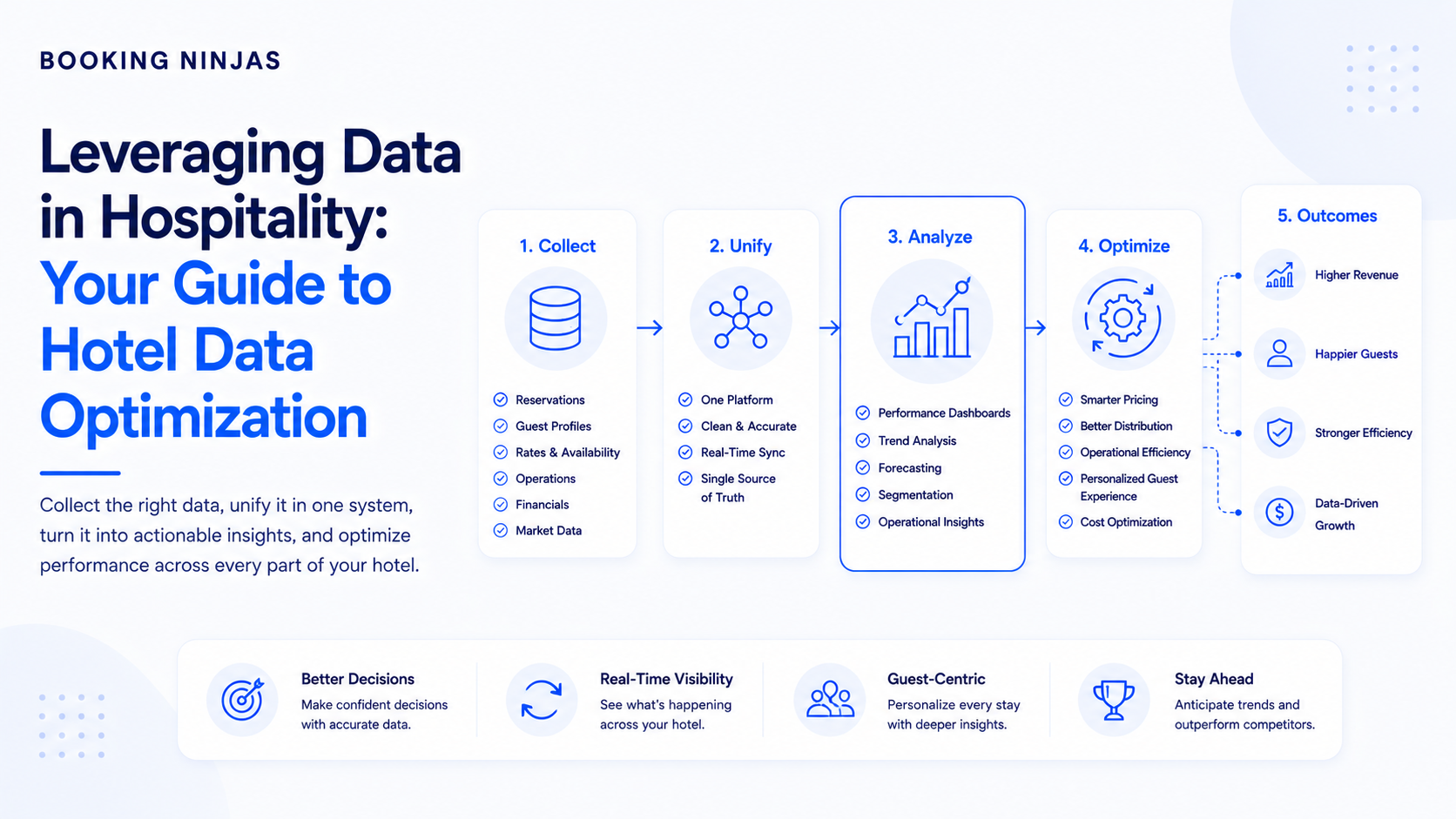
Individual profiles help staff understand one relationship. Aggregated reporting helps management understand patterns across many relationships.
For example, operators may want to examine:
- First-time and returning guest activity
- Booking behavior by customer category
- Corporate account reservation activity
- Travel-partner booking patterns
- Service-request trends
- Relevant transaction and payment activity
- Guest portal usage
- Changes in customer activity over time
Booking Ninjas' Customer Intelligence connects customer profiles with relevant booking, transaction, service, communication, and lifecycle information available within the platform.
Broader Insights capabilities can then support reporting across customer, operational, and financial records.
What makes hotel profile data reliable?
Centralizing records does not automatically make them accurate. Hotels still need clear data-management practices.
Control duplicate profiles
Duplicate guest or company records can fragment history and create inconsistent reporting. Operators need a defined process for identifying and resolving duplicates.
Define which system owns each field
Contact information, reservation status, payment information, consent, rates, and other records should have an understood source rather than several systems maintaining conflicting versions.
Keep important information current
Preferences, contacts, contracts, billing instructions, and other profile information can change. Workflows should allow authorized users to update records when the underlying relationship changes.
Avoid collecting information simply because the system allows it
A larger profile is not automatically a better profile. Hotels should collect and retain information for defined operational, commercial, service, or legal purposes.
How should hotels govern access to profile data?
Not every employee requires access to every piece of information about a guest, corporate customer, or travel partner.
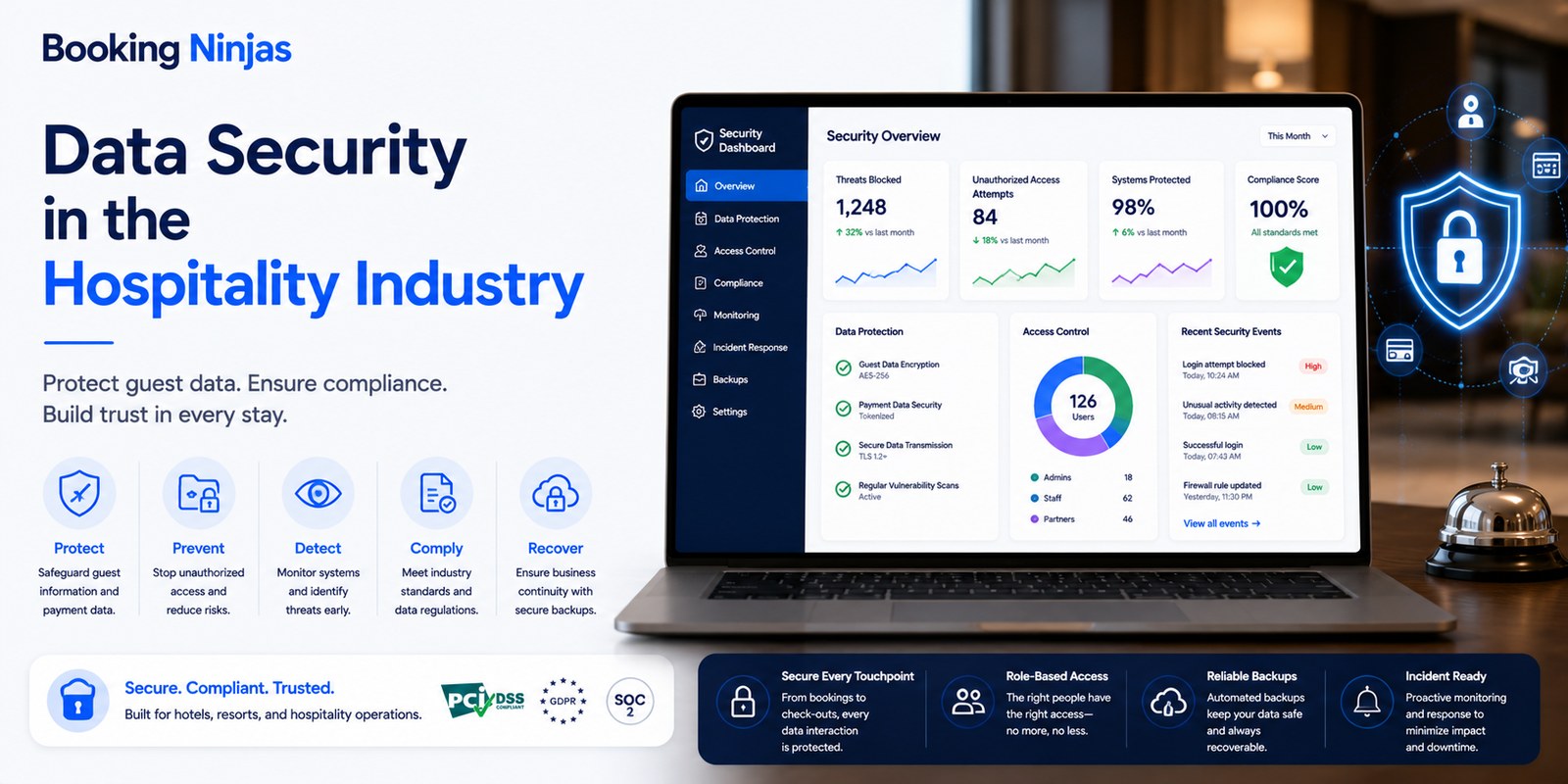
Profile architecture should therefore be designed together with permissions, roles, consent management, auditability, retention practices, and applicable privacy requirements.
For example, an employee who needs operational information to prepare a stay may not need the same access as someone responsible for billing or account management.
Booking Ninjas' Salesforce-native architecture provides a broader platform environment for identity, permissions, workflow, reporting, and governance.
Do hotels need every system to use the same database?
No. Hotels may continue using accounting platforms, payment providers, marketing systems, distribution technology, communication applications, access systems, or other specialist tools.
The key architectural questions are:
- Which system owns each record?
- Which information needs to move?
- When does it need to update?
- Which relationships must be preserved?
- Who is allowed to access the information?
- What happens when synchronization fails?
Booking Ninjas supports connections with external systems through its Integrations layer. The exact data flow depends on the external application, available interfaces, requirements, and implementation scope.
Where can AI fit into hotel profile management?
AI becomes more useful after the hotel has structured the underlying data and relationships.
Depending on the available data and configured use case, AI can support tasks such as summarization, classification, pattern detection, forecasting, prioritization, and recommendations.
Booking Ninjas' AI capabilities operate across booking, operations, billing, insights, portals, and other platform areas.
AI output should still be interpreted in context. A model may identify a pattern in past activity, but that does not make the pattern a fact about what an individual guest wants next.
How should a hotel improve its profile-management model?
- Define the relationships. Identify the guest, corporate, agency, group, or other profiles the hotel actually needs to manage.
- Separate profiles from transactions. Decide which information belongs to the relationship and which belongs to a reservation, payment, request, or other activity.
- Identify the system of record. Determine where each important field originates and which system has authority to update it.
- Connect operational activity. Link reservations, billing, services, agreements, and workflows to the appropriate profile.
- Apply permissions and governance. Define who can view, change, export, or use profile information for each business process.
- Measure usefulness. Review duplicate records, missing fields, staff adoption, workflow exceptions, reporting quality, and other indicators relevant to the hotel's goals.
How does Booking Ninjas connect hotel profiles with operations?
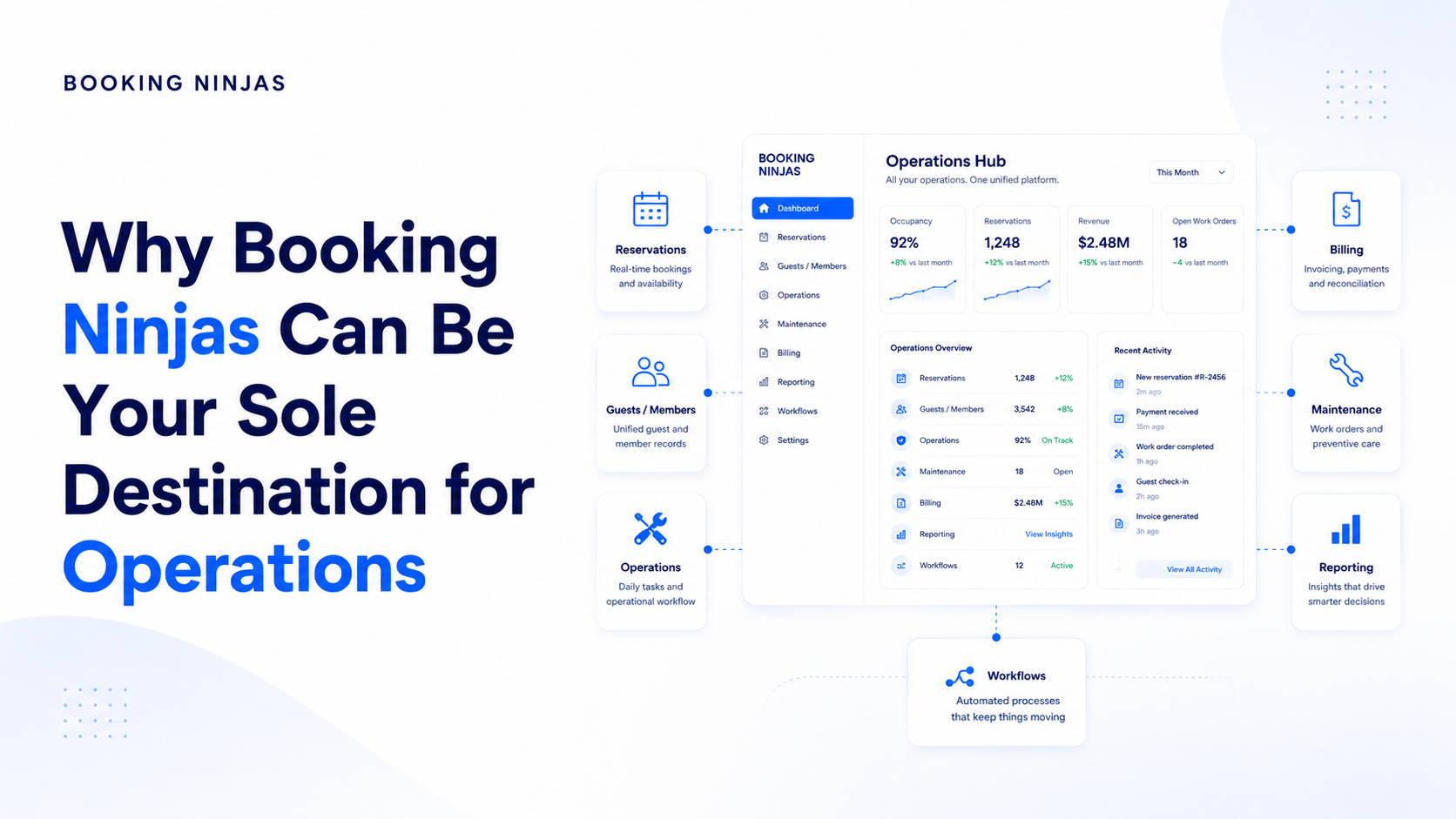
Booking Ninjas is a Salesforce-native platform for bookings and operations . Its Hospitality environment connects reservations, guests, payments, operations, and reporting while using Salesforce as the broader platform foundation.
This allows customer and partner relationships to remain connected with the operational activity created around them rather than forcing the hotel to maintain completely separate PMS and CRM views of the same relationship.
Connect hotel reservations, guests, payments, operations, and reporting.
Explore Hospitality →Keep bookings connected to guests, inventory, dates, rates, and operational status.
Explore Reservation Management →Connect guest-facing bookings, payments, account visibility, and service requests with operations.
Explore Guest Portal →Bring customer, booking, transaction, and service information into structured reporting and analysis.
Explore Customer Intelligence →Connect relevant external financial, communication, distribution, analytics, and operational systems.
Explore Integrations →Connect CRM relationships with permissions, workflows, reporting, automation, AI, and broader platform capabilities.
Explore Salesforce →Frequently asked questions
What is a hotel guest profile?
A hotel guest profile is a structured record representing the hotel's ongoing relationship with a guest. It can connect identity and contact information with relevant reservations, preferences, service activity, payments, communication preferences, and other authorized relationship data.
What is the difference between a guest profile and a reservation?
A guest profile represents the person and the ongoing relationship. A reservation represents a specific booking with dates, inventory, rates, status, and other stay information. One guest profile can therefore be connected to multiple reservations.
Should corporate clients have separate hotel profiles?
Hotels that manage corporate business can maintain organization records that connect relevant contacts, negotiated arrangements, billing requirements, agreements, and booking activity. The exact structure depends on the hotel's corporate operating model.
Can hotels maintain profiles for travel agencies?
Yes. A travel agency or partner profile can connect agency information, contacts, applicable commercial terms, agreements, and relevant reservation activity. The required data depends on how the hotel manages its distribution relationships.
Is a hotel PMS the same as a CRM?
No. A PMS primarily manages reservations and property operations, while CRM manages broader customer and business relationships. The two can be integrated, or hospitality operations can run on a Salesforce-native platform such as Booking Ninjas where CRM and operational records share the same broader platform foundation.
Can AI use hotel guest-profile data?
AI can use appropriately structured and permitted data to support tasks such as summarization, classification, pattern detection, forecasting, and prioritization. Results depend on the available data, configuration, governance, and use case, and predictions should not be treated as certainty about an individual guest.
Connect the relationship to the hotel operation
Bring guest, corporate, and partner records together with reservations, payments, service workflows, reporting, and CRM context in a Salesforce-native operating environment.