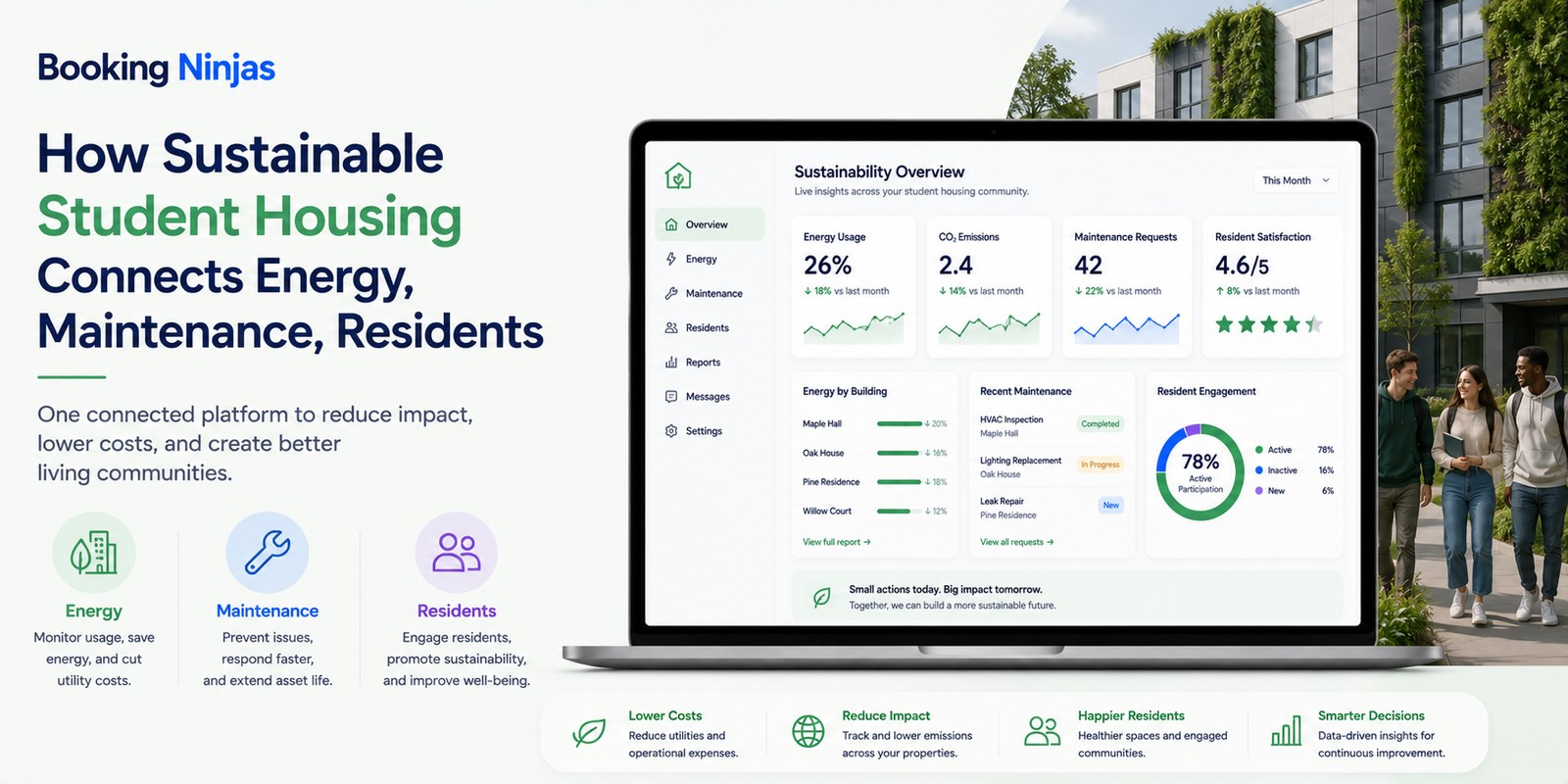
Sustainable student housing is not one technology, building upgrade, or recycling programme. It is an operating approach that connects environmental objectives with the way a housing organisation manages buildings, equipment, utilities, maintenance, inspections, residents, suppliers, and performance data.
Property software does not make a building sustainable by itself. Its role is to help connect the records, workflows, inspections, maintenance activity, communication, and reporting that operators need to manage a sustainability programme.
What is sustainable student housing?
Sustainable student housing is housing operated with defined environmental and resource-management objectives across the building and resident lifecycle.
Depending on the property and its sustainability strategy, areas of focus can include:
- Energy consumption
- Water consumption
- Waste and recycling
- Building and equipment maintenance
- Asset replacement
- Material and procurement choices
- Resident participation
- Operational inspections
- Renewable-energy projects
- Performance and sustainability reporting
The relevant priorities will vary according to the building, location, local requirements, available infrastructure, ownership model, reporting obligations, and financial plan.
What does a student housing sustainability operating model look like?
Choose the environmental or resource objective and define how it will be measured.
Connect the objective with buildings, assets, residents, inspections, maintenance, and daily processes.
Record relevant resource, operational, inspection, and performance information consistently.
Review trends, exceptions, corrective work, and actual results before deciding the next intervention.
Which parts of student housing operations affect sustainability?
| Operational area | What can be managed | Relevant records |
|---|---|---|
| Energy | Consumption, building systems, equipment, upgrades, and operating patterns. | Property, meter or source data, asset, period, usage, target. |
| Water | Consumption, leaks, fixtures, maintenance, and abnormal usage. | Building, reading, issue, work order, inspection. |
| Waste | Collection processes, recycling programmes, contamination, vendor activity, and resident guidance. | Location, waste stream, collection, vendor, issue, period. |
| Assets | Condition, maintenance, repair, replacement, and lifecycle. | Asset, location, inspection, work order, service history. |
| Residents | Communication, guidance, requests, reporting, and participation. | Student, residence, notification, request, activity. |
| Reporting | Targets, measures, trends, corrective actions, and documentation. | KPI, period, property, target, actual value, supporting record. |
How should student housing operators manage energy sustainability?
Energy management should begin by identifying where energy-related information originates and how the organisation intends to use it.
Relevant information can include:
- Property or building
- Reporting period
- Energy source
- Consumption
- Related cost
- Equipment or building system
- Maintenance activity
- Defined target
- Retrofit or improvement project
- Historical performance
Physical interventions can include lighting changes, controls, equipment upgrades, insulation, renewable-energy systems, or other building improvements where they are appropriate for the property.
Those decisions require technical and financial evaluation outside the PMS. The management platform can help preserve the operational records surrounding the decision and its subsequent performance.
How can maintenance data support water and resource management?
Resource use is also connected with property condition.
A leaking fixture, malfunctioning equipment, damaged control, or unresolved building issue can become both a maintenance problem and a sustainability issue.
The useful connection is:
- Issue detected
- Property or room identified
- Request or work order created
- Priority assigned
- Responsible team identified
- Repair or corrective action recorded
- Completion verified
- Recurring pattern reviewed
Booking Ninjas' Work Order Management supports creation, assignment, prioritisation, escalation, status tracking, and historical reporting for maintenance and service work.
What role do inspections play in sustainable student housing?
Inspections provide a structured way to verify conditions that cannot be understood from dashboards alone.
Depending on the housing operation, inspection programmes can cover areas such as:
- Room condition
- Shared-space condition
- Fixtures
- Equipment
- Building-system observations
- Waste or recycling areas
- Turnover condition
- Corrective work
Booking Ninjas' Field Inspection supports scheduled inspections, configurable checklists, documentation, findings, corrective actions, escalation, and inspection history inside Salesforce.
The sustainability value comes from connecting findings to action. An inspection record alone does not improve environmental performance unless the organisation evaluates and resolves the relevant finding.
How does asset maintenance connect with sustainability?
Furniture, appliances, fixtures, mechanical equipment, and other property assets all have operational lifecycles.
Instead of treating replacement as the only response to a problem, operators can maintain history around:
- Asset location
- Condition
- Inspection findings
- Service history
- Repair activity
- Recurring faults
- Replacement decision
- Vendor activity
The appropriate repair, reuse, refurbishment, recycling, or replacement decision depends on the asset, safety considerations, local options, cost, policy, and condition.
A property-management platform can organise the operating history used in that decision without assuming which disposal or procurement choice is environmentally preferable in every situation.
How should student housing operators approach waste and recycling?
Housing operators generally do not need to understand the industrial chemistry of recycling to operate a resident recycling programme.
The more practical property-management questions are:
- Which waste streams are collected?
- Where are collection points located?
- Which materials are accepted locally?
- Who provides collection?
- What schedule applies?
- What instructions do residents need?
- Are contamination or overflow issues being recorded?
- Who owns corrective follow-up?
Requirements vary by local authority, waste provider, property type, and available local infrastructure, so resident guidance should reflect the actual rules that apply to the property.
What role do students play in housing sustainability?
Residents interact with many of the resources being managed, so communication can be part of the sustainability operating model.
Housing teams may need to communicate:
- Recycling instructions
- Waste-collection changes
- Building or utility notices
- Maintenance reporting procedures
- Water or energy initiatives
- Move-in guidance
- Move-out and disposal instructions
- Temporary operational changes
Booking Ninjas' Notification Management can connect rule-driven alerts, updates, recipient controls, communication history, and follow-up workflows with property operations.
Communication should explain the practical action residents need to take rather than assume awareness by itself will change behaviour.
How can a student portal support sustainability operations?
A portal can provide a controlled digital place for relevant resident information and interaction.
Depending on implementation, sustainability-related workflows may connect with:
- Housing notices
- Documents and guidance
- Communication preferences
- Resident requests
- Maintenance reporting
- Account information
- Forms
- Property updates
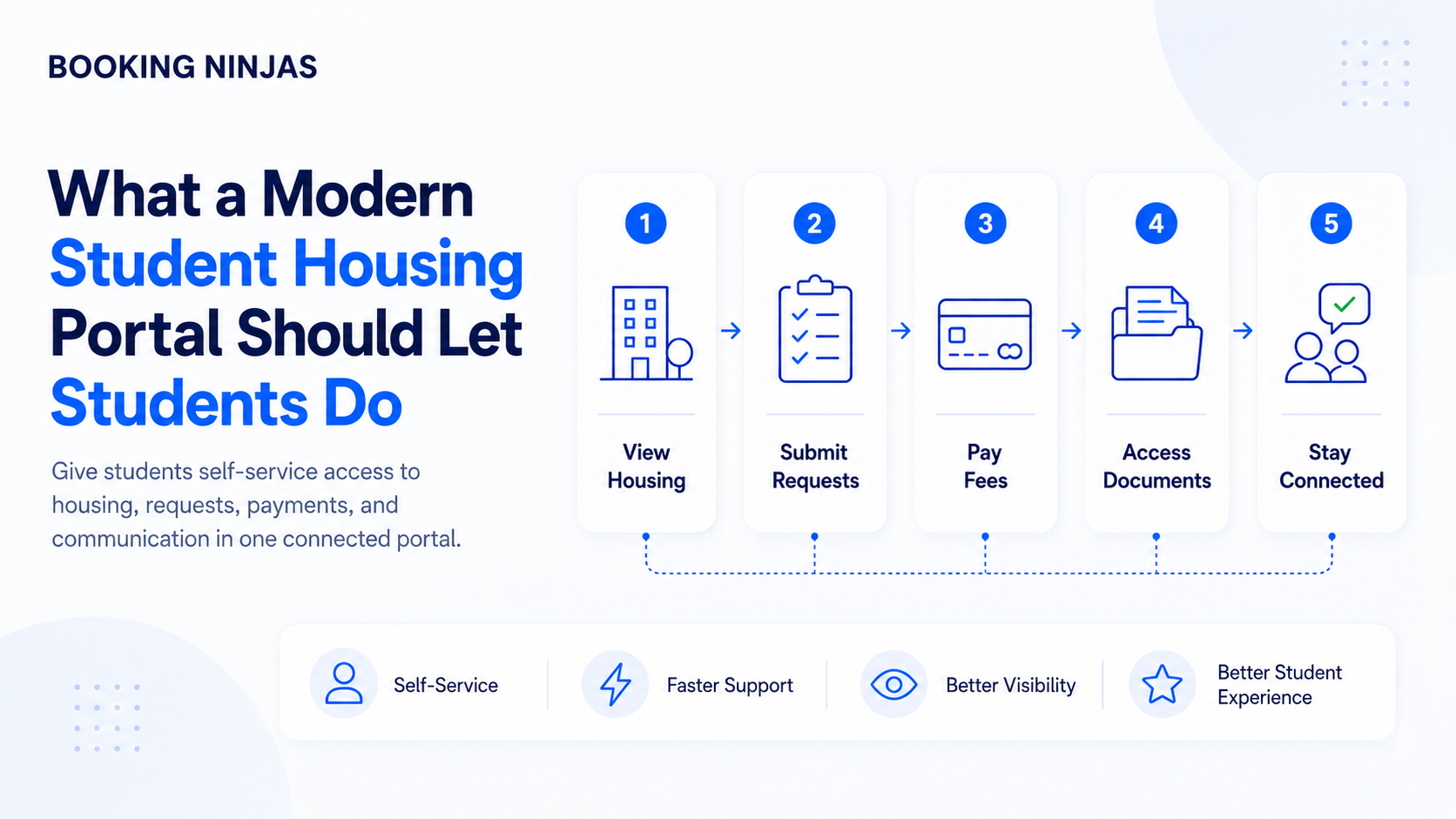
Booking Ninjas' Student Portal provides role-based student access to records, documents, communication, payments, forms, and configured self-service workflows inside Salesforce.
How do smart meters, sensors, solar systems, and building technology fit in?
Property-management software and physical building technology have different responsibilities.
External systems may generate information from:
- Utility meters
- Smart meters
- Energy-management systems
- Building sensors
- Solar or other generation systems
- Environmental controls
- Waste-management providers
- Other specialist infrastructure
When that information is required inside the property-management environment, the operator should determine whether the external system provides a suitable API, export, middleware connection, or other integration method.
Booking Ninjas' API Integration can provide an integration layer where external systems expose suitable interfaces and the connection is included in the implementation scope.
What should student housing operators measure?
Sustainability reporting should begin with clearly defined metrics, data sources, periods, and ownership.
| Measurement area | Example information | Important context |
|---|---|---|
| Energy | Consumption by period, property, building, or defined source. | Measurement basis and source should remain consistent. |
| Water | Consumption and unusual usage patterns where data exists. | Occupancy and building changes may affect comparisons. |
| Waste | Recorded collection, waste-stream, or recycling information. | Availability depends on the waste provider and local process. |
| Maintenance | Sustainability-related work orders, issues, and completion. | Operational records show action, not necessarily environmental impact by themselves. |
| Inspections | Findings, repeat issues, corrective actions, and remediation. | Inspection criteria should be clearly defined. |
| Targets | Property-defined sustainability KPI versus actual result. | Targets need an agreed baseline and reporting period. |
How can sustainability performance be reported?
Once relevant data exists, sustainability measures can be organized alongside other operational KPIs.
Booking Ninjas' Performance Reporting supports structured sustainability and ESG performance tracking within Salesforce, including energy and resource measures, sustainability KPIs, carbon-reduction monitoring, reporting periods, and supporting documentation.
The organisation still needs to define the reporting methodology, source data, calculation rules, baselines, targets, and any external standard or regulatory requirement that applies.
Booking Ninjas should therefore be viewed as the system used to structure and report configured operational information—not as an automatic certification, carbon-accounting authority, or guarantee of compliance.
Why should sustainability data connect with wider housing operations?
Environmental performance often needs operational context.
For example, a change in resource use may need to be reviewed alongside:
- Occupancy
- Building or location
- Academic term
- Maintenance history
- Asset changes
- Inspection findings
- Capital improvements
- Resident activity
Booking Ninjas' Custom Dashboards can provide role-based views across configured operational and performance information inside Salesforce.
Connecting this context can help teams investigate why a metric changed instead of reading the metric in isolation.
Can AI support sustainability management in student housing?
AI can support analysis when relevant, structured data exists.
Potential applications can include:
- Trend detection
- Anomaly identification
- Inspection-pattern analysis
- Recurring maintenance-pattern detection
- Performance summarisation
- Operational prioritisation
AI should not be treated as a substitute for reliable meter data, engineering analysis, environmental methodology, inspection, maintenance, or human review.
A model may help surface a pattern, but the organisation still needs to determine what the pattern means and whether corrective action is appropriate.
How should student housing operators build a sustainability-management process?
- Define the objective. Identify what the organisation wants to measure or improve instead of beginning with a technology purchase.
- Define the measurement. Establish the KPI, unit, baseline, reporting period, target, and calculation method.
- Identify the source data. Determine whether the information comes from utility data, building systems, operational records, vendors, inspections, or another source.
- Connect the property context. Relate the data to the correct building, room, asset, location, occupancy period, or other relevant operational record.
- Assign responsibility. Define who owns monitoring, inspection, maintenance, resident communication, reporting, and corrective action.
- Create operational workflows. Connect findings and exceptions with work orders, inspections, notifications, approvals, or other required follow-up.
- Communicate with residents where relevant. Provide practical instructions and updates for the parts of the sustainability programme that require resident participation.
- Report consistently. Compare performance using the same definitions and data basis across reporting periods.
- Review and adjust. Use the resulting evidence to determine whether operational, maintenance, capital, or communication changes should be made.
How can Booking Ninjas support sustainable student housing operations?
Booking Ninjas is a Salesforce-native platform for bookings and operations . Student housing records, rooms and beds, residents, maintenance, inspections, communication, workflows, reporting, and configured sustainability measures can therefore operate within the broader Salesforce environment.
Booking Ninjas does not make a building environmentally sustainable on its own. It provides an operating and reporting foundation that can connect sustainability-related information with the property activity around it.
Connect buildings, units, rooms, beds, students, assignments, maintenance, inspections, and housing operations.
Explore Student Housing →Structure operational and sustainability KPIs, resource measures, targets, trends, and supporting reporting records.
Explore Performance Reporting →Connect resource or building issues with assigned maintenance, escalation, status, and service history.
Explore Work Order Management →Capture inspections, findings, documentation, corrective actions, and remediation history.
Explore Field Inspection →Connect property events and sustainability workflows with student and staff communication.
Explore Notification Management →Give students controlled access to information, documents, forms, communication, and configured self-service activity.
Explore Student Portal →Build role-specific views across configured housing, operational, and sustainability performance data.
Explore Custom Dashboards →Connect external building, utility, or specialist systems where appropriate interfaces and implementation scope allow.
Explore API Integration →Frequently asked questions
What is sustainable student housing?
Sustainable student housing is housing operated with defined environmental and resource-management objectives across areas such as energy, water, waste, assets, maintenance, resident participation, inspections, and performance reporting. The exact priorities depend on the property and its sustainability strategy.
Is sustainable student housing only about renewable energy?
No. Renewable energy can be one part of a sustainability strategy, but sustainable housing can also involve resource consumption, maintenance, asset lifecycle, waste, water, inspections, procurement, resident communication, and performance measurement.
Can property management software make student housing sustainable?
Property management software does not make a building sustainable by itself. It can help connect property data, maintenance, inspections, communication, workflows, measurements, and reporting used to manage a sustainability programme.
Can student housing software track sustainability KPIs?
Booking Ninjas Performance Reporting can support configured sustainability and ESG performance measures, including energy and resource tracking, sustainability KPIs, carbon-reduction monitoring, trends, and supporting reporting records. Reliable reporting still depends on appropriate source data, definitions, and calculation methods.
Can maintenance support student housing sustainability?
Yes. Maintenance records can help operators identify, assign, and resolve building or equipment issues that may affect resource usage or sustainability objectives. The environmental impact of a particular repair still depends on the issue and property context.
Can smart meters or building sensors connect to a PMS?
They can when the external system provides an appropriate interface and the connection is included in the implementation. Booking Ninjas can support API and middleware-based integrations, but exact compatibility depends on the building technology and its available integration methods.
Can AI improve sustainability reporting automatically?
AI can support trend detection, anomaly identification, summarisation, and analysis where relevant data exists. It does not replace reliable source data, environmental methodology, engineering analysis, or human review.
Is Booking Ninjas student housing software built on Salesforce?
Yes. Booking Ninjas is Salesforce-native, allowing student housing records, maintenance, inspections, resident communication, workflows, reporting, automation, and integrations to use the broader Salesforce platform foundation.
Connect sustainability goals to daily housing operations
See how Booking Ninjas can connect student housing records, maintenance, inspections, communication, sustainability KPIs, reporting, and external-system integrations within one Salesforce-native operating environment.
.jpg)