Modern hospitality operations depend on more than reservations and check-in. Customer records, payments, service requests, housekeeping, workflows, reporting, and external systems all contribute to how a property operates.
Where can a traditional standalone PMS become limiting?
A standalone property management system can manage reservations, rooms, arrivals, departures, and other important hotel processes effectively.
The architectural challenge appears when the organisation also depends on separate CRM, billing, service, marketing, reporting, accounting, or operational systems.
- Customer and reservation records live in different systems
- Service history is separated from CRM context
- Payments require reconciliation across platforms
- Workflows depend on manual system-to-system handoffs
- Reporting requires data from multiple applications
- New operating requirements create additional integrations
None of these problems means a standalone PMS is automatically the wrong architecture. Some organisations can operate effectively with a separate PMS and CRM connected through integrations.
The important question is how much operational context needs to move between those systems and how difficult those relationships become to maintain as the business changes.
Is Salesforce itself a property management system?
No. Salesforce is a platform with CRM, data, workflow, automation, security, reporting, and application capabilities. It does not become a hospitality PMS simply because a hotel uses Salesforce for customer relationships.
A Salesforce-native property management application adds the hospitality-specific operating layer: reservations, availability, check-in and check-out, billing, housekeeping, requests, and other property workflows.
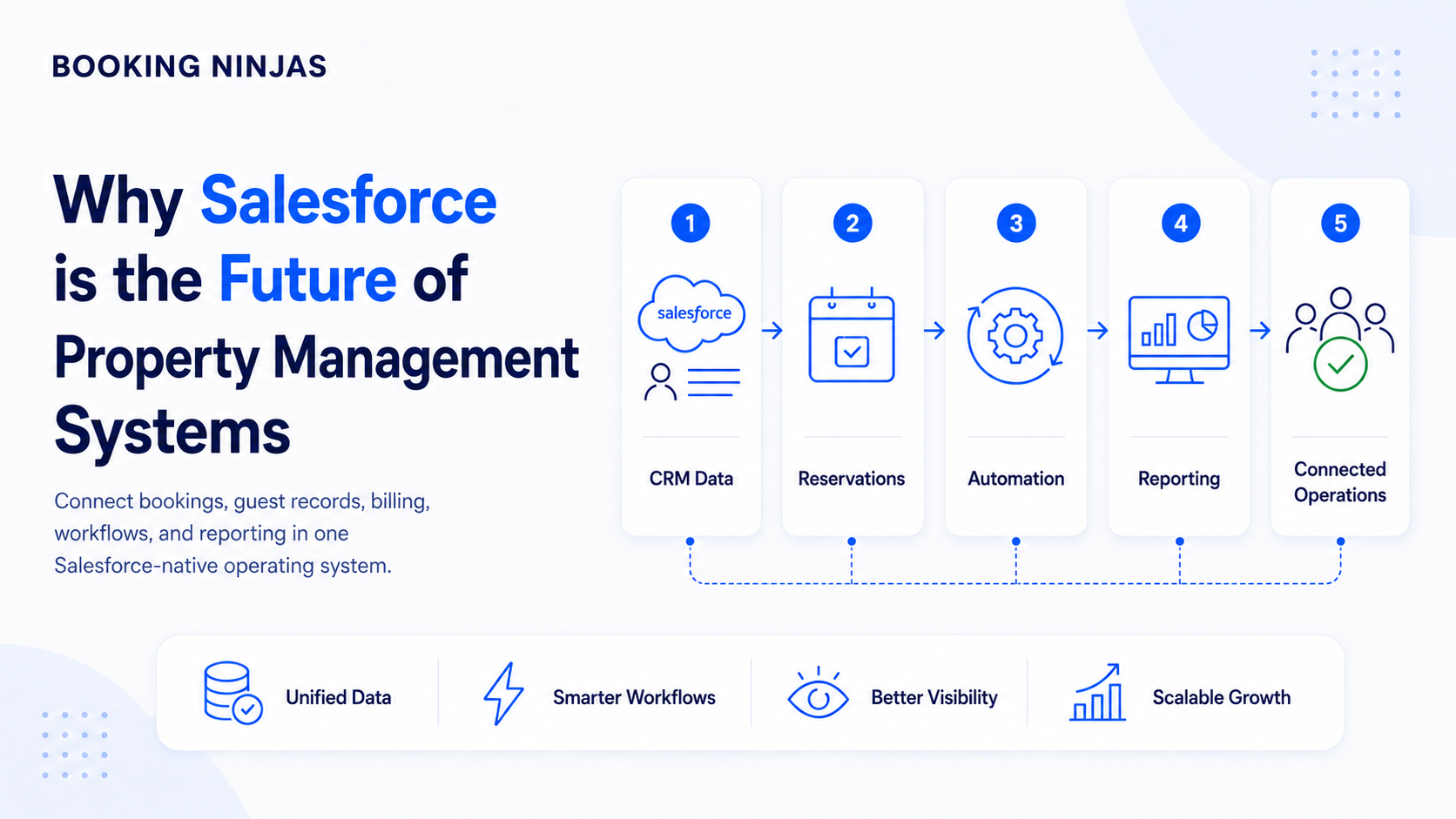
What changes when property operations run on Salesforce?
Maintain the person, company, relationship, and relevant CRM context.
Connect reservations, dates, inventory, rates, and operational status to that relationship.
Connect requests, housekeeping, work, billing, and other property activity.
Apply shared relationships, permissions, workflows, reporting, automation, and integrations.
Booking Ninjas is a Salesforce-native platform for bookings and operations . Its hospitality applications use Salesforce as part of the underlying architecture rather than treating Salesforce as an external CRM that receives a limited copy of PMS data.
Why does native CRM context matter?
A reservation describes a stay. CRM describes a broader relationship. The same customer may have multiple bookings, service interactions, company relationships, requests, payments, or other history over time.
When the reservation and CRM environments share the same platform foundation, operators can preserve more of those relationships without relying on a separate synchronisation process for every interaction.
That does not mean every employee should see every piece of customer information. Permissions and operational roles still determine which information is appropriate for each user.
Which hospitality processes benefit from being connected?
| Process | What should stay connected | Booking Ninjas capability |
|---|---|---|
| Reservations | Customer, dates, inventory, rate, status, and booking history. | Reservation Management |
| Availability | Inventory, capacity, restrictions, dates, and reservable resources. | Availability Management |
| Arrival and departure | Reservation, guest record, room status, payments, and related operational requirements. | Check-In / Check-Out |
| Housekeeping | Property, room, occupancy status, assignments, and cleaning workflow. | Housekeeping |
| Service requests | Guest, booking, property, request type, status, ownership, and resolution process. | Request Management |
| Billing | Charges, payments, balances, customer, booking, and financial context. | Billing & Payment |
What does cloud architecture change for hospitality?
A cloud-based operating model moves application infrastructure away from a property-managed local server environment and allows authorised users to access the system through supported connected devices.
For multi-property organisations, this can make it easier to operate from a shared platform instead of maintaining completely separate installations at each property.
Cloud architecture should not be interpreted as a guarantee of unlimited scale, uninterrupted availability, or security by itself. User access, permissions, integrations, implementation, governance, and operational practices still matter.
Why does configurability matter as hospitality operations change?
Properties rarely operate exactly the same way forever. They may add locations, accommodation types, services, approval processes, customer segments, integrations, or internal reporting requirements.
A Salesforce-native architecture gives Booking Ninjas access to a broader application platform where records, fields, relationships, permissions, workflows, and application logic can be configured around operational requirements.
This does not mean unlimited customisation. Significant new requirements can still require design, implementation, integration, testing, and ongoing management.
Where does workflow automation fit?
Connected data becomes more useful when the next operational step can also be structured.
For example, a status change may assign work, an exception may require approval, a service request may be routed to an appropriate team, or a completed task may move a process to its next stage.
Booking Ninjas' Workflow & Process Management supports these repeatable operational processes within the broader platform.
The role of automation is to execute defined steps. Policies, important exceptions, and higher-consequence decisions can remain under human control.
How does connected data improve reporting?
Reporting becomes more difficult when customer, booking, service, operational, and financial information come from unrelated systems.
Bringing relevant records into a connected environment can make it easier to examine relationships such as:
- Reservation and occupancy activity
- Customer and account history
- Payment and billing activity
- Service-request patterns
- Operational workflow status
- Property or portfolio performance
Booking Ninjas' Insights capabilities provide reporting and decision-support tools around information available within the operating environment.
Does a Salesforce-native PMS eliminate integrations?
No. Hotels and other hospitality operators can still depend on payment providers, accounting systems, ERP platforms, distribution channels, access systems, revenue tools, communication platforms, and other specialist applications.
The purpose of native architecture is not to force every function into one application. It is to provide a clearer operational foundation while allowing required external systems to connect through integrations .
The exact integrations available depend on the external system, supported interfaces, required data flows, and implementation scope.
What about accounting and back-office systems?
Property operations generate financial activity, but that does not mean a hospitality operating platform should automatically replace a dedicated general ledger, ERP, or statutory accounting system.
Booking Ninjas can manage operational billing, payments, balances, reconciliation, and related financial records while connecting to external accounting systems or ERP platforms where appropriate.
The correct architecture depends on which system owns each financial process and what information needs to move between them.
How does Booking Ninjas use Salesforce for hospitality?
Booking Ninjas is built natively on Salesforce as a platform for bookings and operations. Its Hospitality solutions add operational functionality around reservations, availability, arrivals and departures, payments, housekeeping, requests, workflows, reporting, and related processes.
The Salesforce-native foundation means these operational records can use the same broader platform concepts for data relationships, permissions, workflow, reporting, integrations, and application development.
Connect reservations, property operations, billing, service, and reporting.
Explore Hospitality →Apply the platform to hotel reservations, front-office workflows, rooms, payments, and operations.
Explore Hotel Management →Connect reservations to customers, inventory, rates, and operating status.
Explore Reservation Management →Structure service requests, tasks, approvals, and repeatable property workflows.
Explore Workflow & Process →Connect external financial, operational, distribution, and specialist systems where required.
Explore Integrations →Use Salesforce data relationships, permissions, workflows, reporting, integrations, and extensibility as the underlying platform.
Explore Salesforce DNA →When does Salesforce-native architecture make sense?
It becomes particularly relevant when the organisation wants CRM and property operations to share more context or expects its operating requirements to evolve substantially over time.
- Salesforce is already an important business platform
- CRM and PMS data need deeper relationships
- Multiple teams depend on the same operational records
- Workflows cross customer and property operations
- The business expects significant configuration over time
- Several properties or business functions need a shared platform
Other organisations may prefer to maintain an existing PMS and integrate it with Salesforce. The better architecture depends on current systems, workflows, integration requirements, migration complexity, and long-term operating needs.
Frequently asked questions
Is Salesforce a property management system?
No. Salesforce is a CRM and application platform rather than a hospitality PMS by itself. Salesforce-native applications such as Booking Ninjas add reservations, availability, billing, housekeeping, service workflows, and other property-management functionality on top of the Salesforce platform.
What is a Salesforce-native property management system?
A Salesforce-native property management system runs its operational application on the Salesforce platform itself rather than operating as a completely separate PMS that only exchanges selected information with Salesforce.
Does a Salesforce-native PMS still need integrations?
Yes. External accounting, ERP, payment, distribution, access, communication, and other specialist systems can remain part of the architecture. The exact integrations depend on the systems involved and the required data flows.
Is Booking Ninjas built on Salesforce?
Yes. Booking Ninjas is a Salesforce-native platform for bookings and operations, allowing customer, reservation, billing, workflow, and other operational records to use the broader Salesforce platform foundation.
Should every hotel replace its existing PMS with a Salesforce-native system?
No. Some organisations may be better served by integrating their existing PMS with Salesforce, while others may benefit from running more operations on a Salesforce-native platform. The decision depends on existing systems, workflows, integrations, migration requirements, and long-term operating needs.
Connect CRM and hospitality operations on one platform foundation
Bring customers, reservations, payments, service workflows, reporting, and integrations into a Salesforce-native operating environment designed to evolve with the organisation.