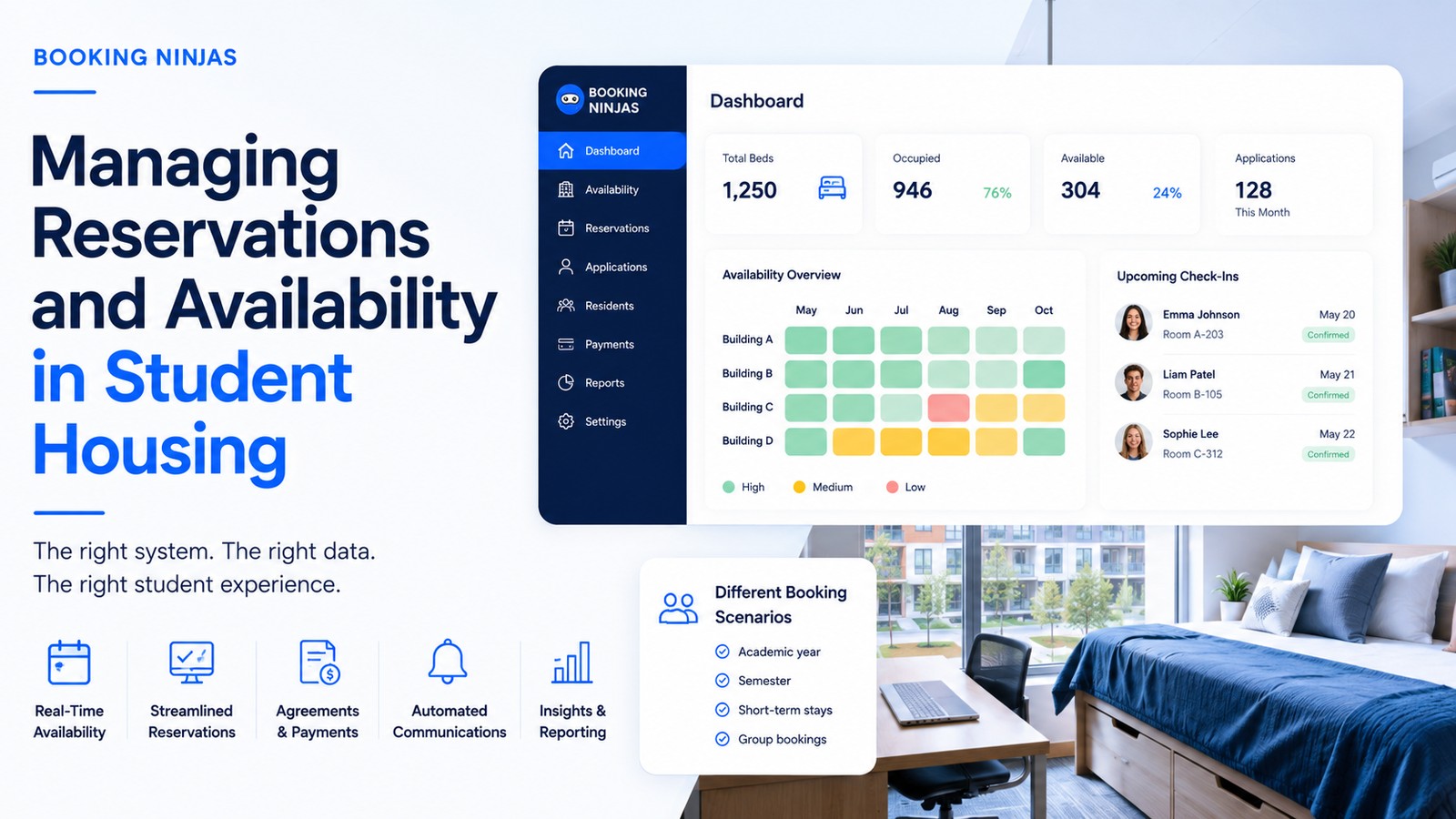
Student housing availability is more complicated than simply counting vacant apartments. Operators may need to manage buildings, units, shared rooms, individual beds, academic terms, student assignments, move-in and move-out dates, maintenance, and upcoming leasing cycles at the same time.
The objective is not simply to fill every bed. Operators need to understand which inventory is actually available, for which term, to which student, and under which housing rules before committing that space.
Why is student housing availability different from traditional rentals?
Traditional residential leasing often focuses on an entire unit and a relatively long lease period. Student housing can introduce additional layers.
- Buildings containing multiple units
- Units containing multiple rooms
- Shared rooms containing individual beds
- Academic-year and semester-based terms
- Program-specific housing periods
- High-volume move-in and move-out cycles
- Student-to-bed assignments
- Turnover and maintenance between assignments
Booking Ninjas' Student Housing solution supports buildings, units, rooms, individual beds, academic-term leasing, student assignments, maintenance, and multi-property housing operations.
What needs to connect in a student housing occupancy model?
Defines the relevant housing period, dates, programme, or leasing cycle.
Defines the property, building, unit, room, and bed that can be assigned.
Records the student's housing commitment and applicable dates or term.
Connects the student to the actual room or bed used during that housing period.
What is the difference between a reservation, availability, and an assignment?
| Record | What it answers | Example |
|---|---|---|
| Availability | Can this room, bed, or other housing inventory be allocated for the required period? | Bed B is available for the Autumn term. |
| Reservation or lease | What housing commitment exists for the student and for what dates or academic term? | A student has housing for the Autumn and Spring terms. |
| Assignment | Which specific building, unit, room, or bed has been allocated to the student? | The student is assigned to Building A, Room 204, Bed B. |
| Occupancy | How much available housing inventory is assigned or occupied for the relevant period? | Occupancy can be reviewed by property, building, room, bed, or term. |
Keeping these concepts separate prevents the housing team from treating every reservation, assignment, and available bed as the same type of record.
How should student housing availability be managed?
Availability should describe which housing inventory can actually be allocated during a defined period.
Booking Ninjas' Availability Management connects available inventory with dates, rules, restrictions, capacity, bookings, and operational changes.
In student housing, that availability model can be applied to buildings, units, rooms, beds, and academic housing periods according to the configured structure.
New commitments reduce future availability
When a room or bed is committed for a term, the relevant inventory should no longer appear available for an overlapping assignment.
Cancellations may reopen inventory
When a reservation, lease, or assignment is cancelled, the affected space may become available again after any applicable rules, approvals, or operational conditions are considered.
Maintenance can temporarily remove inventory
A vacant bed is not necessarily ready for reassignment. Maintenance, inspections, room preparation, damage, or other operational work can affect whether the space should be released.
Why should availability connect to academic terms?
Student housing demand and occupancy often follow institutional calendars rather than a generic monthly rental cycle.
A housing operator may need to distinguish between:
- Academic-year housing
- Autumn or Spring semester housing
- Summer housing
- Short academic programmes
- Internship or special-program housing
- Break or transition periods
The same physical bed can therefore have different availability across different periods.
Booking Ninjas' Student Housing solution supports academic-year, semester-based, and programme-based leasing so housing records can be structured around the periods the organisation actually manages.
Why does bed-level inventory matter?
Unit-level occupancy can hide unused capacity inside shared student accommodation.
For example, a four-bedroom apartment may appear occupied because students already live there even though one room or one bed remains available.
A bed-level model lets the operator preserve the hierarchy between the property, building, unit, room, and individual bed.

How should student housing reservations and leases connect to availability?
Availability tells the team what can be allocated. The reservation or lease records the commitment that consumes that availability.
Booking Ninjas' Reservation Management provides a structured environment for creating, modifying, tracking, and cancelling reservation records while keeping them connected with inventory and availability.
Student housing adds its own operating context around those records, including terms, assignments, move-in and move-out cycles, student profiles, and bed-level inventory.
This becomes especially important when a student changes rooms, changes terms, withdraws, arrives late, or requires another adjustment that affects future housing availability.
Why should the student assignment remain separate from the lease?
A student can have a valid housing commitment while the exact room or bed assignment is still being finalised.
Separating the commitment from the physical assignment gives housing teams more flexibility when planning inventory.
It also makes changes easier to understand. Moving a student from one bed to another should update the assignment without making the organisation lose the underlying housing relationship or term history.
- Student profile
- Housing term
- Lease or reservation
- Property and building
- Unit and room
- Individual bed
- Assignment status
- Move-in and move-out history
How can pre-leasing data help housing teams plan occupancy?
Pre-leasing gives the operator visibility into future commitments before the academic term begins.
Instead of looking only at current physical occupancy, managers can compare future availability with reservations, leases, assignments, cancellations, and housing inventory for the upcoming term.
Useful questions include:
- How many beds exist for the term?
- How many have housing commitments?
- How many have final assignments?
- Which buildings still have availability?
- Where are unassigned commitments concentrated?
- Which cancellations have reopened inventory?
This information supports planning. It does not guarantee that a particular pre-letting strategy will produce a specific occupancy rate.
How do move-ins and move-outs affect availability?
Student housing often concentrates a large amount of operational activity into a short transition period.
A bed moving from one student to another can require several connected steps:
- End the outgoing assignment. Record the student's departure and release the previous housing relationship appropriately.
- Inspect the room or bed. Confirm its condition and identify any work required before reassignment.
- Complete turnover work. Coordinate cleaning, maintenance, repairs, or room preparation.
- Confirm readiness. Ensure the space can actually be used before treating it as ready for the incoming resident.
- Activate the new assignment. Connect the incoming student with the correct room or bed for the relevant term.
Why should maintenance connect to housing availability?
Maintenance is not only a facilities workflow. It can also affect whether housing inventory can be assigned.
Booking Ninjas' Work Order Management connects maintenance and service tasks with assignments, status, priorities, locations, and operational reporting.
When work affects a room or bed, housing teams need to understand whether that inventory remains usable, requires temporary restriction, or is ready to return to the available pool.
How should housing terms connect with billing?
Student housing commitments frequently create financial activity across defined academic periods.
The billing model may involve deposits, instalments, recurring charges, fees, adjustments, refunds, or other arrangements depending on the organisation.
Booking Ninjas' Billing & Payment capabilities connect billing and payment activity with the relevant customer and operating records.
The exact payment schedule should reflect the institution's policies and financial model rather than assuming every student housing operation follows the same semester billing structure.
How should occupancy be managed across multiple residence halls?
A portfolio-level number can tell management how much housing is in use, but it may hide important differences between buildings, programmes, inventory types, or academic terms.
Operators may need to compare:
- Property-level occupancy
- Residence-hall occupancy
- Unit and room utilisation
- Bed-level availability
- Occupancy by academic term
- Assignment status by location
- Upcoming move-out volume
- Inventory temporarily unavailable for turnover
Booking Ninjas supports single-property and multi-property student housing operations so these records can remain connected while preserving the individual housing structure of each location.
What should student housing teams measure?
Occupancy itself is useful, but it becomes more informative when the team understands the records behind the percentage.
| Question | Possible measure | Required context |
|---|---|---|
| How much inventory is committed? | Reserved or leased beds relative to available beds. | Academic term, property, inventory level, status. |
| How much inventory is assigned? | Students with completed room or bed assignments. | Student, term, building, room, bed, assignment status. |
| Where are future gaps? | Available beds for upcoming terms. | Future dates, leases, holds, restrictions, cancellations. |
| What is not ready? | Beds or rooms awaiting maintenance, inspection, or turnover. | Work status, location, availability status, assignment date. |
| How much transition work is coming? | Upcoming move-ins, move-outs, and assignment changes. | Academic term, dates, property, assignment status. |
Booking Ninjas' Insights capabilities can support reporting across relevant housing, customer, operational, and financial records.
Does better reservation management guarantee higher occupancy?
No. Demand still depends on factors such as location, enrolment, housing supply, pricing, property quality, student preferences, institutional policies, competition, and the market being served.
What connected reservation and availability management can do is give operators a clearer operational picture of:
- What inventory exists
- What inventory is actually available
- What has already been committed
- Which students still need assignments
- Where future vacancy gaps exist
- Which inventory is blocked by operational work
That visibility can support better housing decisions without treating software as a guarantee of occupancy or financial performance.
Why does a Salesforce-native student housing model matter?
Student housing creates relationships between students, housing inventory, academic terms, assignments, payments, maintenance, and operational workflows.
Booking Ninjas runs student housing operations on Salesforce, which allows these records to use the same broader platform foundation rather than maintaining housing activity in an unrelated database.
The Salesforce-native foundation provides the broader data, workflow, permission, automation, reporting, and integration environment around those housing relationships.
How should a student housing operator improve availability management?
- Define the inventory hierarchy. Map properties, buildings, units, rooms, and individual beds at the level the organisation actually assigns.
- Define the academic periods. Establish academic years, semesters, programmes, or other housing terms that affect availability.
- Separate commitments from assignments. Define when a student has secured housing and when a specific bed has been assigned.
- Connect changes to availability. Make sure cancellations, transfers, extensions, restrictions, and other changes affect the correct inventory.
- Connect turnover operations. Include inspections, maintenance, room readiness, and other work required before inventory is released.
- Report by the right level. Review occupancy and availability by term, property, room, bed, assignment status, and other dimensions relevant to management.
How does Booking Ninjas connect student housing occupancy operations?
Booking Ninjas is a Salesforce-native platform for bookings and operations . Its Student Housing solution connects housing inventory, academic terms, student assignments, maintenance, and operational visibility within the same broader platform foundation.
This allows the organisation to manage the relationship between the student and the housing inventory rather than treating occupancy as an isolated spreadsheet or reporting number.
Manage buildings, units, rooms, beds, academic-term leasing, student assignments, maintenance, and housing operations.
Explore Student Housing →Maintain availability, capacity, dates, restrictions, and inventory rules around housing resources.
Explore Availability Management →Keep housing commitments connected with dates, inventory, status, changes, and operational records.
Explore Reservation Management →Connect maintenance and turnover activity with the locations and housing inventory affected.
Explore Work Order Management →Connect student and housing records with applicable billing, payment, balance, and financial workflows.
Explore Billing & Payment →Report across relevant occupancy, assignment, operational, customer, and financial information.
Explore Insights →Frequently asked questions
What is student housing availability management?
Student housing availability management is the process of tracking which buildings, units, rooms, or individual beds can be allocated during a defined academic or housing period while accounting for existing commitments, assignments, restrictions, and operational conditions.
Can student housing software manage individual beds?
Yes. Booking Ninjas supports buildings, units, rooms, individual beds, and student assignments, allowing housing operations to manage inventory at bed level where required.
Does Booking Ninjas support academic-term leasing?
Yes. Booking Ninjas supports academic-year, semester-based, and programme-based student housing leases. The exact term structure can be configured around the organisation's housing model.
What is the difference between a housing reservation and a bed assignment?
A reservation or lease represents the student's housing commitment for a defined period. A bed assignment identifies the specific room or bed allocated to that student. Keeping the two records connected but distinct makes changes and housing planning easier to manage.
Can maintenance affect student housing availability?
Yes. A vacant room or bed may still be unavailable if inspection, maintenance, cleaning, repair, or other turnover work is required. Availability should therefore reflect operational readiness as well as existing housing commitments.
Does reservation software guarantee higher student housing occupancy?
No. Occupancy depends on demand, enrolment, location, pricing, housing supply, property quality, competition, institutional policies, and other market factors. Connected reservation and availability management can give operators clearer information for planning and housing decisions.
Can Booking Ninjas manage multiple student housing properties?
Yes. Booking Ninjas supports both single-property and multi-property student housing operations with centralised visibility across housing inventory, assignments, maintenance, and related operational records.
Connect every bed to the housing lifecycle
Bring academic terms, rooms, beds, reservations, assignments, billing, maintenance, turnover, and occupancy visibility into a Salesforce-native student housing environment.

.jpg)


-web.jpg)