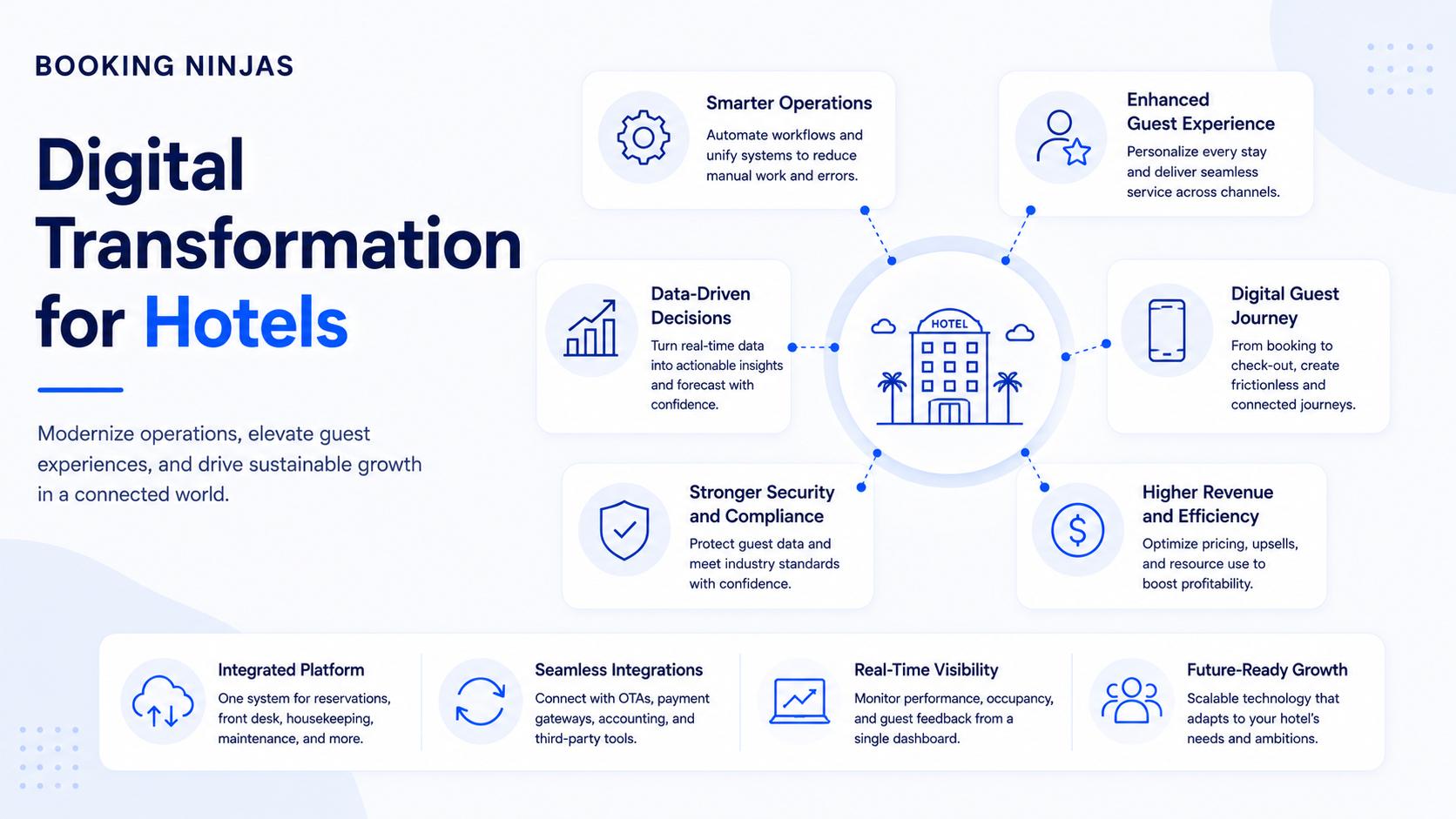
Digital transformation in a hotel means redesigning how reservations, guest information, payments, staff workflows, service requests, and reporting work together through connected digital systems. The goal is not to add more software. It is to make hotel operations easier to see, manage, automate, and improve.
What does digital transformation mean for a hotel?
Hotel digital transformation is broader than moving a paper process onto a screen. It changes how information moves between the guest journey and the operating teams behind it.
A reservation, for example, can affect room availability, guest communication, payment status, housekeeping preparation, front-desk activity, management reporting, and future guest history. When those processes depend on separate records, staff must repeatedly reconcile what happened. A connected operating model reduces that fragmentation.
Common signs a hotel still has fragmented digital operations
- Reservation details are copied manually between systems.
- Guest history is difficult to see outside the front-desk tool.
- Payments and invoices are reconciled separately from bookings.
- Housekeeping, maintenance, or service tasks rely on calls or chat.
- Managers build reports by combining several exports.
- Adding a new workflow requires another disconnected application.
Which hotel operations should digital transformation connect?
The right scope depends on the hotel's size, service model, existing technology, and operational priorities. In most cases, the useful question is not whether every tool should be replaced, but whether the hotel's most important records and workflows can stay connected.
| Area | What should stay connected | Relevant Booking Ninjas capability |
|---|---|---|
| Reservations | Guests, stay dates, room or unit inventory, status changes, and the operational activity created by the booking. | Reservation Management |
| Availability | Inventory, occupancy, restrictions, and the resources that can actually be sold or assigned. | Availability Management |
| Guest and account data | Profiles, history, preferences, communication, transactions, and relationships that should not exist as isolated records. | Salesforce DNA |
| Billing and payments | Charges, invoices, payments, adjustments, and the reservation or service that explains the financial activity. | Billing & Payment |
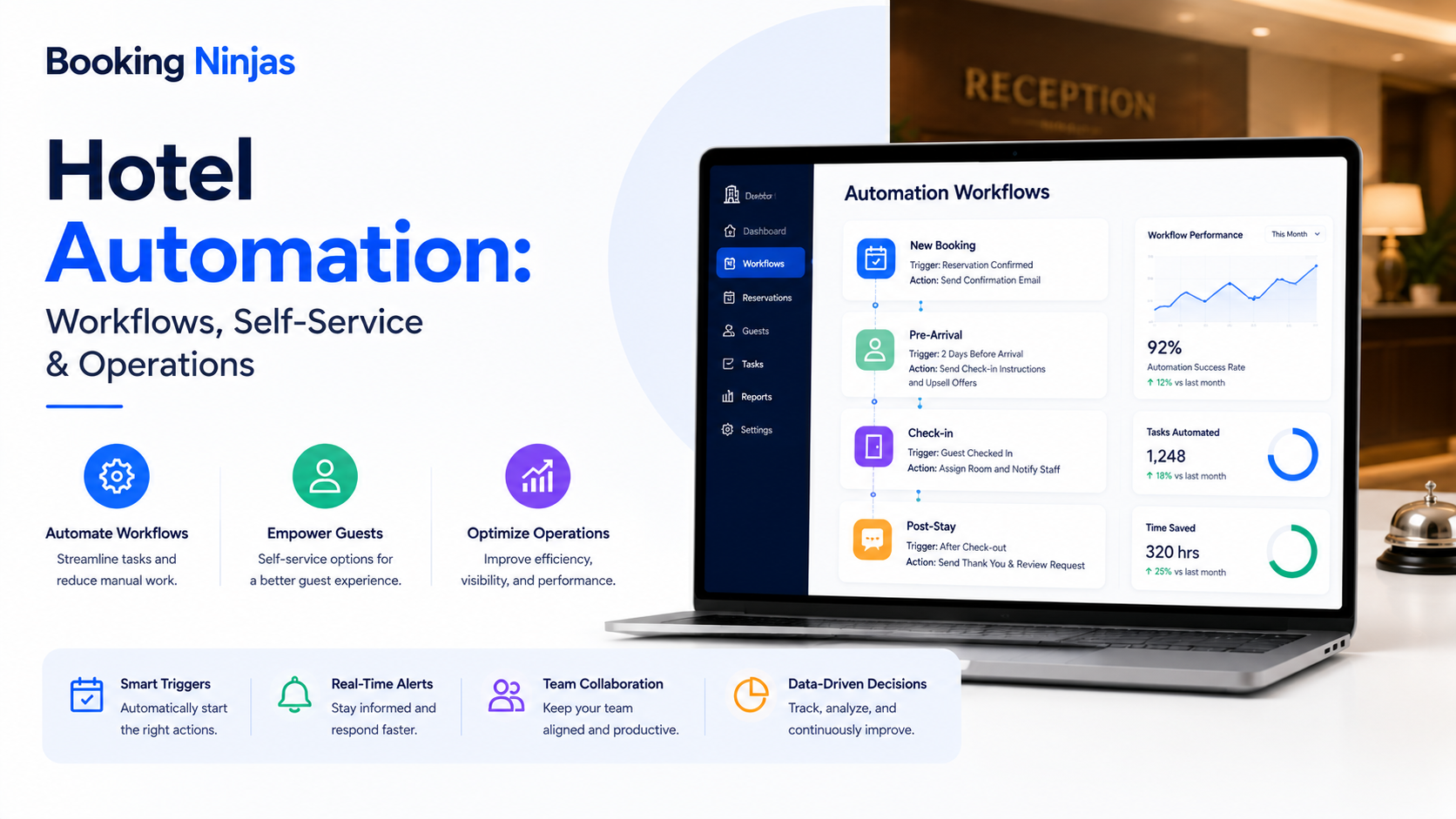
| Staff workflows | Tasks, approvals, assignments, exceptions, reminders, and follow-up between departments. | Workflow & Process |
| Reporting | Operational, financial, guest, and management information that leaders use to understand performance. | Insights |
| External systems | Accounting, payment, communication, analytics, and other systems that still need to exchange information with hotel operations. | Integrations |
What changes when hotel operations become more connected?
Digital transformation becomes useful when it improves the way real work moves through the property. The value is operational continuity: one action can update the records, teams, and reporting that depend on it.
Booking activity keeps its context
A reservation can remain connected to the guest, stay, room, payment, communication, and later service activity.
Reservation Management →Work moves between departments
Repeatable processes can route tasks, approvals, reminders, and exceptions instead of relying only on manual follow-up.
Workflow & Process →Revenue activity stays explainable
Charges and payments are easier to understand when financial records remain connected to the bookings and services behind them.
Billing & Payment →Reporting uses shared operational data
Leaders can work from connected information rather than waiting for multiple departments to assemble separate spreadsheets.
Insights →Existing systems can have a defined role
Transformation does not automatically require replacing every application. Required systems can be evaluated for integration.
Integrations →The operating model can keep evolving
A configurable foundation makes it easier to add new workflows, roles, records, reporting, and integrations as requirements change.
Salesforce DNA →This same principle also affects personalisation. A hotel can make better use of guest context when profile and operational data are connected rather than spread across isolated tools. For a deeper look at that topic, see the guide to connected hotel data and guest profiles .
How should a hotel approach digital transformation?
Start with the operational problem, not the software catalogue. Hotels get a clearer implementation path when they define which records, decisions, and handoffs must improve before choosing how the technology should be configured.
Document how a reservation becomes a stay, how payments are handled, how staff receive work, where exceptions occur, and which systems hold the important records.
Decide which guest, reservation, room, payment, service, and operational records need a consistent source of truth.
Start where staff repeatedly re-enter data, reconcile conflicting information, wait for approvals, or move manually between systems.
Decide which existing accounting, payment, communication, access, analytics, or other systems should remain and what data must move between them.
Configure, migrate, test, train, and approve important workflows in stages so the hotel can validate real operations before expanding scope.
Track the operational outcomes that matter, then improve the model as new workflows, properties, services, or reporting needs appear.
How long does hotel digital transformation take?
There is no reliable universal timeline for hotel digital transformation. A focused workflow can be implemented much faster than a property-wide replacement involving historical data, multiple integrations, complex billing rules, custom processes, and several teams.
The practical timeline depends on scope, data quality, migration volume, integration access, configuration, testing, training, acceptance, and the number of workflows being changed. A phased rollout is often easier to control than treating transformation as one large switch-over event.
What should hotels evaluate before choosing a digital platform?
Can the platform represent the hotel's actual room, reservation, service, billing, staffing, and exception workflows without forcing every department into the same process?
Can guest, reservation, financial, and operational records remain connected enough to support service, reporting, and automation?
Which systems need to remain, what interfaces are available, and how often does information need to move between them?
Can teams work from shared information while keeping appropriate access controls, responsibilities, and approval boundaries?
Can management trace reports back to the operational records that created the numbers instead of relying on repeated manual consolidation?
Can the operating model accommodate new services, properties, workflows, integrations, and reporting requirements without requiring a complete restart?
How can Booking Ninjas support hotel digital transformation?
Booking Ninjas is a Salesforce-native platform for bookings and operations. For hotels, the platform can provide a configurable environment for connecting reservations, guest records, financial activity, workflows, reporting, and integrations around the operating model the property needs.
The Hotel Management Software solution provides the hospitality-specific operating context, while Booking Ninjas' broader feature architecture supports the individual booking, billing, workflow, reporting, and integration processes behind it.
The Salesforce-native foundation matters most when the hotel wants operational records to participate in broader permissions, automation, reporting, CRM, and integration workflows instead of remaining in a separate operational silo. The article on Salesforce as a property-management foundation explains that architecture in more detail.
Frequently asked questions
What is digital transformation in the hotel industry?
Hotel digital transformation is the process of redesigning hotel operations around connected digital records, workflows, automation, and reporting. It can include reservations, guest data, billing, service operations, staff processes, integrations, and management insight.
Does digital transformation mean replacing every hotel system?
No. A hotel can keep systems that still perform a useful role. The important question is whether those systems can exchange the data and operational context required by the wider workflow.
Is a PMS enough for hotel digital transformation?
A PMS can be an important foundation, but digital transformation is broader than room and reservation management. The hotel must also consider payments, guest records, staff workflows, reporting, integrations, and the processes that connect departments.
What should a hotel digitise first?
Start with a high-friction workflow that affects important operations and can be measured clearly. Common candidates include reservation handoffs, payment processing, guest communication, room readiness, service requests, or management reporting.
How long does a hotel digital-transformation project take?
The timeline depends on scope. A focused process may be relatively small, while a hotel-wide programme involving migration, integrations, custom workflows, testing, and training can require a much larger implementation effort.
Why does connected hotel data matter?
Connected data gives staff and managers more consistent context about the guest, booking, payment, service, and operational activity behind a decision. It also reduces the need to repeatedly reconcile separate records.
Can digital transformation be implemented in phases?
Yes. A phased implementation can begin with the highest-priority workflow, validate it with real users, and then expand into additional departments, integrations, automation, and reporting as requirements mature.
Build hotel operations around connected workflows
If your hotel is evaluating how reservations, guest data, payments, staff processes, reporting, and existing systems should work together, Booking Ninjas can help map the operating model and implementation scope.