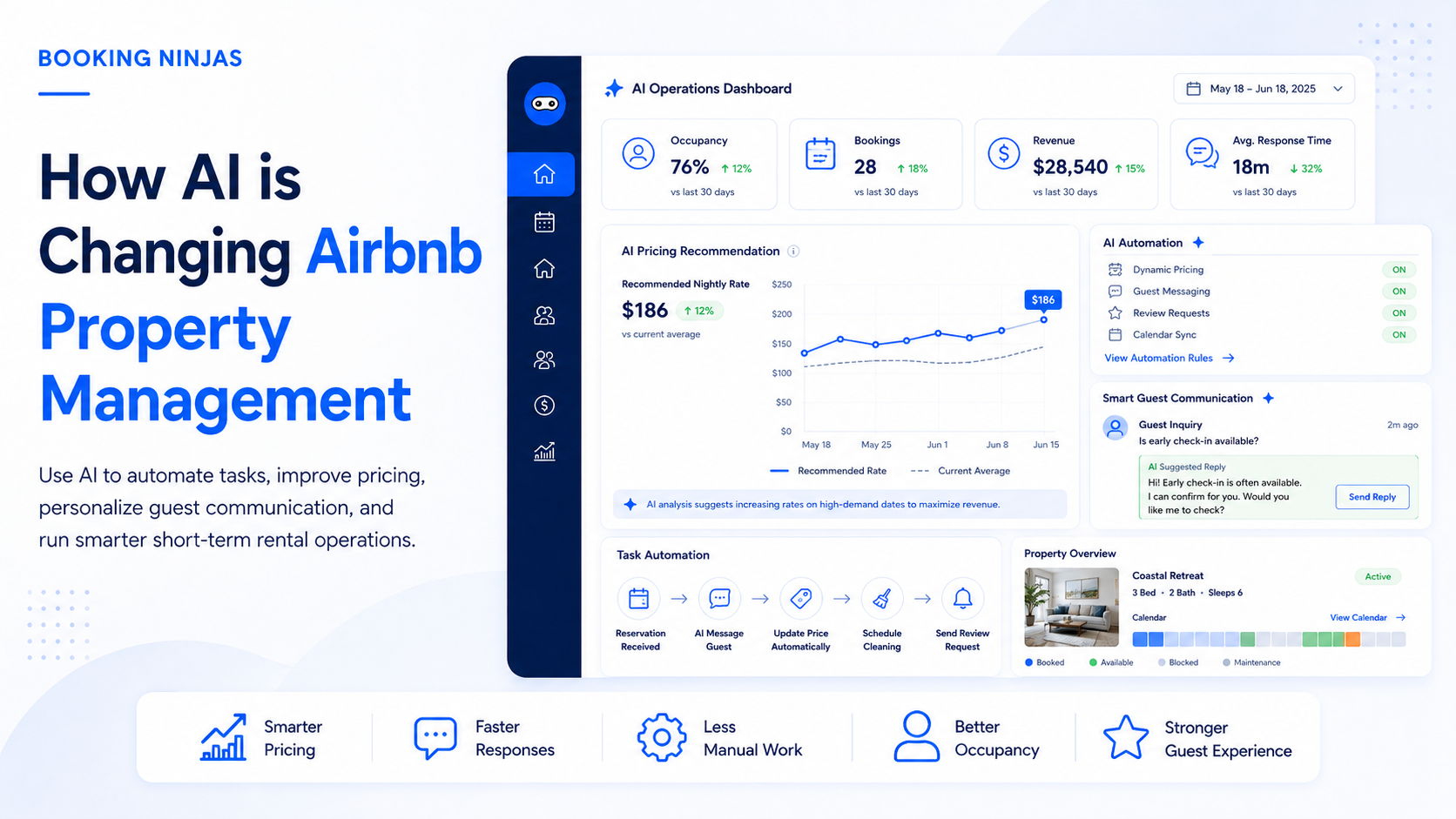
Airbnb operations generate a continuous stream of reservations, guest messages, pricing decisions, cleaning tasks, maintenance issues, payments, and property data. AI becomes useful when it can interpret that information in the context of the work that needs to happen next.
This distinction matters. AI is not a digital property manager that should be expected to make every decision independently. Its value depends on the information it can access, the rules around its use, and how its output connects with reservations, staff, guests, and operational workflows.
What does AI mean in Airbnb property management?
AI in short-term rental operations can refer to several different capabilities rather than one universal system.
| Capability | What it can support | Example |
|---|---|---|
| Generative AI | Create, summarize, classify, or restructure information. | Drafting a response based on a guest's question and reservation context. |
| Predictive AI | Analyze historical patterns to estimate future conditions. | Supporting demand, occupancy, revenue, or maintenance forecasting. |
| Pattern detection | Identify recurring or unusual behavior in operational data. | Detecting repeated maintenance issues or unusual booking patterns. |
| Decision support | Prioritize information or recommend an action for review. | Highlighting reservations, work orders, or pricing decisions that may require attention. |
Booking Ninjas' AI layer extends across booking, operations, facilities, billing, insights, portals, and integrations within its Salesforce-native operating environment.
What is the difference between AI and workflow automation?
AI and automation often work together, but they solve different problems.
AI can interpret information, detect patterns, summarize records, forecast conditions, classify an issue, or support a decision.
Workflow automation executes a defined action.
Reservations, guests, availability, rates, payments, work orders, and communication provide context.
AI summarizes, detects patterns, forecasts, classifies, or recommends according to the use case.
A person or predefined policy determines which action should be permitted.
Automation updates records, assigns work, sends approved communication, or moves the process forward.
What data gives AI useful context for Airbnb operations?
An AI model becomes more operationally useful when its output can be grounded in the records relevant to the task.
- Property and listing information
- Reservations and stay dates
- Availability and occupancy
- Rates and pricing history
- Guest and customer records
- Communication history
- Housekeeping and turnover activity
- Maintenance and work orders
- Payments and financial activity
- Operational status and exceptions
The information required should be determined by the use case. Giving an AI system more data does not automatically make its output better.
Data quality, record relationships, permissions, relevance, and governance remain important when AI is added to an operating workflow.
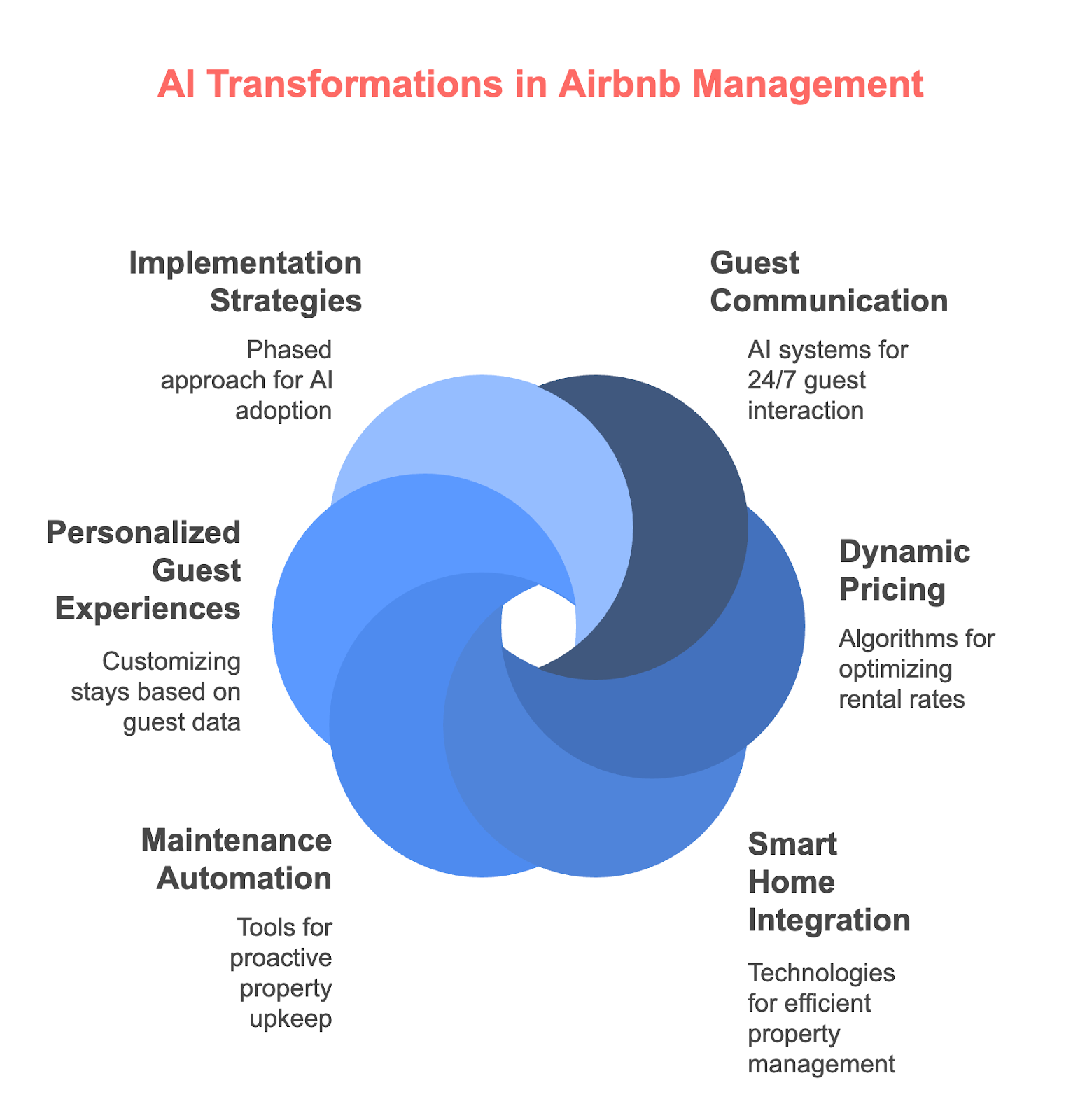
How can AI support Airbnb guest communication?
Short-term rental communication contains a large number of repetitive questions, but each message still exists within a particular reservation and guest relationship.
AI can support communication tasks such as:
- Summarizing a guest conversation
- Classifying the reason for a message
- Drafting responses for review
- Identifying messages that may require attention
- Providing chatbot-style assistance
- Using booking context to make responses more relevant
Booking Ninjas' Airbnb environment centralizes guest communication with reservation and operational records, while its AI for People & Portals provides an AI layer for conversational and personalized engagement.
Not every message should be handled without review. Complaints, emergencies, payment disputes, safety concerns, unusual requests, and other exceptions may require direct human attention.
How can AI support Airbnb pricing decisions?
Pricing is one of the clearest examples of the difference between AI analysis and automated execution.
AI can analyze available booking, occupancy, availability, pricing, and demand information to identify patterns or support forecasts. Rate rules then determine whether and how a price should change.
Booking Ninjas' Rate Management supports seasonal and dynamic pricing, minimum and maximum rates, thresholds, overrides, and custom business rules.
AI can support the analysis behind those decisions, but the pricing model should still reflect the operator's strategy and commercial boundaries.
Where can AI help with housekeeping and turnover?
Airbnb operations often have short windows between checkout and the next arrival. The primary requirement is therefore reliable coordination between reservations and operational work.
A checkout can trigger a defined cleaning workflow without requiring AI. AI becomes more relevant when the operator wants additional interpretation or prioritization.
Depending on the available data and implementation, AI can support tasks such as:
- Prioritizing time-sensitive work
- Identifying recurring operational delays
- Detecting unusual patterns
- Supporting workload planning
- Summarizing unresolved operational issues
- Forecasting periods of higher operational demand
The distinction keeps a predictable cleaning trigger as automation while using AI where interpretation or prediction adds value.
Can AI support preventive maintenance for short-term rentals?
It can support maintenance analysis where the operation has enough relevant history and asset or work-order information.
Booking Ninjas' Work Order Management connects maintenance activity with assignments, locations, priorities, status, reporting, and operational history.
AI can then support use cases such as identifying recurring issues, recognizing maintenance patterns, estimating risk, or helping prioritize work.
| Approach | Example | Role of AI |
|---|---|---|
| Reactive | Create a work order after a guest reports a broken item. | AI may help classify or prioritize the issue. |
| Scheduled | Create an inspection every defined number of days. | AI is not required for the schedule itself. |
| Pattern-based | Identify an asset or property with repeated service issues. | AI can help surface recurring patterns. |
| Predictive | Estimate where maintenance risk may be increasing. | Requires suitable historical or operational data and should be treated as decision support rather than certainty. |
How do smart-property systems fit into the AI architecture?
Smart locks, building systems, sensors, energy platforms, access systems, and other connected technologies are separate from AI itself.
These external systems can provide additional signals or execute actions where an appropriate integration exists.
For example, a connected system might contribute information about an asset, access event, environmental condition, or equipment state. That information could then become part of an operational workflow or analytical model.
Booking Ninjas supports external connections through its Integrations architecture. The exact connection depends on the external system, available APIs, authentication, data model, and implementation scope.
How can AI use guest and customer data responsibly?
Connected guest records can give AI useful context, but historical activity should not be treated as certainty about a person's future preferences or intentions.
Relevant data may include:
- Previous reservations
- Stay history
- Service requests
- Appropriately recorded preferences
- Transaction history
- Communication history
Booking Ninjas' Customer Intelligence connects customer profiles with booking, transaction, service, and lifecycle information.
AI can analyze those records for patterns or recommendations where the use case and permissions support it. Operators should still distinguish observed behavior from assumptions about the guest.
Which Airbnb decisions should still involve people?
The appropriate boundary depends on risk and operational consequences.
Routine, predictable workflows may be suitable for higher levels of automation. Ambiguous, sensitive, unusual, or financially important decisions may need review.
| Situation | AI can support | Human role |
|---|---|---|
| Routine guest question | Identify the topic and draft or provide an approved response. | Review exceptions or unusual circumstances. |
| Pricing | Detect patterns, forecast conditions, and recommend rate actions. | Define strategy, limits, exceptions, and approval rules. |
| Maintenance | Classify issues, identify patterns, and support prioritization. | Diagnose uncertain problems and approve significant work. |
| Guest dispute | Summarize history and relevant records. | Evaluate context and decide the appropriate response. |
| Operational exception | Flag unusual activity or surface relevant information. | Determine whether and how the normal workflow should change. |
Why can AI become more useful across a multi-property Airbnb portfolio?
Managing more properties creates more calendars, reservations, turnovers, guest interactions, work orders, pricing decisions, and exceptions.
The challenge is not simply the volume of data. It is identifying which information deserves attention across many simultaneous operations.
AI can support portfolio management by summarizing activity, identifying patterns, highlighting anomalies, forecasting demand, or prioritizing work where the underlying data supports the use case.
Booking Ninjas' Airbnb Property environment provides centralized visibility across listings, reservations, guest communication, housekeeping, payments, and multi-property operations.
How is AI different from ordinary reporting?
Reporting normally organizes known records into metrics, dashboards, comparisons, and trends.
AI can add another analytical layer by helping interpret those records, detect anomalies, forecast possible outcomes, summarize complex information, or prioritize what should be reviewed.
Booking Ninjas' Insights environment provides reporting and decision-support capabilities across financial, customer, and operational information.
Where should an Airbnb operator start with AI?
Start with an operational problem rather than starting with the technology.
- Choose one decision or workflow. Identify a specific problem such as repetitive guest questions, pricing review, maintenance prioritization, or portfolio reporting.
- Identify the required data. Determine which reservations, customers, properties, work orders, prices, or other records are necessary for that use case.
- Check the data quality. Make sure the information is structured, current, appropriately connected, and suitable for the decision.
- Define the AI role. Decide whether AI should summarize, classify, forecast, recommend, detect, or assist with another clearly defined task.
- Define the automation boundary. Establish which actions can happen automatically and which require review or approval.
- Measure the workflow. Compare the resulting process with the original operating problem and adjust the implementation if necessary.
How should you evaluate an AI use case?
A useful AI implementation should have a clearer test than "we added AI."
| Question | What to evaluate |
|---|---|
| What problem are we solving? | Define the specific decision, delay, repetitive task, or information problem. |
| Does the system have the required context? | Check whether the necessary booking, customer, operational, financial, or external data is available. |
| What does AI actually do? | Separate prediction, summarization, classification, or recommendation from ordinary workflow automation. |
| What happens when AI is uncertain? | Define escalation, review, approval, or fallback behavior. |
| How will we judge usefulness? | Measure the workflow outcome relevant to the original problem instead of assuming AI automatically creates value. |
Why does connected Salesforce data matter for Airbnb AI?
AI becomes more useful when the information required for a decision already has meaningful relationships.
Booking Ninjas runs bookings and operations on Salesforce, allowing reservations, customers, payments, workflows, maintenance, reporting, and other configured operational records to share the broader Salesforce platform foundation.
That can provide AI with more connected operational context than a workflow in which reservations, guest records, maintenance, and financial activity are maintained as unrelated datasets.
How does Booking Ninjas connect AI with Airbnb operations?
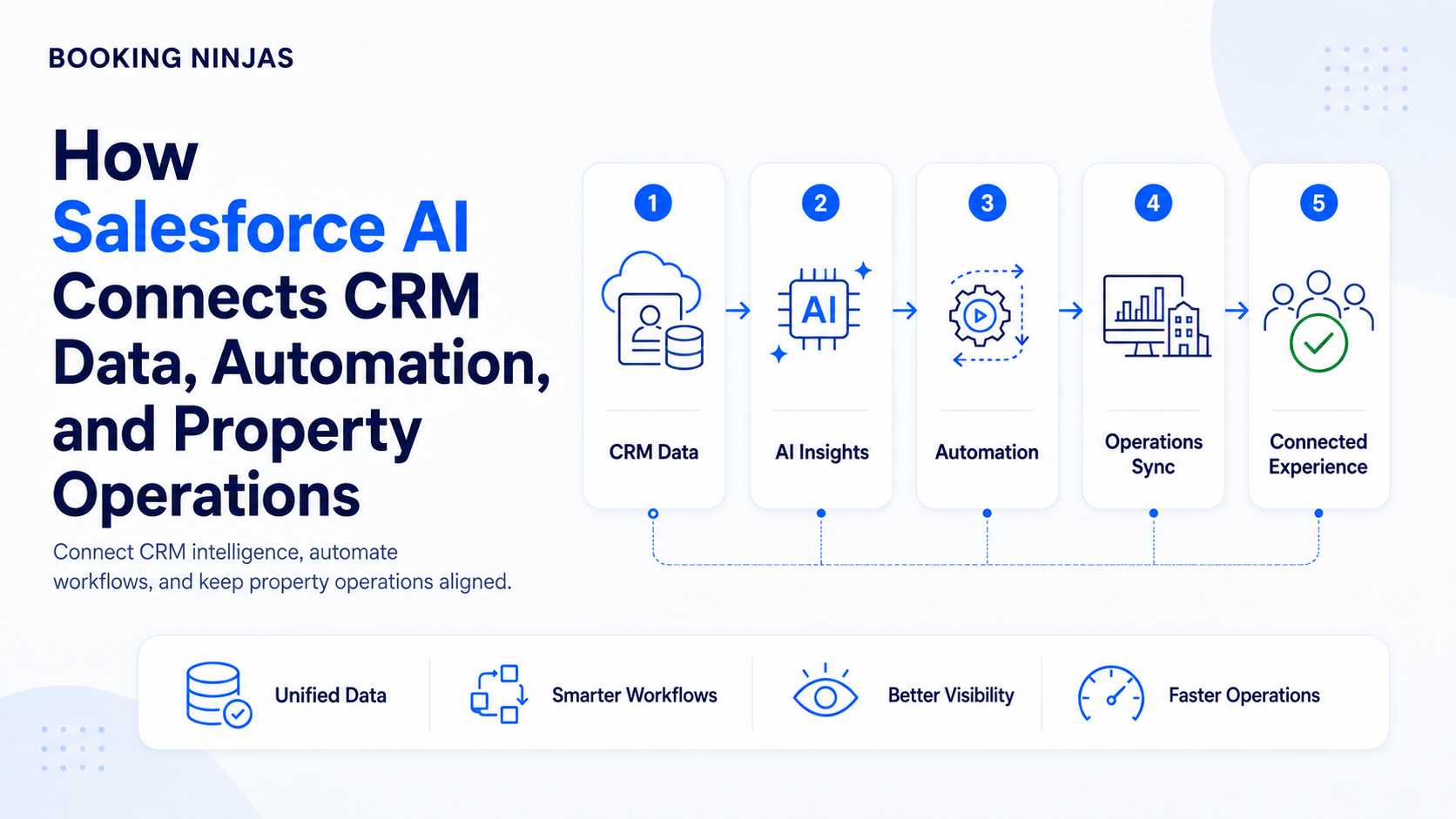
Booking Ninjas is a Salesforce-native platform for bookings and operations . Its Airbnb environment connects listings, reservations, guest communication, housekeeping, payments, reporting, and other operational workflows.
AI can then operate as an intelligence layer around connected booking and operational records rather than as an isolated tool working without property context.
Manage short-term rental listings, reservations, guest communication, housekeeping, payments, and multi-property operations.
Explore Airbnb Properties →Apply AI across booking, operations, facilities, insights, customer engagement, billing, and connected workflows.
Explore AI →Connect pricing rules and controls with booking, availability, and AI-supported revenue analysis.
Explore Rate Management →Manage maintenance tasks while using operational history for prioritization, recurring-issue analysis, and predictive support.
Explore Work Order Management →Connect customer profiles with relevant booking, transaction, service, and engagement information.
Explore Customer Intelligence →Connect external systems and data sources where the AI or operational workflow requires them.
Explore Integrations →Frequently asked questions
How can AI help Airbnb property managers?
AI can support tasks such as summarization, classification, forecasting, pattern detection, prioritization, guest engagement, pricing analysis, and maintenance decision support when the relevant booking and operational data is available.
Does AI replace Airbnb property management automation?
No. AI can interpret information or support a decision, while workflow automation executes defined actions such as assigning work, updating records, sending approved communications, or moving an operational process forward.
Can AI automatically respond to Airbnb guests?
AI can support conversational and automated communication where the system and workflow are configured for it. Operators should still define which messages can be handled automatically and which situations require human review.
Can AI improve Airbnb pricing?
AI can analyze booking, availability, pricing, and demand information to support forecasts or pricing decisions. It does not guarantee higher occupancy or revenue, and pricing rules should remain within the operator's defined commercial boundaries.
Can AI predict short-term rental maintenance problems?
AI can support identification of recurring issues, maintenance patterns, and potential risk where sufficient and relevant operational history is available. Predictive output should be treated as decision support rather than certainty that equipment will fail.
Should Airbnb hosts automate every decision with AI?
No. The appropriate level of automation depends on the workflow, data quality, operational risk, property characteristics, and the consequences of an incorrect decision. Sensitive or unusual situations may require human review.
Is Booking Ninjas AI connected to Airbnb property operations?
Booking Ninjas provides AI capabilities within its Salesforce-native platform for bookings and operations, allowing AI-supported workflows to use relevant reservation, customer, pricing, maintenance, financial, and operational context where the implementation supports it.
Give AI the context of the whole operation
Connect Airbnb reservations, guests, pricing, maintenance, communication, payments, workflows, reporting, and AI within a Salesforce-native operating environment.