Hotels create data every time someone makes a reservation, changes a stay, pays an invoice, checks into a room, submits a request, completes a housekeeping task, or interacts with another part of the operation.
The objective is not to collect as much information as possible. It is to make the information the hotel already depends on easier to trust and easier to use.
What does hotel data optimization actually mean?
A hotel can have thousands of records and still have poor data. Volume alone does not create insight.
Useful hotel data needs several characteristics: the record must represent the correct thing, important fields need to be reasonably complete, relationships between records need to be preserved, and staff need to know what the information means.
Reduce duplicates, conflicting records, missing fields, and inconsistent definitions.
Preserve relationships between guests, reservations, rooms, payments, requests, and operational activity.
Understand what each metric represents and which business process created it.
Use the information in reporting, planning, workflows, and operational decisions.
What types of data does a hotel actually create?
Hotel data comes from many operational areas. Each type answers a different question.
| Data area | Examples | Useful questions |
|---|---|---|
| Reservations | Stay dates, inventory, rates, booking source, status, modifications, cancellations. | What is being booked, when, for how long, and through which source? |
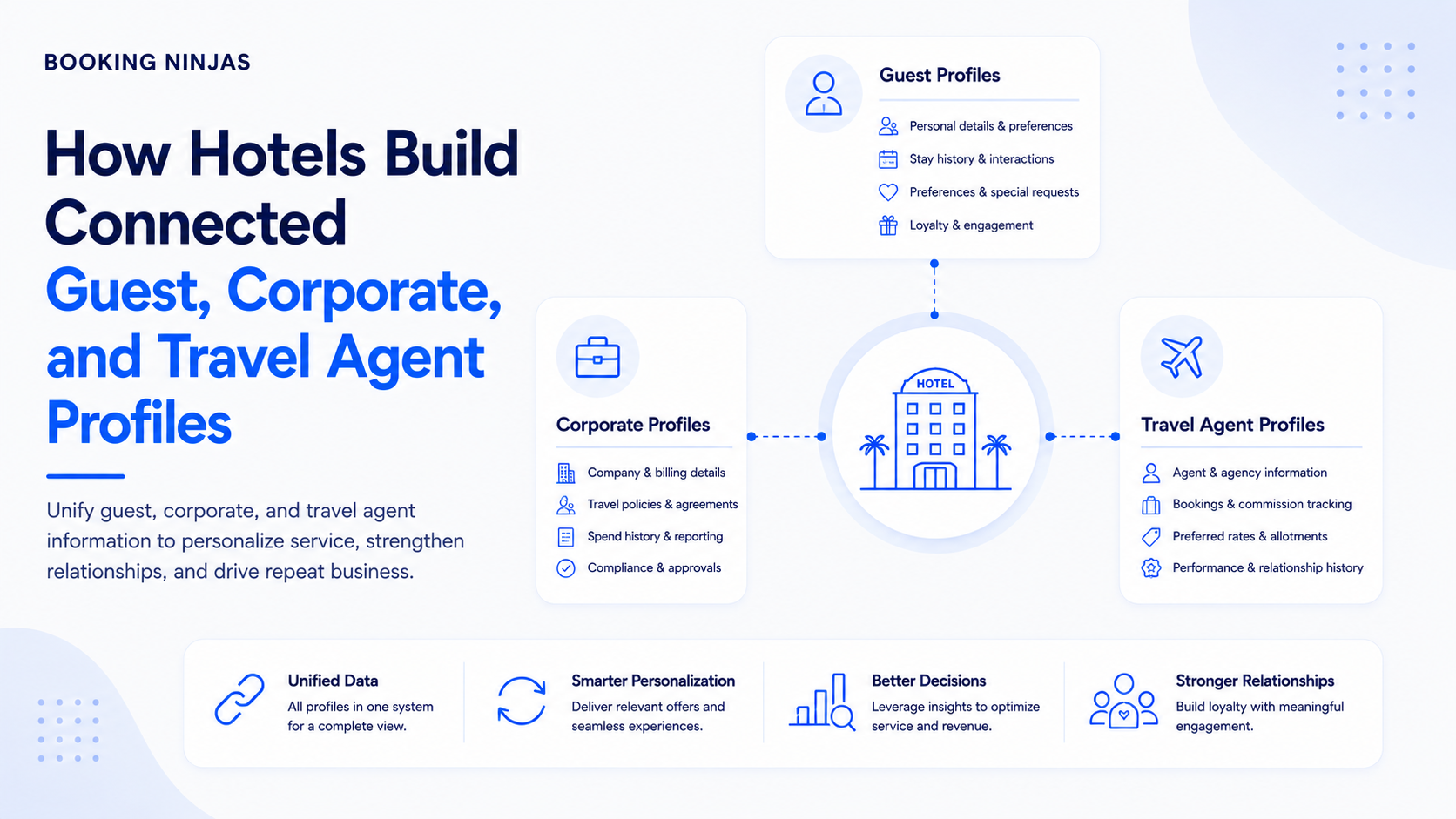
| Customer | Guest profiles, account relationships, relevant communication and service history. | Who is interacting with the property and what relevant relationship context exists? |
| Financial | Charges, invoices, payments, balances, refunds, and other operational financial records. | What financial activity is associated with each customer, stay, service, or property? |
| Operations | Housekeeping, requests, work orders, tasks, room readiness, inspections, and workflow status. | Where is work occurring, what is delayed, and which processes require attention? |
| Distribution | Booking channels, availability, rates, restrictions, and channel activity. | How is inventory reaching the market and how does activity differ across sources? |
| External | Market information, connected accounting data, external systems, sensors, or specialist applications. | Which outside information is required to understand or execute the hotel workflow? |
Why is the PMS an important part of the hotel data model?
The PMS sits close to many of the events that define a hotel stay: reservations, inventory, arrivals, departures, guest records, charges, and operational status.
Booking Ninjas' Reservation Management connects reservations with guests, dates, inventory, rates, and booking activity inside the broader operating environment.
But the PMS should not automatically be treated as the owner of every type of hotel data. Accounting systems, payment providers, specialist operational systems, marketing tools, or other applications may continue to own specific records.
What matters is knowing how those records relate to one another.
What causes hotel data silos?
A data silo appears when information required by one workflow is isolated inside another system, team, spreadsheet, or database and cannot be used reliably where it is needed.
Common examples include:
- Guest records separated from reservation history
- Payment records requiring manual reconciliation
- Housekeeping status maintained outside reservation operations
- Maintenance work disconnected from rooms or assets
- Separate property reports using different definitions
- CRM and PMS maintaining conflicting customer information
Solving a silo does not always mean migrating everything into one database.
Sometimes the better approach is to keep a specialist system while establishing a reliable integration and clearly defining which system owns each record.
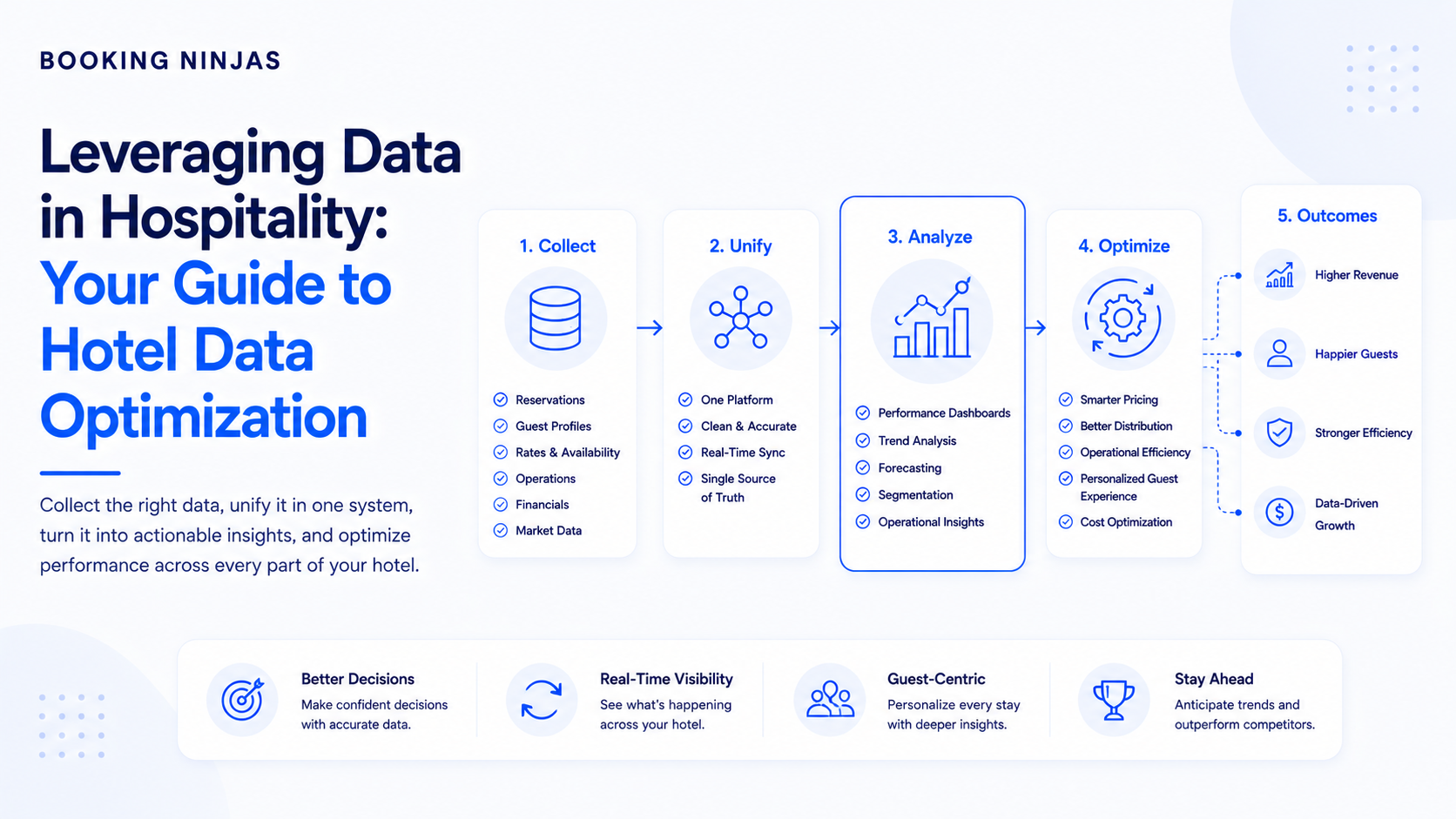
How do hotels turn raw data into useful decisions?

- Start with the decision. Define the operational question before deciding which data to collect or analyze.
- Identify the required records. Determine which reservation, customer, financial, operational, or external data is actually relevant.
- Check data quality. Identify duplicates, missing information, inconsistent definitions, stale records, and incorrect mappings.
- Connect the relationships. Make sure the guest, reservation, room, payment, task, property, or other entity can be connected correctly.
- Analyze in context. Use reporting, comparison, forecasting, or other analytical methods appropriate to the question.
- Act and measure again. Apply the finding to a workflow or decision, then review whether the resulting operational data supports the original assumption.
How can data improve visibility into hotel operations?
Operational reporting becomes more useful when it describes the actual work being performed rather than only summarizing financial results after the fact.
Housekeeping and room readiness
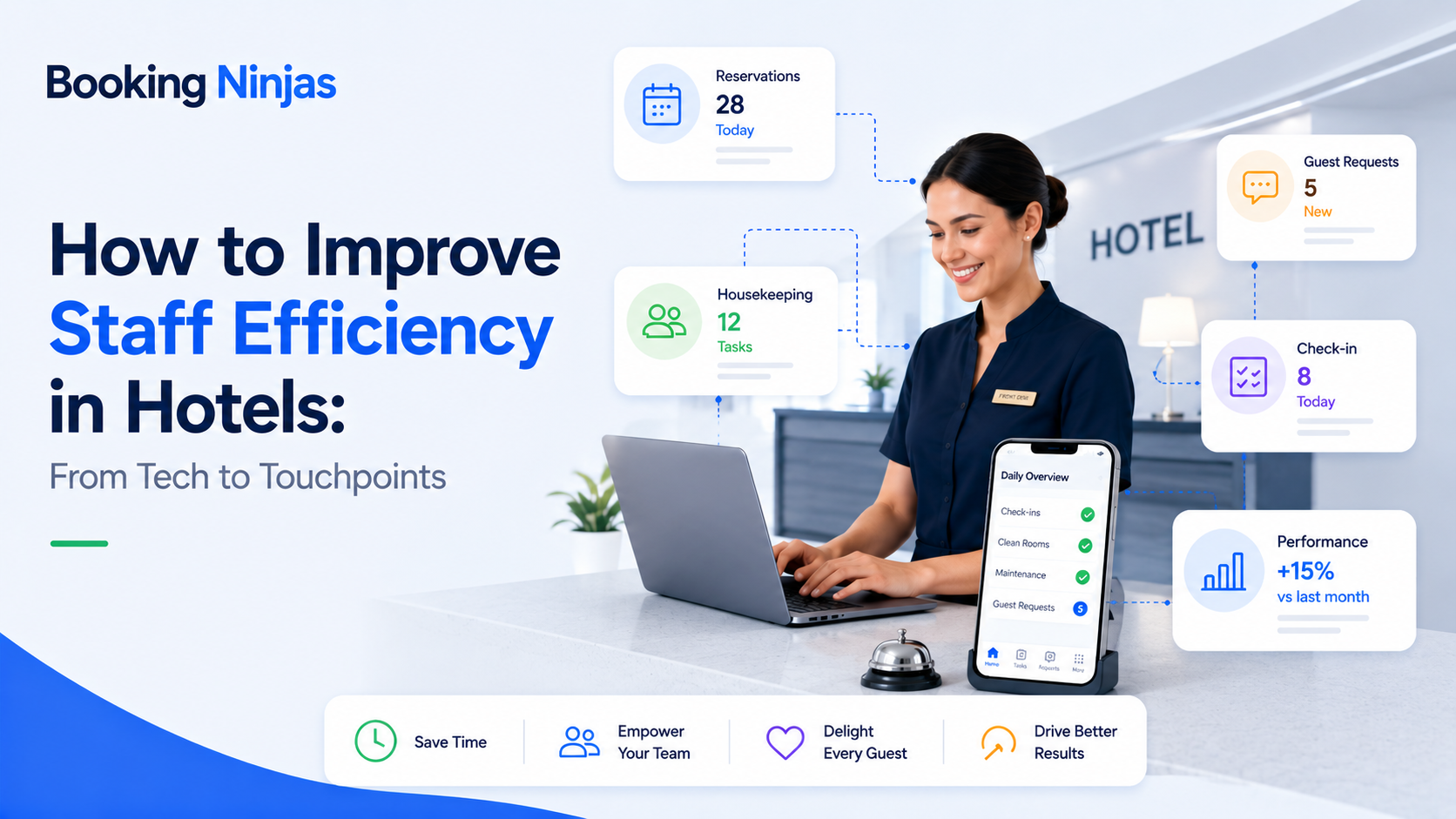
Booking activity, occupancy, cleaning assignments, inspections, and room status can be connected to give teams a clearer view of room readiness.
Booking Ninjas' Housekeeping capabilities connect cleaning schedules, assignments, inspections, and room-status tracking with the operational environment.
Maintenance and work orders
Maintenance data becomes more useful when a work order can be connected to the relevant room, property, asset, request, priority, assignment, status, and history.
Work Order Management provides structured creation, assignment, status tracking, routing, and operational reporting around maintenance and service work.
Service requests and workflow
Request data can show volume, category, ownership, status, response patterns, and recurring operational issues when requests are captured consistently.
Which hotel metrics are worth tracking?
A useful metric should answer a business question. A hotel does not need every possible KPI on one dashboard.
| Business question | Possible measures | Required context |
|---|---|---|
| How is inventory being used? | Occupancy, availability, stay length, reservation volume. | Dates, room or unit type, property, booking status. |
| How are rates performing? | ADR, revenue trends, rate performance, discount activity. | Inventory, stay dates, segment, booking source, rate plan. |
| Where is work delayed? | Open tasks, completion time, overdue work, readiness status. | Assignment, priority, location, status, workflow stage. |
| How are customers interacting? | Repeat stays, service activity, requests, booking patterns. | Reliable customer identity and relationship history. |
| How are payments progressing? | Charges, payments, outstanding balances, reconciliation exceptions. | Customer, reservation, invoice, transaction, property. |
How should hotels use customer data?
Customer data becomes useful when it provides relevant context for a real relationship or decision.
Reservation history, service activity, transactions, communication history, and appropriately recorded preferences can help staff and management understand patterns without assuming that every past interaction predicts what the guest will want next.
Booking Ninjas' Customer Intelligence connects customer profiles with booking, transaction, service, and lifecycle information available in the platform.
That information can support segmentation, reporting, customer analysis, and decision-making where the underlying data and use are appropriate.
How does hotel data support pricing and revenue decisions?
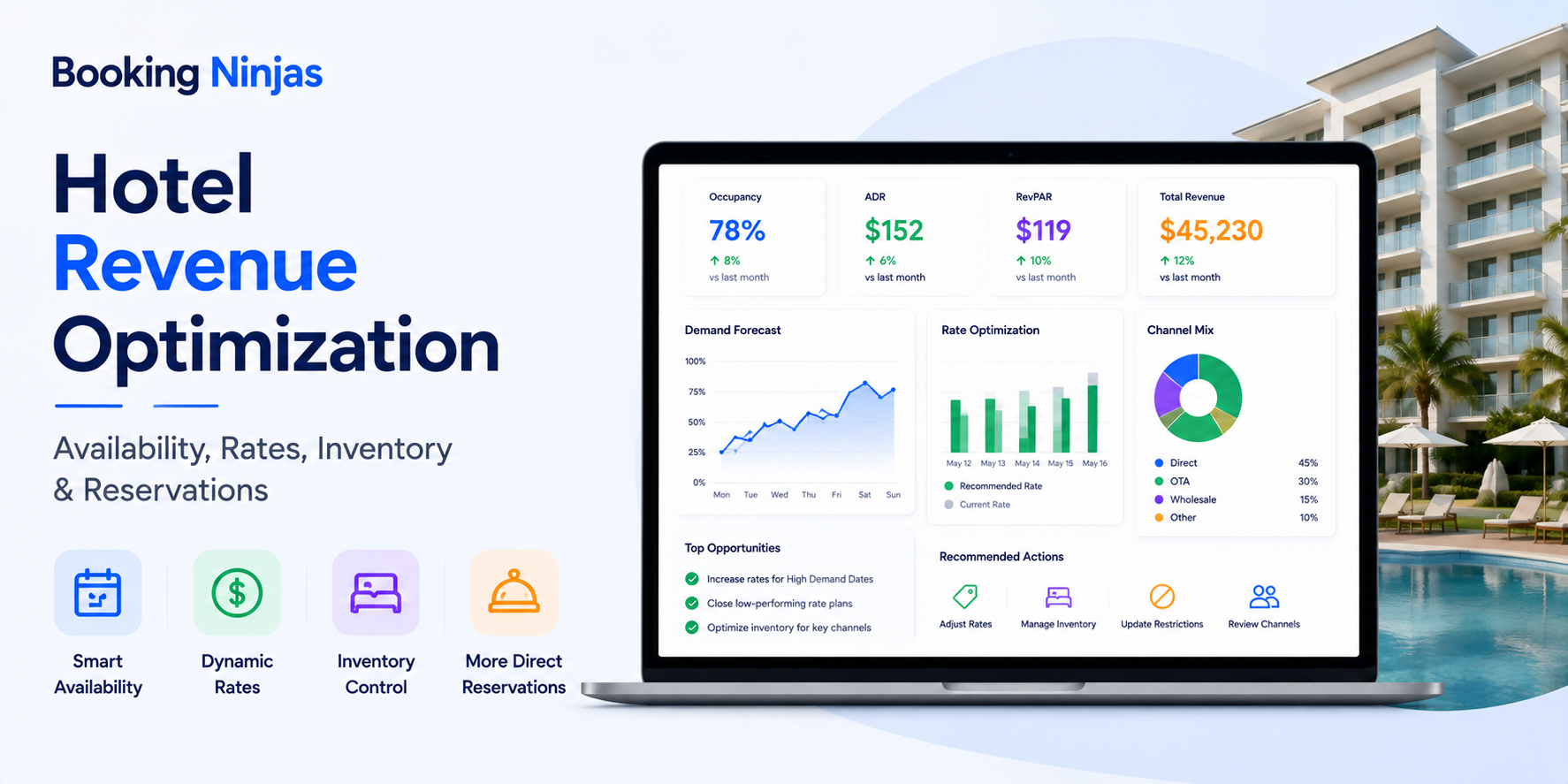
Pricing decisions can use information such as historical booking activity, availability, stay dates, rate performance, demand patterns, customer segments, and other relevant signals.
Booking Ninjas' Revenue Optimization capabilities support analysis of revenue drivers, pricing performance, margins, trends, and forecasting within the broader Salesforce-native platform.
Analytics can help operators compare options and respond more systematically to changing conditions. They do not guarantee that a particular pricing decision will increase revenue or profitability.
What is the difference between reporting and insight?
Reporting describes information in a structured way. Insight comes from interpreting that information in relation to a question, comparison, trend, target, or decision.
A dashboard showing housekeeping completion is reporting. Examining whether late room readiness is concentrated around particular properties, shifts, workload levels, or booking patterns begins to create decision support.
Booking Ninjas' Insights layer brings together reporting and decision-support capabilities across operational, customer, and financial information.
What makes hotel data trustworthy?
Technology cannot compensate for undefined ownership or poor data practices. Hotels need governance around the information used in operations and reporting.
Define a system of record
Staff should understand which application owns important records such as reservations, customer details, invoices, payment status, room readiness, and other operational information.
Standardize important definitions
Teams need to agree on what statuses, categories, segments, and metrics mean. Two reports using the same label should not quietly measure different things.
Control access
Access should reflect job responsibilities and the sensitivity of the information. Centralized visibility should not mean unrestricted visibility.
Maintain data over time
Customer information, asset records, integrations, rates, organizational structures, and business rules change. Data-quality processes should account for those changes.
Collect data for a reason
Hotels should avoid accumulating information simply because a field exists. Collection, access, retention, and use should follow defined operational, commercial, analytical, or legal purposes and applicable requirements.
Where does AI fit into hotel data optimization?
AI becomes more useful after data has enough structure and context for the system to understand the records being analyzed.
Depending on the use case and available data, AI can support tasks such as:
- Summarizing operational information
- Detecting patterns and anomalies
- Supporting demand forecasting
- Prioritizing tasks or issues
- Identifying recurring operational patterns
- Supporting pricing and revenue analysis
AI output should be treated as decision support rather than certainty. Forecast quality depends on the underlying data, model, assumptions, operating environment, and intended use.
What does a data-driven hotel actually look like?
Being data-driven does not mean staff stop using judgment. It means important decisions can be supported by evidence that employees understand and trust.
Teams need to know:
- Where important information comes from
- What the metrics they use actually mean
- Which system should be updated
- How to identify questionable data
- When automation can handle a process
- When human review is required
Training should therefore focus not only on how to use software, but also on how information moves through the hotel's operating processes.
How should a hotel start optimizing its data?
- Choose one operational problem. Start with a decision or workflow that is difficult because the required information is incomplete, delayed, or fragmented.
- Map the records involved. Identify the customer, reservation, room, payment, task, asset, property, or external information the workflow depends on.
- Identify the system of record. Decide where each important piece of information originates and which system is responsible for updating it.
- Fix the critical data-quality problems. Address duplicates, missing relationships, inconsistent status values, bad mappings, and other issues that undermine the workflow.
- Connect the workflow. Use the appropriate platform or integration so information reaches the people, reports, or automated processes that require it.
- Measure whether the decision improved. Compare against the hotel's own operating baseline and refine the data model as new requirements become clear.
How does Booking Ninjas connect hotel data?
Booking Ninjas is a Salesforce-native platform for bookings and operations . Its Hospitality environment connects reservations, guests, payments, operations, and reporting within a broader platform foundation.
This allows operational relationships to remain connected as data moves from the reservation into billing, service workflows, housekeeping, reporting, analytics, and other configured processes.
External systems can remain part of the architecture where required. The goal is not to force every hotel function into one application, but to establish clearer relationships between the systems and records the operation depends on.
Connect reservations, guests, payments, operations, and reporting across hospitality workflows.
Explore Hospitality →Turn operational, customer, and financial records into structured reporting and decision support.
Explore Insights →Connect customer profiles with booking, transaction, service, and relationship information.
Explore Customer Intelligence →Analyze revenue drivers, pricing performance, trends, and relevant forecasting information.
Explore Revenue Optimization →Connect external systems when operational or analytical data needs to move between applications.
Explore Integrations →Apply AI across relevant booking, operational, financial, and insight workflows where the data and use case support it.
Explore AI →Frequently asked questions
What is hotel data optimization?
Hotel data optimization is the process of making operational data reliable, connected, understandable, and usable for reporting, workflows, forecasting, analytics, and business decisions.
What types of data do hotels collect?
Hotels can generate reservation, customer, availability, rate, billing, payment, housekeeping, service, maintenance, distribution, and other operational data. External systems can contribute additional financial, market, asset, or analytical information.
Does all hotel data need to be stored in one system?
No. Specialist systems can remain part of the hotel's technology architecture. What matters is defining which system owns each important record and connecting the data required by cross-system workflows and reporting.
Why is hotel data quality important?
Poor-quality data can create misleading reports, duplicate customer records, incorrect mappings, inconsistent workflows, and unreliable analysis. Data quality helps ensure that decisions are based on records that correctly represent the underlying operation.
How can AI use hotel operational data?
Depending on the data and configured use case, AI can support summarization, pattern detection, anomaly detection, forecasting, prioritization, and other forms of decision support. Results depend on data quality, context, configuration, and the model being used.
Is Booking Ninjas built on Salesforce?
Yes. Booking Ninjas is a Salesforce-native platform for bookings and operations, allowing reservation, customer, financial, workflow, operational, and reporting records to use the broader Salesforce platform foundation.
Turn hotel data into operational context
Connect reservations, customers, payments, operations, workflows, reporting, integrations, and insights in a Salesforce-native operating environment.