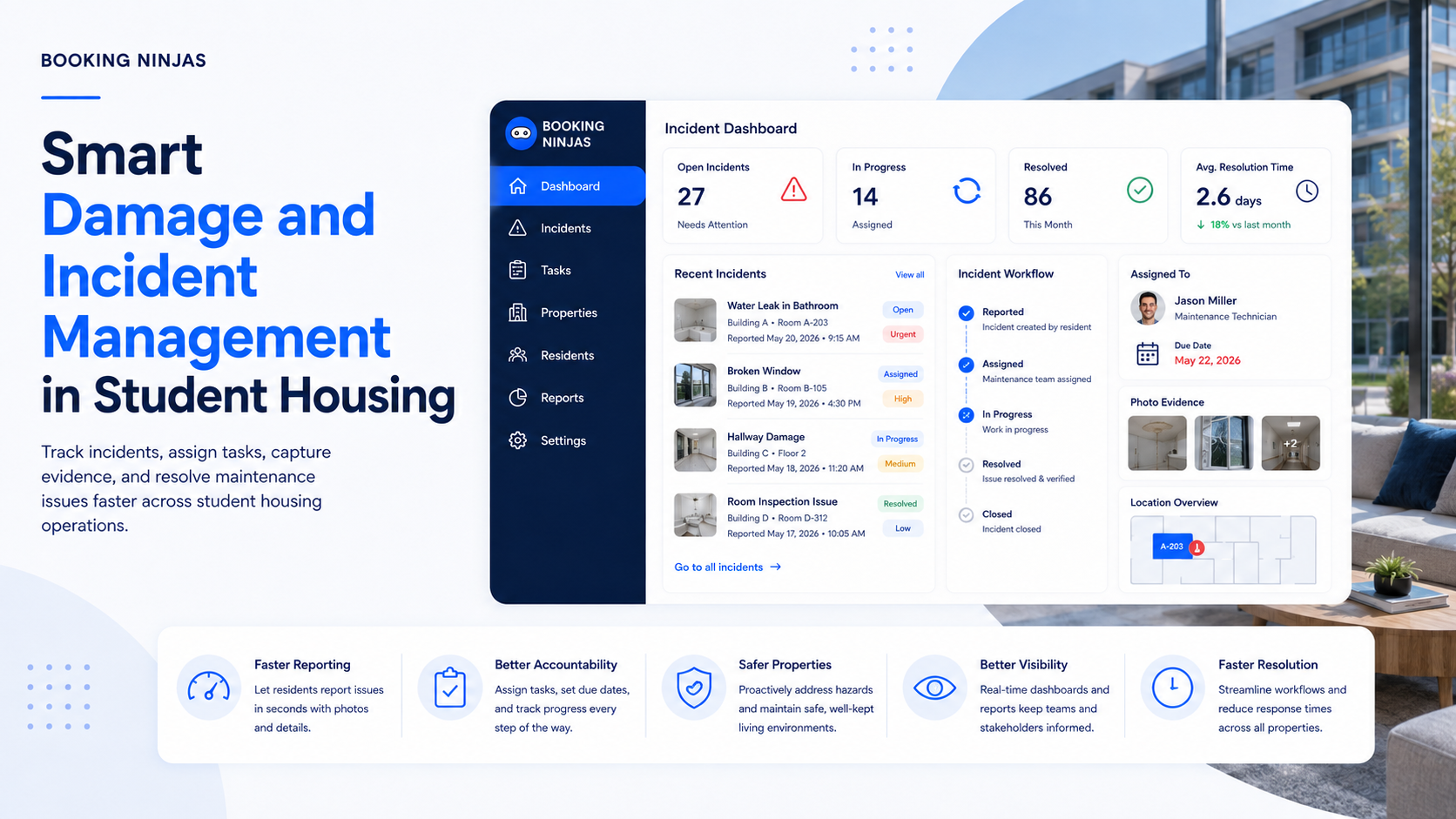
A broken appliance, damaged bedroom wall, repeated noise complaint, water leak, failed room inspection, and serious safety incident may all require attention from a student housing team—but they should not automatically be managed as the same type of record or workflow.
The goal is not simply to create more tickets. It is to make sure the right issue reaches the right people, carries enough context to act on it, and remains traceable through resolution.
What is the difference between a request, incident, work order, and inspection?
These records can be connected, but they answer different operational questions.
| Record | What it answers | Student housing example |
|---|---|---|
| Request | What does a resident, staff member, or other user need someone to review or provide? | A student reports a leaking faucet or asks for assistance with a room issue. |
| Incident | What event occurred, how serious is it, and what response or escalation is required? | Property damage, a security-related event, or another operational or safety-related occurrence. |
| Work order | What maintenance or operational work needs to be completed, by whom, and with what status? | Repair the damaged door and track the work through completion. |
| Inspection | What condition was observed at a particular location or point in time? | A move-out inspection identifies damage requiring review or corrective work. |
What should the damage and incident management process look like?
Record the issue, location, reporter, relevant housing context, description, and supporting information.
Classify the issue, determine severity or priority, and decide which team or process should own the response.
Create work, coordinate response, communicate with relevant people, and escalate where required.
Confirm resolution, preserve documentation, and review patterns that may require future operational changes.

How should students and staff report housing issues?
The intake process should make ordinary service issues easy to report while collecting enough information for staff to determine what needs to happen next.
Booking Ninjas' Request Management can capture internal or external requests through configured channels and maintain ownership, priority, status, and follow-up in Salesforce.
Depending on the implementation, request information may include:
- Student or reporter
- Residence hall
- Unit, room, or shared space
- Issue category
- Description
- Priority or severity
- Photos or supporting documents
- Status
- Assigned team
- Related housing record
A Student Portal can also provide student-facing access to records, documents, communication, status information, and configured self-service workflows.
The exact issue-reporting experience depends on how the housing organization configures its portal, forms, permissions, and request process.
Should serious safety incidents be reported like ordinary maintenance requests?
No.
A routine maintenance request and an immediate threat to health, safety, or security have very different response requirements.
If an event involves an immediate danger, medical emergency, fire, serious security concern, or another urgent threat, residents and staff should follow the institution's emergency procedures and contact the appropriate emergency or campus response resources. Property-management software should not replace those emergency channels.
After immediate response is underway, an Incident Management workflow can provide structured documentation, severity, ownership, escalation, corrective actions, resolution status, and follow-up.
The purpose of the system is to support coordination and record keeping around the incident—not to make high-stakes emergency decisions on behalf of trained staff.
How should student housing teams manage property damage?
Property damage should begin with evidence and context rather than an assumption about responsibility.
Useful information can include:
- Property, building, room, or bed
- Date the condition was observed
- Inspection findings
- Photos or documentation
- Related resident assignment
- Prior condition records
- Maintenance history
- Corrective work required
Damage does not automatically prove who caused it or whether a resident should be charged.
Responsibility and any financial follow-up should be determined according to the organization's housing agreement, applicable policies, evidence, review process, and legal requirements.
Why are move-in and move-out inspections important?
Student housing has concentrated move-in and move-out periods, so condition records can provide an important reference point during turnover.
Booking Ninjas' Field Inspection capability supports scheduled inspections, configurable checklists, mobile-friendly forms, documentation uploads, findings, corrective actions, and remediation tracking.
A structured inspection process can help housing teams record:
- Initial room condition
- Move-out condition
- Shared-space findings
- Maintenance requirements
- Room-readiness status
- Required corrective actions
Inspection findings can then feed the appropriate maintenance, incident, or review workflow instead of remaining isolated in a paper checklist.
When should a damage report become a work order?
Once the housing team determines that physical or operational work is required, the issue can move into a work-order process.
Booking Ninjas' Work Order Management provides structured creation, assignment, prioritization, status tracking, escalation, and historical reporting around maintenance and service work.
A work order can preserve connections to information such as:
- Residence hall or property
- Unit or room
- Originating request
- Related incident
- Assigned employee or team
- Priority
- Status
- Completion history
This keeps the operational task separate from the resident's original report while preserving the relationship between them.
What does a connected damage workflow look like?
- A student reports water under the sink. The request captures the resident, room, description, and supporting information.
- The issue is triaged. Staff determine priority and route it to the responsible facilities team.
- A work order is created. The maintenance task records ownership, status, and the work required at that location.
- Additional damage is discovered. Staff document the affected cabinetry or flooring and preserve relevant inspection information.
- The repair is completed. The technician updates the work-order status and records the completed action.
- The room is reviewed. A follow-up inspection can confirm whether remediation is complete and whether further work is required.
- The records remain connected. The organization retains the request, work, findings, resident, room, and resolution history for future reference.
If the circumstances indicate a broader safety or operational event, an incident record can be added without forcing the maintenance work itself to become the incident record.
How should behavioral or community incidents be handled?
Noise complaints, roommate disputes, policy concerns, and other residential-life issues are different from a broken appliance.
These events may require review by residential-life, housing, security, student-affairs, or other authorized staff according to the organization's policies.
A structured incident workflow can preserve:
- What was reported
- When and where it occurred
- Relevant people or records
- Severity or priority
- Assigned responsibility
- Follow-up actions
- Resolution status
- Appropriate documentation
The system should support the organization's process, permissions, and documentation requirements rather than automatically deciding disciplinary outcomes.
How should students receive updates about reported issues?
Residents should not need to repeatedly contact several departments simply to determine whether an ordinary request has been received or assigned.
Depending on the configured workflow, updates can be triggered when a request:
- Is received
- Is assigned
- Changes status
- Requires more information
- Is escalated
- Is completed
Booking Ninjas Workflow & Process Management can connect routing, notifications, approvals, escalations, and downstream tasks around structured operational processes.
Sensitive incident information should only be shared with appropriate users according to the organization's access rules and policies.
How should damage charges connect to the operational record?
If an organization determines through its own policy and review process that a resident is financially responsible for damage, the financial record should remain traceable to the evidence and housing context behind that decision.
That may include:
- Inspection finding
- Damage documentation
- Related resident or account
- Housing assignment
- Approved charge
- Invoice or financial record
- Payment status
- Adjustment or reversal, if applicable
Booking Ninjas' Billing & Payment layer can connect approved financial activity with relevant customer and operational records.
How can incident and maintenance history support prevention?
Prevention begins with understanding recurring operational patterns, not with assuming that every future problem can be predicted.
Connected historical records can help teams review questions such as:
- Which buildings generate repeated requests?
- Which assets require recurring repair?
- Which incident categories appear most often?
- Where do resolution delays occur?
- Which inspection findings recur?
- Which corrective actions remain open?
Booking Ninjas Incident Management, Work Order Management, and Field Inspection can preserve historical records and reporting around incidents, maintenance, inspections, and corrective actions.
AI-supported analysis can also help identify recurring patterns, delayed responses, or areas that may deserve additional attention where sufficient data is available.
Those outputs should be treated as decision support rather than as a guarantee that a future failure or incident will occur.
What should student housing teams measure?
| Question | Possible measure | Useful context |
|---|---|---|
| What is still unresolved? | Open requests, incidents, work orders, and corrective actions. | Priority, owner, location, status, age. |
| Where do issues recur? | Repeated requests, incidents, or inspection findings. | Building, room, asset, category, time period. |
| Where are response delays occurring? | Time between intake, assignment, action, and completion. | Team, severity, request type, location. |
| Is turnover work complete? | Open inspection findings and work orders before move-in. | Academic term, room, building, readiness date. |
| Which issues need management review? | High-severity incidents, escalations, repeated failures, or overdue corrective actions. | Risk, status, responsible team, historical context. |
Reporting should help staff understand the underlying operational records rather than reducing complex safety or resident situations to a single performance score.
Why should incident and maintenance records connect to the housing assignment?
In student housing, the location and resident relationship can change from one academic term to another.
A useful operational record therefore needs enough context to show which property, building, room, bed, resident assignment, and academic period were relevant when the issue occurred.
Booking Ninjas' Student Housing solution connects buildings, units, rooms, beds, student profiles, assignments, move-in and move-out history, maintenance, inspections, and turnover.
How should student housing operators design the workflow?
- Define the record types. Decide what counts as a service request, incident, work order, inspection finding, corrective action, and financial follow-up.
- Define severity and priority. Establish which issues are routine, urgent, safety-related, or subject to immediate escalation.
- Map ownership. Decide which teams handle facilities, housing operations, residential life, security, billing, and other categories.
- Connect the housing context. Link requests and incidents with the appropriate building, unit, room, bed, resident, and assignment where relevant.
- Define corrective workflows. Determine when an issue should create a work order, inspection, approval, notification, escalation, or another task.
- Define sensitive-data access. Restrict incident and resident information according to roles, responsibilities, policies, and applicable requirements.
- Define closure. Establish what evidence or review is required before a request, work order, inspection finding, or incident can be considered complete.
How does Booking Ninjas connect student housing incident and maintenance operations?
Booking Ninjas is a Salesforce-native platform for bookings and operations . Its Student Housing environment connects residents, housing assignments, rooms, beds, maintenance, inspections, turnover, and operational records within the same broader platform foundation.
Request, Incident, Work Order, Inspection, Workflow, Portal, and Billing capabilities can then support different stages of the process without collapsing all of them into a single generic ticket.
Connect residents, buildings, rooms, beds, assignments, maintenance, inspections, turnover, and housing operations.
Explore Student Housing →Capture, classify, route, prioritize, and track resident or operational requests.
Explore Request Management →Document incidents with severity, escalation, response, corrective actions, status, and historical reporting.
Explore Incident Management →Manage repair, maintenance, and service work from assignment through completion.
Explore Work Order Management →Capture room conditions, inspection findings, documentation, corrective actions, and remediation status.
Explore Field Inspection →Provide secure student-facing access to relevant records, documents, communication, status information, and configured self-service processes.
Explore Student Portal →Frequently asked questions
What is the difference between a maintenance request and an incident in student housing?
A maintenance request asks for a service or repair, while an incident records an event that may require structured assessment, escalation, response, or follow-up. One issue can create both records when maintenance work and incident documentation are both required.
Can students report housing issues through Booking Ninjas?
Booking Ninjas supports structured request intake through configurable channels, while the Student Portal can provide student-facing access to communication, records, documents, status information, and configured self-service workflows. The exact reporting process depends on the implementation.
Can a maintenance request automatically create a work order?
Yes, where the workflow is configured to do so. Request classification, priority, location, or other rules can be used to route work and create follow-up tasks. Organizations can also require review or approval before particular work begins.
Can Booking Ninjas manage student housing inspections?
Yes. Booking Ninjas supports inspections, configurable checklists, mobile-friendly forms, documentation uploads, findings, corrective actions, remediation tracking, and historical inspection records.
Does property damage automatically mean a student should be charged?
No. Damage should be documented and reviewed according to the housing provider's agreements, policies, evidence, applicable requirements, and decision process. Software can preserve the relevant records but should not automatically infer responsibility from the existence of damage.
Should students use a housing portal to report emergencies?
Not when an event presents an immediate danger or requires urgent emergency response. Residents and staff should follow the institution's emergency procedures and contact the appropriate emergency or campus response resources. Software can support documentation, coordination, escalation, and follow-up around the incident.
Can AI help identify recurring student housing incidents or maintenance problems?
AI can support pattern detection, risk analysis, prioritization, and identification of recurring issues when sufficient relevant operational data is available. These outputs should be treated as decision support rather than certainty about future incidents or equipment failures.
Connect the issue to the work required to resolve it
Bring student records, housing assignments, requests, incidents, inspections, work orders, communication, and operational history into a Salesforce-native student housing environment.